
7,500 Buildings in Alexandria, Egypt, at Risk of Collapse Likely Due to Global Warming; International Countermeasures Becoming Urgent
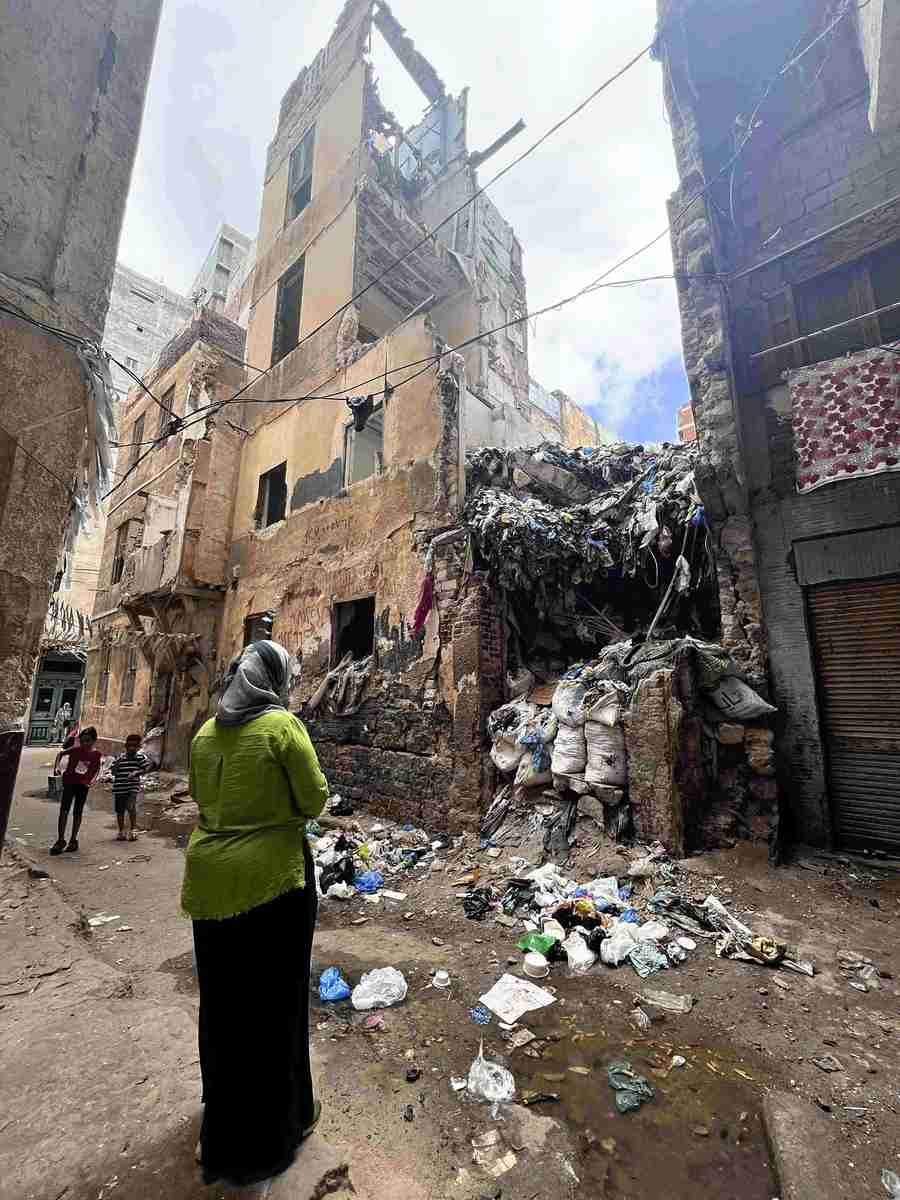
People pass in front of a broken and vacant building at risk of imminent collapse in Alexandria, northern Egypt, on July 30.
1:00 JST, September 1, 2025
ALEXANDRIA, Egypt — About 7,500 buildings are at risk of collapse in Alexandria, Egypt, a city that has seen many such disasters.
About 30% of all collapsed buildings in Egypt from 2014 to 2020 were in Alexandria, which faces the Mediterranean Sea.
Scientists are pointing out a possible cause for the collapses: higher sea levels caused by global warming.
Underground water eruption
With a population of about 5.6 million, Alexandria is the second largest city in Egypt. The city has been dubbed the Pearl of the Mediterranean due to the blue sea and historic townscape that make up its breathtaking scenery.
In late July, debris from building collapses was seen scattered throughout a residential area near the seashore. Naglaa Abdelnabi, 36, and her family members were doing household chores under a canvas tarp being used as a roof in the ruins of a collapsed apartment in the Al-Raml district. Her family had lived in the apartment for 25 years.
She came back from an outing one day to find the building had disappeared. As the family could not afford to move into another house, Abdelnabi lived on streets before eventually returning to the ruins where the apartment used to be.
“I also lost my possessions, and there’s nothing I can do,” she said.
On the opposite side of Alexandria Port, a leaning eight-story condominium looked as if it was relying on a neighboring high-rise building to stand. According to residents on the top floor of the about 50-year-old condominium, water erupted from the ground when construction began on the neighboring high-rise about 10 years ago, and the condominium started to lean. Cracks began forming in the pillars and walls a few months ago, and residents, fearing the building may come down, have no choice but to consider moving.
Subsidence
About 1,000 buildings collapsed or partly collapsed in Egypt from 2014 to 2020, killing more than 480 people, according to data compiled by Arab Reporters for Investigative Journalism. In Alexandria, 287 buildings collapsed, the highest of any city in the country and nearly double the number in Cairo, which recorded the second highest number.
An average of two building collapses occurred each year along Alexandria’s seashores from 2001 to 2009, according to a report by a study group that included U.S. university researchers carried in a science journal in February this year. The number has been rising rapidly since around 2011, reaching 22 collapses each year from 2010 to 2021.
A combination of factors such as aging buildings and maintenance issues was once considered to be the cause of Egypt’s building collapses. However, a new assumption has surfaced: Alexandria’s conspicuously high number might be due to higher sea levels.
The report published in February explains that Alexandria’s seashores have eroded about 3.6 meters on average annually over the past 20 years. It points out that encroaching sea water alongside changes in underground water levels have caused the ground to sink and buildings to collapse.
Alternate houses
The Egyptian government is viewing the situation with a rising sense of crisis. It has constructed coastal levees and scheduled demolitions for about 7,500 buildings in Alexandria that are at risk of collapsing, among other measures. Additionally, Egyptian Prime Minister Mostafa Madbouly, who inspected some sites in mid-July, announced a plan to build 55,000 alternate housing units.
The World Meteorological Organization (WMO) announced in March that the world’s average temperature and the rate of sea level rise each hit a record high in 2024. The rise in sea level doubled from 2.1 millimeters annually between 1993 and 2002 to 4.7 millimeters between 2014 and 2024.
The WMO urged that swift countermeasures are needed to cope with global warming, warning that higher sea levels have damaged ecosystems and infrastructures in coastal areas.
Other countries, including Tunisia, Italy and the United States, have also confirmed that buildings have been damaged mainly due to shore erosion. Taking countermeasures on an international scale has therefore become an urgent task.







Most Read
Popular articles in the past 24 hours
-

Nidec Chairman Resigns Amid Accounting Scandal at Major Japanese ...
-
Hokkaido's Shiretoko Peninsula Offers Unique Drift Ice Walking To...
-

Humbert Humbert: Husband-Wife Vocal Duo Brings Cheerful Singing t...
-

Trump’s Address: Confront the Dead End that Authoritarianism Has ...
-

Japan’s Hikonyan Cat Mascot to Celebrate 20th Birthday with Party...
-
6 of Japan's Remote Islands to Be Added to Govt List for Priority...
-

Pakistan, Afghan Forces Clash after Days of Hostilities
-
JR Kyushu Mulls Using Trains for Concertgoer Lodgings; Performanc...
Popular articles in the past week
-

Producer Behind Pop Group XG Arrested for Cocaine Possession
-

Nepal Bus Crash Kills 19 People, Injures 25 Including One Japanes...
-

Tokyo Skytree's Elevator Stops, Trapping 20 People; All Rescued (...
-

Milano Cortina 2026: Japanese Gold Medalist Figure Skater Miura S...
-

Japan’s Major Real Estate Firms Expanding Overseas Businesses to ...
-

Reciprocal Tariffs Ruled Illegal: Judiciary Would Not Tolerate Pr...
-

Japanese High School Student Aims to Share Kaiten History Through...
-

Milano Cortina 2026: Miura-Kihara Duo, Other Japanese Figure Skat...
Popular articles in the past month
-
Producer Behind Pop Group XG Arrested for Cocaine Possession
-

Japan PM Takaichi’s Cabinet Resigns en Masse
-

Man Infected with Measles Reportedly Dined at Restaurant in Tokyo...
-

Israeli Ambassador to Japan Speaks about Japan’s Role in the Reco...
-

Videos Plagiarized, Reposted with False Subtitles Claiming ‘Ryuky...
-

Man Infected with Measles May Have Come in Contact with Many Peop...
-

Prudential Life Insurance Plans to Fully Compensate for Damages C...
-

Woman with Measles Visited Hospital in Tokyo Multiple Times Befor...
Top Articles in World
-
Israeli Ambassador to Japan Speaks about Japan’s Role in the Reconstruction of Gaza
-
Videos Plagiarized, Reposted with False Subtitles Claiming ‘Ryukyu Belongs to China’; Anti-China False Information Also Posted in Japan
-

Chinese Embassy in Japan Reiterates Call for Chinese People to Refrain from Traveling to Japan; Call Comes in Wake of ¥400 Mil. Robbery
-
Nepal Bus Crash Kills 19 People, Injures 25 Including One Japanese National
-

Russia: Visa Required for Visiting Graves in Northern Territories, Lifting of Sanctions Also Necessary
JN ACCESS RANKING
-
Producer Behind Pop Group XG Arrested for Cocaine Possession
-
Japan PM Takaichi’s Cabinet Resigns en Masse
-
Man Infected with Measles Reportedly Dined at Restaurant in Tokyo Station
-
Israeli Ambassador to Japan Speaks about Japan’s Role in the Reconstruction of Gaza
-
Videos Plagiarized, Reposted with False Subtitles Claiming ‘Ryukyu Belongs to China’; Anti-China False Information Also Posted in Japan