
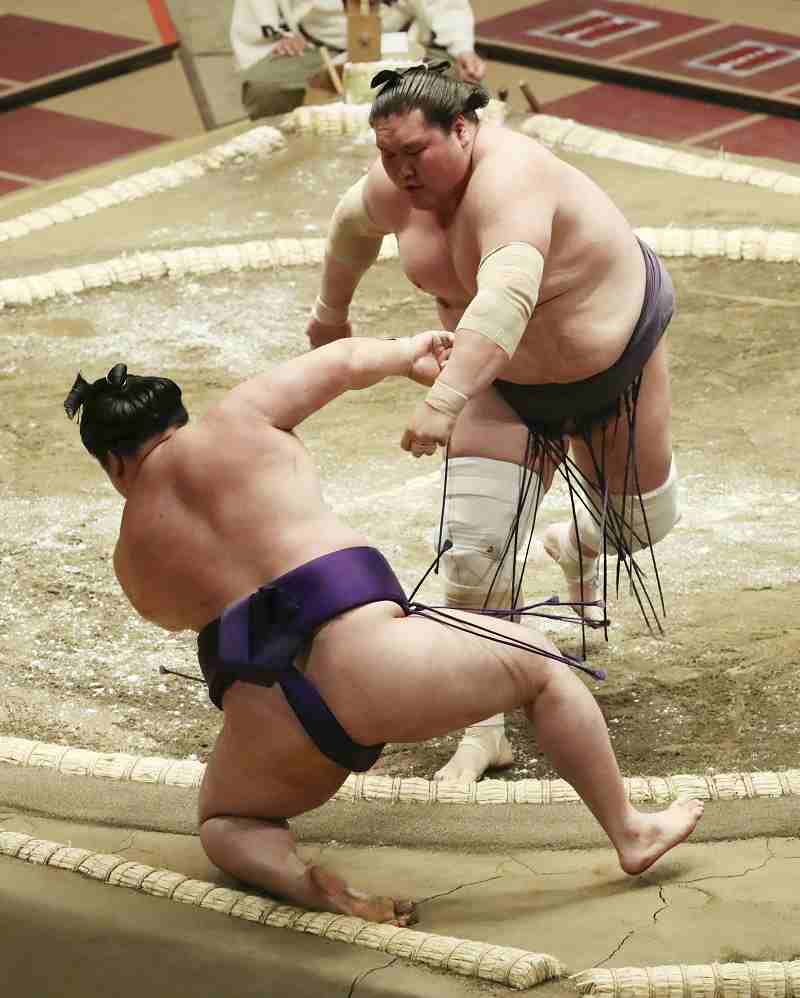
Newly repromoted ozeki Terunofuji opens the Summer Grand Sumo Tournament with a victory over No. 2 maegashira Meisei on May 9 at Tokyo’s Ryogoku Kokugikan.
20:01 JST, May 18, 2021
After a span of 21 tournaments dating back to the Autumn Grand Sumo Tournament in September 2017, Teru- nofuji’s name is back on the rankings list as an ozeki.
It marks the 12th time —and makes him the 11th wrestler — from the Showa era (1926-89) to the present day that a former ozeki worked his way back up to the second-highest rank.
However, nobody before him ever did it after plunging as low as the jonidan division, the second lowest of the sport’s six tiers.
The current system mandating the demotion of an ozeki to sekiwake after posting losing records in two consecutive tournaments came about after a rules revision in July 1969. Prior to that, it took a majority of losses at three consecutive tourneys.
While the revision made the rule stricter, it also included an instant relief clause — the former ozeki could now regain the rank by notching at least 10 wins at the tournament immediately following demotion.
In seven of the 12 demotions so far, the wrestler did just that, earning a quick promotion back to the rank with 10 or more wins as a sekiwake in the next tournament.
The most recent example was Takakeisho, who secured a return to ozeki at the 2019 Autumn tournament when he posted an impressive 12-3 record. He finished tied for the top spot with sekiwake Mitakeumi, but lost to him in a playoff for the championship.
Prior to Terunofuji, there were only two former ozeki who regained the rank after falling as low as the rank-and-file maegashira ranks of the makuuchi division.
Shionoumi dropped down to No. 2 maegashira in January 1950 and took three tournaments to rise back to ozeki. More than a quarter-century later, Kaiketsu capped a seven-tournament quest back to the second-highest rank in March 1977 after dropping to No. 6 maegashira.
Prior to World War II, when there were no rules regarding ozeki demotion, poor performances led to two instances of an ozeki being dropped to sekiwake when the banzuke ranking list was compiled.
One was Noshirogata, who wrestled as a sekiwake for two tournaments before returning to ozeki, and the other was Nayoroiwa, who needed four tournaments to do so.
There are four ozeki on the banzuke at the Summer Grand Tournament currently underway in Tokyo — Asanoyama, Takakeisho, Shodai and Terunofuji — the first time there have been that many since the 2019 Nagoya tourney.
Some observers say that the 29-year-old Terunofuji’s power puts him a notch above his fellow ozeki, and makes him the closest of the four to earning promotion to yokozuna.
Energized by his dramatic comeback, Terunofuji has said he now “aims for greater heights.”
Meanwhile, the 24-year-old Takakeisho, the 27-year-old Asano- yama and the 29-year-old Shodai will all look to make their presence felt at the Summer tournament.
— Shuji Miki is a sumo expert.





Most Read
Popular articles in the past 24 hours
-

German Journalist Traces Footsteps of Great-Grandfather Who Was P...
-

10 Foreign Tourists Sustain Injuries After Fire at Capsule Hotel ...
-

World Baseball Classic: Venezuela Beats Japan in Nail-biting Back...
-
Rapid Services Resume on JR Chuo Line; Suspension Caused by Accid...
-
Rapid Services on JR Chuo Line Suspended; Accident at Kokubunji S...
-

Zelenskiy Says Ukraine Wants Money, Technology in Return for Midd...
-

World Baseball Classic: Venezuela Beats Japan in Back-and-Forth Q...
-

World Baseball Classic: Red Sox’s Abreu Hits 3-run Homer, Giving ...
Popular articles in the past week
-
Japan Figure Skating Legend Yuzuru Hanyu Is Proud Disaster Surviv...
-
15 Measles Patients Confirmed in Tokyo in Past 6 Days; 1 May Have...
-
Massive Sewer Pipe Found Jutting Out of Highway in Osaka
-
Japan Govt to Tighten Requirements to Receive Permanent Residency...
-
Power Outage Forces About 980 Passengers in Yokohama to Walk to T...
-
JR Tokai Breaks Ground on Yamanashi Maglev Station; Will Be Part ...
-

Parents in Japan to Get Instagram Notifications When Teens Repeat...
-
'World's Oldest Bio-Business' Is Japan's Seed Koji Retailing, Mol...
Popular articles in the past month
-

Producer Behind Pop Group XG Arrested for Cocaine Possession
-

Japan PM Takaichi’s Cabinet Resigns en Masse
-

Man Infected with Measles Reportedly Dined at Restaurant in Tokyo...
-
Japan Figure Skating Legend Yuzuru Hanyu Is Proud Disaster Surviv...
-

iPS Treatments Pass Key Milestone, but Broader Applications Far f...
-

Sanae Takaichi Elected Prime Minister of Japan; Keeps All Cabinet...
-

South Korea Tightens Rules on Foreigners Buying Homes in Seoul Me...
-

Nepal Bus Crash Kills 19 People, Injures 25 Including One Japanes...
Top Articles in Sports
-
Japan Figure Skating Legend Yuzuru Hanyu Is Proud Disaster Survivor and Gold Medalist, Vows to Continue Support Efforts
-

Milano Cortina 2026: Figure Skaters Riku Miura, Ryuichi Kihara Pair Win Gold; Dramatic Comeback from 5th Place in SP
-
Milano Cortina 2026: Japanese Gold Medalist Figure Skater Miura Says When Kihara Retires ‘I Retire Too’
-
Milano Cortina 2026: Riku Miura, Ryuichi Kihara Clinch Japan’s 1st Gold in Pairs Figure Skating, Rebounding from Disappointing Short Program
-

Milano Cortina 2026: Japan’s Mari Fukada Wins Gold in Women’s Snowboard Slopestyle; Japan’s Kokomo Murase in Bronze
JN ACCESS RANKING
-
Producer Behind Pop Group XG Arrested for Cocaine Possession
-
Japan PM Takaichi’s Cabinet Resigns en Masse
-
Man Infected with Measles Reportedly Dined at Restaurant in Tokyo Station
-
Japan Figure Skating Legend Yuzuru Hanyu Is Proud Disaster Survivor and Gold Medalist, Vows to Continue Support Efforts
-
iPS Treatments Pass Key Milestone, but Broader Applications Far from Guaranteed