
Japan’s LDP Counts on PM’s Popularity for Votes; New Party to Rely on Block Votes from Key Organizations
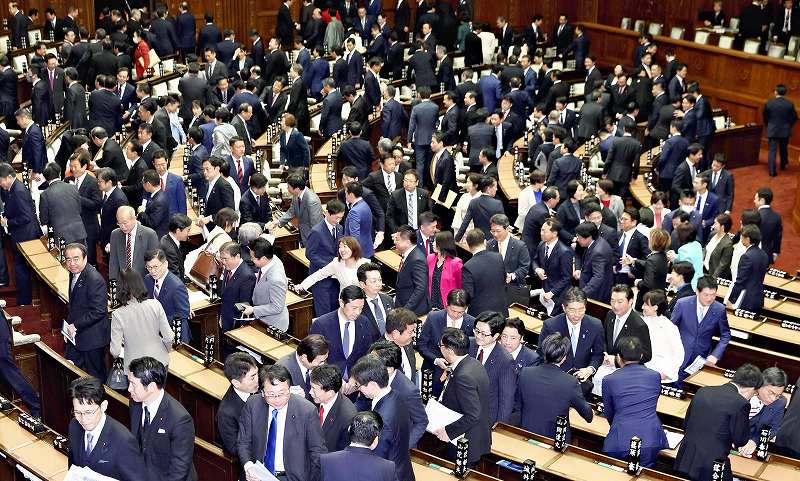
Former lawmakers leave the chamber after the dissolution of the House of Representatives on Friday.
17:25 JST, January 24, 2026
With the election campaign for the House of Representatives effectively underway, the ruling Liberal Democratic Party aims to make the most of the current Cabinet’s high approval rating by making the race a “confidence vote” for Prime Minister Sanae Takaichi.
Meanwhile, the Centrist Reform Alliance – formed by the Constitutional Democratic Party of Japan and Komeito – is upping its criticism of Takaichi for “dissolving the lower house without cause.” The new party seeks to pit itself against the ruling coalition by relying on block votes from supporting groups including the Japanese Trade Union Confederation (Rengo), which backs the CDPJ, and Soka Gakkai, a lay-Buddhist group that is Komeito’s support body.
Official campaigning will begin on Tuesday, with voting and ballot counting to take place Feb. 8.
You may also like to read
Some Differences Seen Among Party Pledges on Consumption Tax Cuts, Parties Look to Stand Out More on Other PoliciesAccording to nationwide polls by The Yomiuri Shimbun, approval of the Takaichi Cabinet has stayed above 70% since she took office in October. Strong support has been particularly notable among young people, who have otherwise tended distance themselves from the LDP.
Within the LDP, expectations are growing that this will “lead to unaffiliated voters and conservative voters being won over [to the party].” It has thus made increasing the exposure of Takaichi a basic tactic in its campaign.
The LDP has reduced the number of words used in the pamphlet for its campaign pledges, instead relying heavily on photos of the prime minister, even creating a page almost entirely dedicated to such photos.
Over the weekend, the party plans to have Takaichi appear on a succession of TV programs. “The decisive factor will be how much we can translate the prime minister’s popularity into votes for our candidates,” a senior LDP member said.
Prospective candidates, too, are seeking to “ride the wave of Takaichi’s popularity,” with requests for her support flooding in. One candidate crafted a flyer featuring an image of themself and Takaichi standing side by side by combining two photographs.
A cabinet minister said, “We will widely distribute the campaign pledge pamphlet that prominently features the prime minister.”
Takaichi, at a press conference on Monday, the day she announced her intention to dissolve the lower house, said, “I want the people to decide whether I should be prime minister.”
You may also like to read
Over 1,200 Plan to Run in General Election; Ruling Parties to Compete in Some ConstituenciesShe even employed the phrase, an “election to choose the administration,” which has often been used by opposition parties. “If the LDP and [coalition partner] the Japan Innovation Party secure a majority of seats, I will be Prime Minister,” she said. “Otherwise, it will be either Prime Minister (Yoshihiko) Noda or Prime Minister (Tetsuo) Saito” – referring to the coleaders of the CRA.
The JIP is likewise placing its hopes on the “face of the party leader.”
JIP leader Hirofumi Yoshimura is currently aiming for victory in the Osaka gubernatorial election, slated to take place on the same day as the lower house election. He had held the position until resigning to call for the election. A senior party member said they expect to see a synergy between the two elections.
For the LDP, one cause for concern is that its approval ratings have remained low. A nationwide poll by The Yomiuri Shimbun last month found support for the LDP at 30%, even lower than the 38% posted in October 2024, just before the previous lower house election, in which the LDP suffered a crushing defeat.
Regarding violations of the Political Funds Control Law, which involved intraparty factions of the LDP and was one cause of the headwinds it experienced in the previous lower house election, a party member close to the prime minister said, “Criticism has waned somewhat, but harsh opinions remain.”
Another cause of concern is that the LDP can no longer count on votes from the supporters of Komeito, its former coalition partner. This has been estimated to amount to 10,000 to 20,000 votes per single-seat constituency, making the upcoming race a battle based solely on the “real strength” of parties and candidates.
“I really feel Komeito supporters are drifting away from us day after day,” said a former cabinet minister.
A mid-ranking party member confided, “It’s truly unpredictable whether the tailwind from the prime minister or the headwind from losing Komeito votes will be stronger.”


Related Tags




Most Read
Popular articles in the past 24 hours
-

Strait of Hormuz Closure Shakes Markets; Prolonged Closure Could ...
-

Iran Situation: Japan Must Exert Diplomatic Efforts without Merel...
-

Measles Patient Visited Hospital in Bunkyo Ward, Tokyo, Metropoli...
-

Milano Cortina 2026: Japanese Figure Skater Miura Returns to Home...
-

Takayama Among World's Top 10 Most Welcoming Cities for 2026; 2nd...
-
2 of Japan's Opposition Parties Submit Bill to Revise Political F...
-
Chiba Police to Arrest Japanese National in Midair; Man Accused o...
-

Former Nomura Securities Employee Given 18-year Prison Sentence f...
Popular articles in the past week
-
Milano Cortina 2026: Japanese Gold Medalist Figure Skater Miura S...
-
Tokyo Spends Big on Children, Wins Over Parents
-

Japan’s Miura, Kihara Announce Withdrawal from Figure Skating Wor...
-

Yokohama to Test Out Renewable-Powered Offshore Floating Data Cen...
-

BOJ Keeping Eye on Economy and Takaichi's ‘Proactive Fiscal Polic...
-
Tokyo Measles Patient Traveled to Fukuoka Aboard JAL Planes; Susp...
-
Japan’s Takaichi Speaks on New U.S. Tariff in Upper House, Says P...
-

Nidec Chairman Resigns Amid Accounting Scandal at Major Japanese ...
Popular articles in the past month
-

Producer Behind Pop Group XG Arrested for Cocaine Possession
-

Japan PM Takaichi’s Cabinet Resigns en Masse
-

Man Infected with Measles Reportedly Dined at Restaurant in Tokyo...
-

Israeli Ambassador to Japan Speaks about Japan’s Role in the Reco...
-

Videos Plagiarized, Reposted with False Subtitles Claiming ‘Ryuky...
-

Prudential Life Insurance Plans to Fully Compensate for Damages C...
-

Woman with Measles Visited Hospital in Tokyo Multiple Times Befor...
-

iPS Treatments Pass Key Milestone, but Broader Applications Far f...
Top Articles in Politics
-
Japan PM Takaichi’s Cabinet Resigns en Masse
-

Sanae Takaichi Elected Prime Minister of Japan; Keeps All Cabinet Appointees from Previous Term
-

Japan’s Govt to Submit Road Map for Growth Strategy in March, PM Takaichi to Announce in Upcoming Policy Speech
-

LDP Wins Landslide Victory, Secures Single-party Majority; Ruling Coalition with JIP Poised to Secure Over 300 seats (UPDATE 1)
-

LDP Wins Historic Landslide Victory
JN ACCESS RANKING
-
Producer Behind Pop Group XG Arrested for Cocaine Possession
-
Japan PM Takaichi’s Cabinet Resigns en Masse
-
Man Infected with Measles Reportedly Dined at Restaurant in Tokyo Station
-
Israeli Ambassador to Japan Speaks about Japan’s Role in the Reconstruction of Gaza
-
Videos Plagiarized, Reposted with False Subtitles Claiming ‘Ryukyu Belongs to China’; Anti-China False Information Also Posted in Japan