
Japanese Government Plans New License System Specific to VTOL Drones; Hopes to Encourage Proliferation through Relaxed Operating Requirements
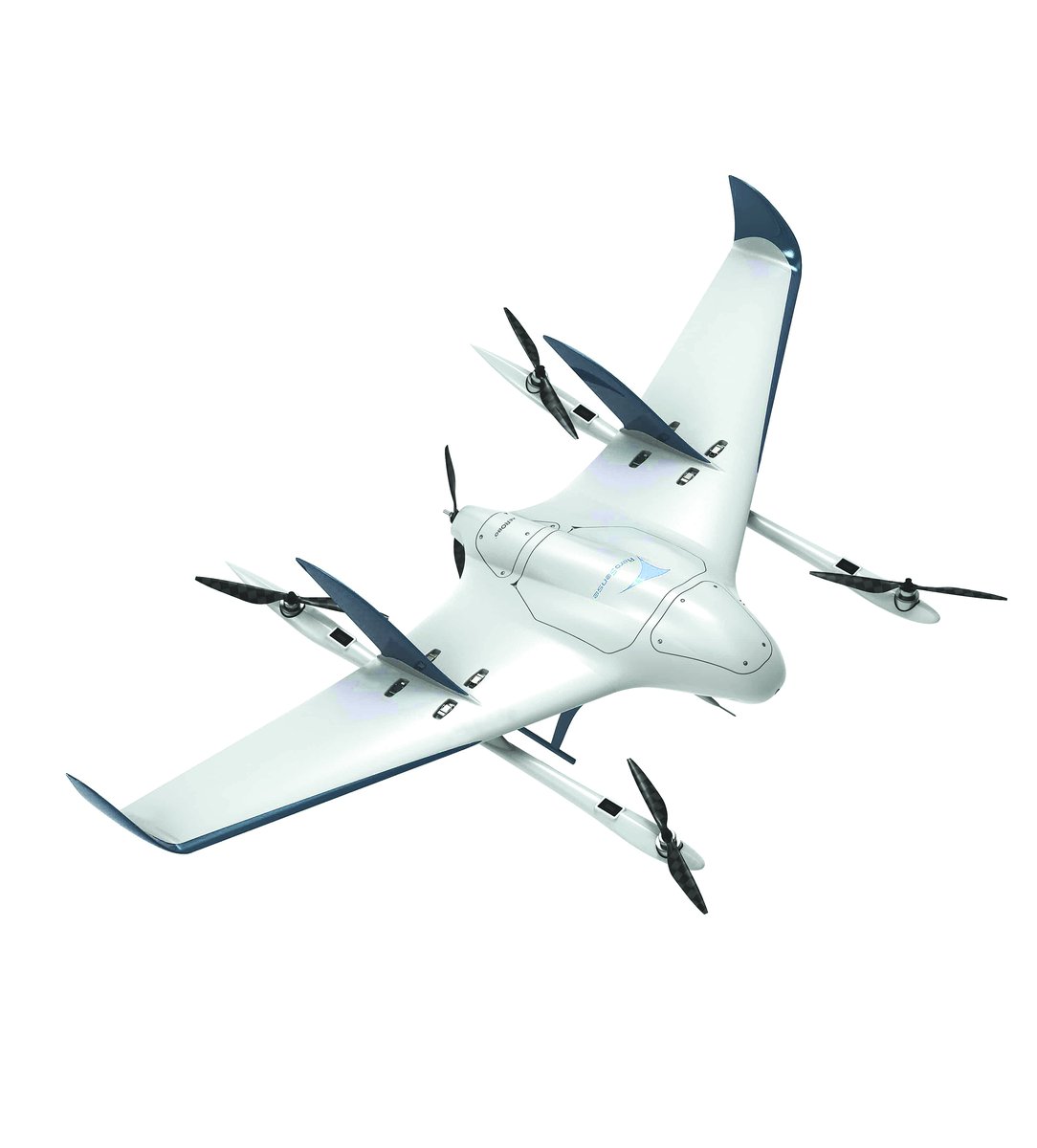
A model of a fixed-wing VTOL drone
2:00 JST, January 14, 2026
The government has begun coordinating to establish a new licensing system specifically for operating fixed-wing vertical takeoff and landing (VTOL) drones by the end of this year, according to government sources. The new license will be a national certification attesting that the holder has sufficient skills to control drones of this type.
Fixed-wing VTOL drones are distinguished from other drone types by their ability to fly at high speeds. These machines, representing the next generation of drones, are expected to be useful in inspecting infrastructural installations that span wide areas, such as roads, railroad tracks and networks of power cables, as well as for transporting goods in areas experiencing depopulation.
Currently, flying VTOL drones requires a license that is said to demand higher skills than necessary. By lowering a hurdle to obtain the license, the government aims to encourage more people to obtain such a license, boosting the development of domestically produced drones.
VTOL drones can vertically take off and land like helicopters, allowing users to fly them out of narrow spaces in urban areas or disaster zones.
At high altitudes, their fixed wings allow these drones to fly autonomously for long periods of time at high speeds. Controlling drones of this type is also easier than controlling unmanned planes which need runways to take off and land.
Under a system established in 2022, people with the proper national certification are allowed to fly drones out of their direct line of sight, even over densely populated areas. However, the current system does not provide a licensing framework specific to VTOL drones. People wanting to operate drones of this kind need a more difficult-to-obtain license to fly unmanned aircraft. The skill level required to get a license of this kind is higher than what is necessary for controlling a VTOL drone, which some experts have identified as a factor inhibiting the proliferation of drone use.
According to the sources, the Council for Promotion of Regulatory Reform is discussing reviewing the licensing system, and the new system for VTOL-type drones will be included in its interim report to be compiled by the end of this month at the earliest.
Coinciding with this change, the Land, Infrastructure, Transport and Tourism Ministry is considering revising an ordinance for enforcement of the Civil Aeronautics Law related to VTOL-type drones by the end of this year.
The size of the global market for drones is predicted to be about 50% larger in 2030 than in 2024, when it sat at around ¥980 billion. Chinese makers hold more than 70% of the global market, and about 90% of the Japanese market, leaving Japanese makers far behind. However, most Chinese-made drones are multi-copter types which use several rotors to hover in the air. Given these conditions, the government aims to encourage the use within Japan of VTOL-type drones, which is expected to rapidly increase, to support the growth of domestic drone makers.







Most Read
Popular articles in the past 24 hours
-

Strait of Hormuz Closure Shakes Markets; Prolonged Closure Could ...
-

Measles Patient Visited Hospital in Bunkyo Ward, Tokyo, Metropoli...
-

Iran Situation: Japan Must Exert Diplomatic Efforts without Merel...
-

Milano Cortina 2026: Japanese Figure Skater Miura Returns to Home...
-

2 of Japan's Opposition Parties Submit Bill to Revise Political F...
-

Takayama Among World's Top 10 Most Welcoming Cities for 2026; 2nd...
-

Chiba Police to Arrest Japanese National in Midair; Man Accused o...
-

Former Nomura Securities Employee Given 18-year Prison Sentence f...
Popular articles in the past week
-

Milano Cortina 2026: Japanese Gold Medalist Figure Skater Miura S...
-

Tokyo Spends Big on Children, Wins Over Parents
-

Japan’s Miura, Kihara Announce Withdrawal from Figure Skating Wor...
-

Yokohama to Test Out Renewable-Powered Offshore Floating Data Cen...
-

BOJ Keeping Eye on Economy and Takaichi's ‘Proactive Fiscal Polic...
-

Tokyo Measles Patient Traveled to Fukuoka Aboard JAL Planes; Susp...
-

Japan’s Takaichi Speaks on New U.S. Tariff in Upper House, Says P...
-

Nidec Chairman Resigns Amid Accounting Scandal at Major Japanese ...
Popular articles in the past month
-

Producer Behind Pop Group XG Arrested for Cocaine Possession
-

Japan PM Takaichi’s Cabinet Resigns en Masse
-

Man Infected with Measles Reportedly Dined at Restaurant in Tokyo...
-

Israeli Ambassador to Japan Speaks about Japan’s Role in the Reco...
-

Videos Plagiarized, Reposted with False Subtitles Claiming ‘Ryuky...
-

Prudential Life Insurance Plans to Fully Compensate for Damages C...
-

Woman with Measles Visited Hospital in Tokyo Multiple Times Befor...
-

iPS Treatments Pass Key Milestone, but Broader Applications Far f...
Top Articles in Politics
-
Japan PM Takaichi’s Cabinet Resigns en Masse
-

Sanae Takaichi Elected Prime Minister of Japan; Keeps All Cabinet Appointees from Previous Term
-

Japan’s Govt to Submit Road Map for Growth Strategy in March, PM Takaichi to Announce in Upcoming Policy Speech
-

LDP Wins Landslide Victory, Secures Single-party Majority; Ruling Coalition with JIP Poised to Secure Over 300 seats (UPDATE 1)
-

LDP Wins Historic Landslide Victory
JN ACCESS RANKING
-
Producer Behind Pop Group XG Arrested for Cocaine Possession
-
Japan PM Takaichi’s Cabinet Resigns en Masse
-
Man Infected with Measles Reportedly Dined at Restaurant in Tokyo Station
-
Israeli Ambassador to Japan Speaks about Japan’s Role in the Reconstruction of Gaza
-
Videos Plagiarized, Reposted with False Subtitles Claiming ‘Ryukyu Belongs to China’; Anti-China False Information Also Posted in Japan