
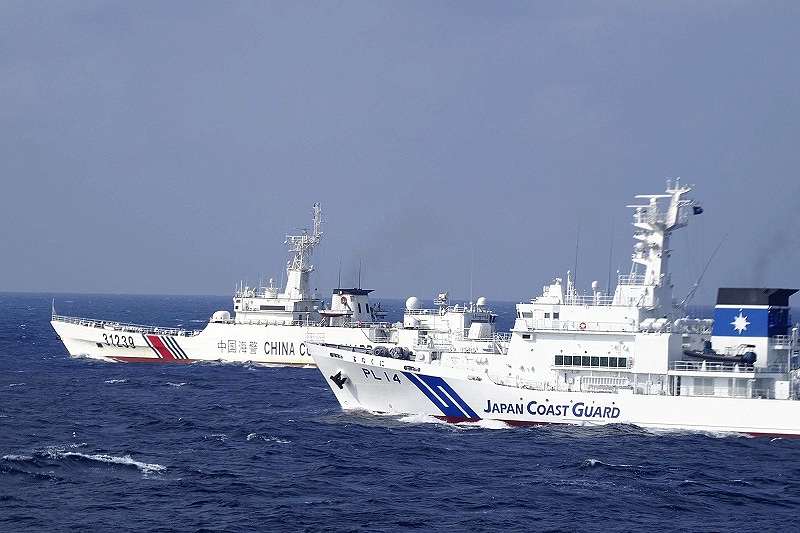
A Japan Coast Guard patrol boat, forefront, is seen monitoring a China Coast Guard vessel in waters around the Senkaku Islands in Okinawa Prefecture.
17:48 JST, November 21, 2022
The government and ruling parties are making adjustments to state in the revised National Security Strategy that China’s hegemonic behavior is a “challenge” to the security of Japan and the Asian region, The Yomiuri Shimbun has learned.
The move is in line with the views of the United States and the North Atlantic Treaty Organization, which also see Beijing’s conduct as challenging.
Issues surrounding Taiwan also are expected to be mentioned in the document — set to be updated by the end of the year — according to multiple government and ruling party sources.
The National Security Strategy is a basic guideline for foreign and defense policies covering the next decade or so.
The current strategy, compiled in 2013, states that China’s actions are “an issue of concern to the international community including Japan.” A major focus of the revision will be the wording used to describe Japan’s views on China, which has become increasingly oppressive toward neighboring countries since President Xi Jinping came to power.
In the strategy, the government and ruling parties plan to clarify their sense of urgency over China, which is increasingly trying to alter the status quo by force or coercion, such as by repeatedly sending China Coast Guard vessels into Japanese territorial waters around the Senkaku Islands in Okinawa Prefecture.
Nevertheless, economic ties between Japan and China remain strong. Full-scale political interactions have also resumed, with Prime Minister Fumio Kishida holding bilateral talks with Xi in Bangkok on Thursday on the sidelines of the Asia-Pacific Economic Cooperation forum — the first bilateral in-person summit for the two countries in three years.
U.S., NATO views
In the U.S. National Security Strategy released in October, U.S. President Joe Biden’s administration states that China “presents America’s most consequential geopolitical challenge.” NATO, too, mentions China as a security challenge in its Strategic Concept, adopted in June.
Consequently, many officials within the government and ruling parties say it is appropriate for Japan, which desires a “constructive and stable relationship” with China, to define that country’s activities as a “challenge,” while deterring Beijing through the Japan-U.S. alliance.
On the issue of Taiwan, which has been coming under increasing Chinese military pressure, Japan will signal in the updated strategy that it will not tolerate the forcible unification of Taiwan with the Chinese mainland by emphasizing the importance of “peace and stability in the Taiwan Strait.”
The existing strategy states that Japan will cooperate with Russia “in all areas,” but this view will be drastically revised in light of Moscow’s invasion of Ukraine. North Korea, meanwhile, which has repeatedly launched ballistic missiles, is expected to remain a “threat” to Japan.
The government plans to finalize the language of the updated strategy as early as early next month based on discussions within the ruling parties.







Most Read
Popular articles in the past 24 hours
-
Nidec Chairman Resigns Amid Accounting Scandal at Major Japanese ...
-

Trump’s Address: Confront the Dead End that Authoritarianism Has ...
-

Humbert Humbert: Husband-Wife Vocal Duo Brings Cheerful Singing t...
-

Japan’s Hikonyan Cat Mascot to Celebrate 20th Birthday with Party...
-

Pakistan, Afghan Forces Clash after Days of Hostilities
-
Japan's Kairos Rocket Set to Launch on Sunday After Delays
-

China-linked Actor Tried Using ChatGPT to Target Japan's PM Takai...
-

JR Kyushu Mulls Using Trains for Concertgoer Lodgings; Performanc...
Popular articles in the past week
-

Producer Behind Pop Group XG Arrested for Cocaine Possession
-

Tokyo Skytree's Elevator Stops, Trapping 20 People; All Rescued (...
-

Nepal Bus Crash Kills 19 People, Injures 25 Including One Japanes...
-
Milano Cortina 2026: Japanese Gold Medalist Figure Skater Miura S...
-

Japan’s Major Real Estate Firms Expanding Overseas Businesses to ...
-

Reciprocal Tariffs Ruled Illegal: Judiciary Would Not Tolerate Pr...
-
Japanese High School Student Aims to Share Kaiten History Through...
-

Milano Cortina 2026: Miura-Kihara Duo, Other Japanese Figure Skat...
Popular articles in the past month
-
Producer Behind Pop Group XG Arrested for Cocaine Possession
-

Japan PM Takaichi’s Cabinet Resigns en Masse
-

Man Infected with Measles Reportedly Dined at Restaurant in Tokyo...
-

Israeli Ambassador to Japan Speaks about Japan’s Role in the Reco...
-

Videos Plagiarized, Reposted with False Subtitles Claiming ‘Ryuky...
-

Man Infected with Measles May Have Come in Contact with Many Peop...
-

Prudential Life Insurance Plans to Fully Compensate for Damages C...
-

Woman with Measles Visited Hospital in Tokyo Multiple Times Befor...
Top Articles in Politics
-
Japan PM Takaichi’s Cabinet Resigns en Masse
-

Sanae Takaichi Elected Prime Minister of Japan; Keeps All Cabinet Appointees from Previous Term
-

Japan’s Govt to Submit Road Map for Growth Strategy in March, PM Takaichi to Announce in Upcoming Policy Speech
-

LDP Wins Historic Landslide Victory
-

LDP Wins Landslide Victory, Secures Single-party Majority; Ruling Coalition with JIP Poised to Secure Over 300 seats (UPDATE 1)
JN ACCESS RANKING
-
Producer Behind Pop Group XG Arrested for Cocaine Possession
-
Japan PM Takaichi’s Cabinet Resigns en Masse
-
Man Infected with Measles Reportedly Dined at Restaurant in Tokyo Station
-
Israeli Ambassador to Japan Speaks about Japan’s Role in the Reconstruction of Gaza
-
Videos Plagiarized, Reposted with False Subtitles Claiming ‘Ryukyu Belongs to China’; Anti-China False Information Also Posted in Japan