
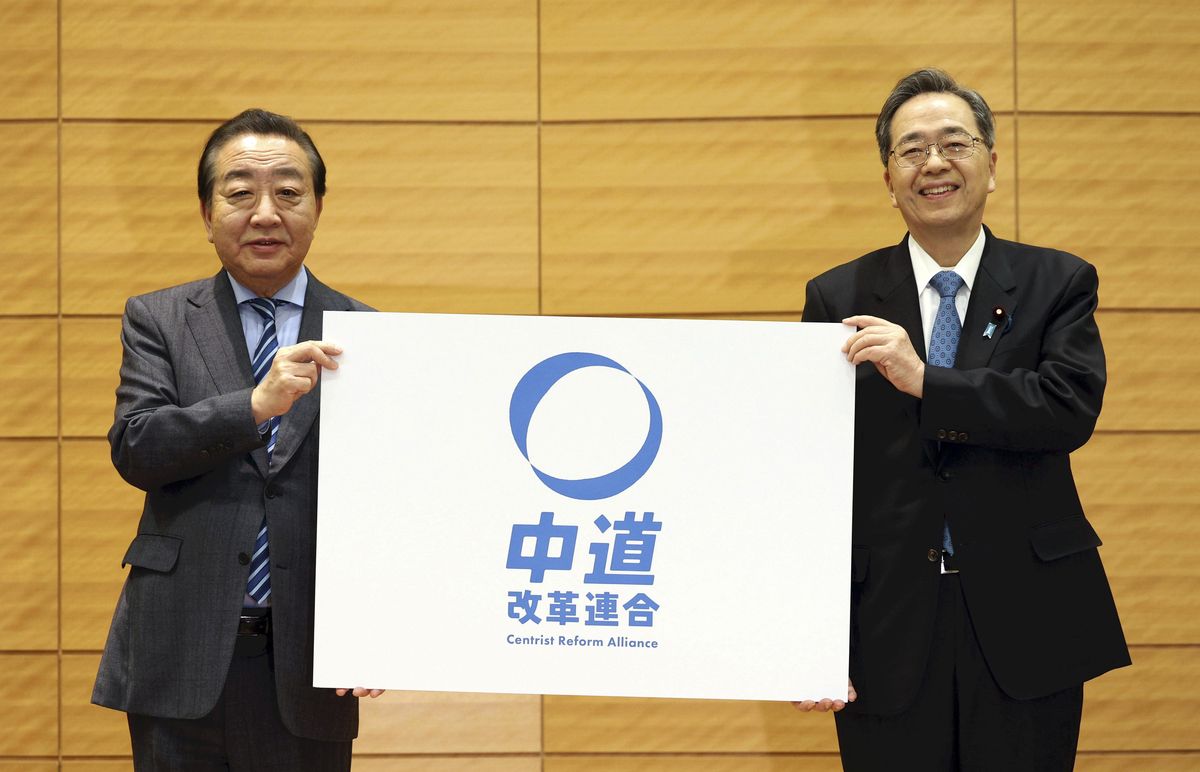
CDPJ leader Yoshihiko Noda, left, and Komeito leader Tetsuo Saito announce their new party’s name on Friday afternoon at the Diet Building.
15:42 JST, January 17, 2026
Seizing the opportunity to form a new party with Komeito, the Constitutional Democratic Party of Japan is aiming to reach a certain level of compromise with its new partner on fundamental national policies, including security and energy.
The CDPJ is prepared to adopt a pragmatic approach, as Komeito is seeking. But if the platform and campaign pledges for the new party — called the Centrist Reform Alliance — are left vague in the anticipated House of Representatives election, this could leave the cause of future intra-party conflicts.
“Our party concluded it is entirely possible to agree with Komeito. We are finishing up the work,” CDPJ leader Yoshihiko Noda said regarding the new party’s basic policies at a press conference on Friday. Noda emphasized that there are no major policy differences between the two parties.
Noda is conscious of the framework of Komeito’s “centrist reform vision” compiled last November. The vision consists of “five pillars,” including “realistic foreign and defense policies and constitutional amendments,” and accepts the restart of nuclear power plants whose safety has been confirmed and that have gained local understanding. The vision also advocates establishing a “seamless security system” based on the security-related laws.
Last autumn, CDPJ Secretary General Jun Azumi instructed the party’s Policy Research Council Chairman Satoshi Honjo to sort out the points in common and the differences with Komeito’s five pillars.
During the merger talks between the two parties, Komeito leader Tetsuo Saito said, “We will form a new party with those who agree with our five policy pillars.”
Since inaugurating party leadership last September, Noda, who advocates a change of government, has been looking for an opportunity to shift the party’s basic policies toward a centrist line as there are many left-leaning lawmakers within the party.
The CDPJ has advocated a policy of “zero nuclear power” in its platform, with many of its lawmakers remaining cautious about restarting nuclear reactors. Its platform also includes a policy for “abolishing those parts deemed unconstitutional” in the security-related laws.
One middle-level member said, “As our party strength continues to flounder, the only way to resolve intra-party conflicts is to rewrite the platform under a new party.”
The draft platform for the Centrist Reform Alliance was revealed on Friday. It includes ambiguous expressions such as “realistic foreign and defense policies,” giving a glimpse of the new party’s consideration for the CDPJ.
Within Komeito, too, there are voices of concern. Members have argued that if a policy agreement is not reached, there will be repeated intra-party conflicts.
Meanwhile, the Centrist Reform Alliance aims to field about 200 candidates from among former CDPJ legislators and newcomers in single-seat constituencies for the lower house election.
Komeito is expected to withdraw its candidacy from all four single-seat constituencies to support the CDPJ side. Its candidates will instead be placed high on the list for the proportional representation segment.
To create a pattern of facing off against the ruling Liberal Democratic Party, it will also be necessary for opposition candidates to be unified.
Seiji Osaka, the CDPJ’s election strategy chief, told reporters on Friday, “We want to avoid a situation in which we struggle against the Democratic Party for the People,” showing his party’s eagerness to cooperate with other opposition parties in the election.
However, DPFP leader Yuichiro Tamaki said, “This is a new party, so the rules we’ve followed to date will be reset,” suggesting a review of the cooperative relationship that had been built with the CDPJ.






Most Read
Most read in the last 24 hours
-

India’s Arms Indigenization Quest for Self-Reliance / Big Firms, ...
-

Shifts Startup Focus to Nurturing Global Winners
-

Princess Aiko Enjoys Imperial Court Music, Dance; Production, Cos...
-

Bibimbap with Spring Vegetables and Asari Clam Miso a Rich Taste ...
-

Mother Supports My Sister Too Much, Gives Her Kids Much More Than...
-

Umami History: Kyoto Chef Murata Worked to Share Japan’s Scientif...
-

Appeal of Japanese Food: Make Good Use of ‘Discoveries’ by People...
-

Official App to Help Startups Meet Other Participants
Most read in the last 7 days
-
Earthquake Hits Japan's Tohoku Region; 3-meter Tsunami Warning Is...
-

China, South Korea Object to Japanese PM Takaichi's Ritual Offeri...
-

Trump Extends the Ceasefire with Iran but Keeps the Blockade
-

India's Arms Indigenization Quest for Self-Reliance / New Delhi S...
-

¥1,000 Coins to Be Issued to Mark Anniversary of Beginning of Jap...
-

Most Serious Cyberattacks against the UK Now from Russia, Iran an...
-

Trump Opposes United–American Merger, Signals Support for Spirit
-

System Malfunction in Haneda Airport Causes 83 Flight Cancelation...
Most read in the last 30 days
-
Earthquake Hits Japan's Tohoku Region; 3-meter Tsunami Warning Is...
-

Police Find Child's Shoe During Search for Missing Boy in Nantan,...
-

Body Found in Nantan, Kyoto Prefecture, During Search for 11-Year...
-
China, South Korea Object to Japanese PM Takaichi's Ritual Offeri...
-

Cherry Blossoms, Rapeseed Flowers Perform Colorful ‘Duet’ in Niig...
-
Trump Extends the Ceasefire with Iran but Keeps the Blockade
-

Olympic Gold Medal-Winning Figure Skaters Riku-Ryu Announce Retir...
-

Japanese Prime Minister Takaichi Speaks to Pakistani Prime Minist...
Top Articles in Politics
-
India’s Arms Indigenization Quest for Self-Reliance / New Delhi Sticks to Its ‘All-Alignment’ Guns Even after Iran Warship Attack
-
Japan Aims to Enhance Deterrence, Defense Industry by Allowing Exports of Weapons
-

Former Japan PM Murayama’s Farewell Ceremony Held; Former Deputy PM Kono Vows to ‘Carry on Path Toward Peace’
-
Japan Monitoring Situation Surrounding Revocation of Taiwan President’s Flight Permit by 3 Island Countries
-

Chinese Warships Cruise Past Japanese Islands in Retaliation for MSDF Ship Using Taiwan Strait
JN ACCESS RANKING
-
Earthquake Hits Japan’s Tohoku Region; 3-meter Tsunami Warning Issued (Update 1)
-
Police Find Child’s Shoe During Search for Missing Boy in Nantan, Kyoto Prefecture
-
Body Found in Nantan, Kyoto Prefecture, During Search for 11-Year-Old Boy in Area (Update 1)
-
China, South Korea Object to Japanese PM Takaichi’s Ritual Offering to Yasukuni Shrine
-
Cherry Blossoms, Rapeseed Flowers Perform Colorful ‘Duet’ in Niigata
Most read in the last 24 hours
-
India’s Arms Indigenization Quest for Self-Reliance / Big Firms, ...
-
Shifts Startup Focus to Nurturing Global Winners
-
Princess Aiko Enjoys Imperial Court Music, Dance; Production, Cos...
-
Bibimbap with Spring Vegetables and Asari Clam Miso a Rich Taste ...
-
Mother Supports My Sister Too Much, Gives Her Kids Much More Than...
Most read in the last 7 days
-
Earthquake Hits Japan's Tohoku Region; 3-meter Tsunami Warning Is...
-
China, South Korea Object to Japanese PM Takaichi's Ritual Offeri...
-
Trump Extends the Ceasefire with Iran but Keeps the Blockade
-
India's Arms Indigenization Quest for Self-Reliance / New Delhi S...
-
¥1,000 Coins to Be Issued to Mark Anniversary of Beginning of Jap...
Most read in the last 30 days
-
Earthquake Hits Japan's Tohoku Region; 3-meter Tsunami Warning Is...
-
Police Find Child's Shoe During Search for Missing Boy in Nantan,...
-
Body Found in Nantan, Kyoto Prefecture, During Search for 11-Year...
-
China, South Korea Object to Japanese PM Takaichi's Ritual Offeri...
-
Cherry Blossoms, Rapeseed Flowers Perform Colorful ‘Duet’ in Niig...