
Deployment of Longer-range Anti-ship Missiles Eyed for Kyushu; Nearer Range to Be Covered by Hypersonic Missiles, Rockets
6:00 JST, July 22, 2024
The Defense Ministry has begun coordinating for the deployment of improved surface-to-ship missiles and high-speed gliding missiles to the Ground Self-Defense Force’s Western Army in Kyushu as early as fiscal 2026. The improved anti-ship missiles will have a range of over 1,000 kilometers, several times farther than the current model can reach.
The planned deployment at the Western Army’s 2nd Artillery Brigade in Yufu, Oita Prefecture, is aimed at beefing up defense of the Nansei Islands by deploying several types of missiles with different ranges, given China’s continued aggression at sea in the region.
According to government officials, the improved surface-to-ship missiles are being developed based on the current Type 12 surface-to-ship guided missile, which has a range of several hundred kilometers.
When deployed in Kyushu and Okinawa, the new missile, in the event of an emergency, will be able to hit an enemy ship farther away than existing guided missiles can.
Standoff defense capabilities, which allow missiles to be launched from outside an enemy’s range of defensive fire, are considered a pillar of the National Defense Strategy formulated by the government in 2022. This has led to the timeline for improved missiles being pushed forward.
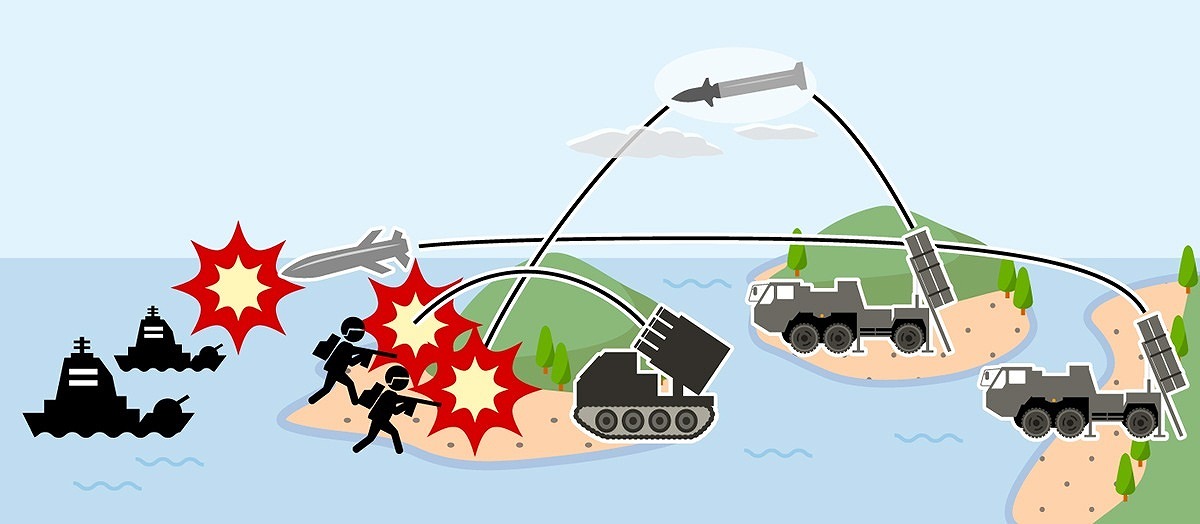
Those enemy units that manage to dodge these long-range missiles and land on the Nansei Islands would be hit with new missiles Hyper Velocity Gliding Projectiles (HVGP), which the ministry plans to deploy for the defense of the remote islands.
The gliding missiles will be equipped with a warhead that falls at high speeds, making it more difficult for an enemy to intercept. They will have a range of several hundred kilometers, and would likely be fired from an island close to the island under attack.
At the same time, multiple launch rocket systems (MLRS) that would be deployed beforehand would launch rockets simultaneously against an enemy force tens of kilometers away.
The ministry plans to defend the remote islands with a “three-tiered” defense network of missiles for long, medium and short range. The improved anti-ship missiles and new gliding missiles will be developed by the domestic defense industry.
The GSDF intends to use the new gliding missiles as a trump card for defending the remote islands. “Defense equipment that makes an enemy hesitate to approach Japanese territory will aid deterrence,” said one government official.
The 2nd Artillery Brigade is also being considered as a likely home for a unit specializing in gliding missiles, which will be established by fiscal 2032.








Most Read
Popular articles in the past 24 hours
-

Nidec Chairman Resigns Amid Accounting Scandal at Major Japanese ...
-

Humbert Humbert: Husband-Wife Vocal Duo Brings Cheerful Singing t...
-

Trump’s Address: Confront the Dead End that Authoritarianism Has ...
-

Japan’s Hikonyan Cat Mascot to Celebrate 20th Birthday with Party...
-

Pakistan, Afghan Forces Clash after Days of Hostilities
-
JR Kyushu Mulls Using Trains for Concertgoer Lodgings; Performanc...
-

China-linked Actor Tried Using ChatGPT to Target Japan's PM Takai...
-

Japan's Kairos Rocket Set to Launch on Sunday After Delays
Popular articles in the past week
-

Producer Behind Pop Group XG Arrested for Cocaine Possession
-

Nepal Bus Crash Kills 19 People, Injures 25 Including One Japanes...
-

Tokyo Skytree's Elevator Stops, Trapping 20 People; All Rescued (...
-

Milano Cortina 2026: Japanese Gold Medalist Figure Skater Miura S...
-

Japan’s Major Real Estate Firms Expanding Overseas Businesses to ...
-

Reciprocal Tariffs Ruled Illegal: Judiciary Would Not Tolerate Pr...
-

Japanese High School Student Aims to Share Kaiten History Through...
-

Milano Cortina 2026: Miura-Kihara Duo, Other Japanese Figure Skat...
Popular articles in the past month
-
Producer Behind Pop Group XG Arrested for Cocaine Possession
-

Japan PM Takaichi’s Cabinet Resigns en Masse
-

Man Infected with Measles Reportedly Dined at Restaurant in Tokyo...
-

Israeli Ambassador to Japan Speaks about Japan’s Role in the Reco...
-

Videos Plagiarized, Reposted with False Subtitles Claiming ‘Ryuky...
-

Man Infected with Measles May Have Come in Contact with Many Peop...
-

Prudential Life Insurance Plans to Fully Compensate for Damages C...
-

Woman with Measles Visited Hospital in Tokyo Multiple Times Befor...
Top Articles in Politics
-
Japan PM Takaichi’s Cabinet Resigns en Masse
-

Sanae Takaichi Elected Prime Minister of Japan; Keeps All Cabinet Appointees from Previous Term
-

Japan’s Govt to Submit Road Map for Growth Strategy in March, PM Takaichi to Announce in Upcoming Policy Speech
-

LDP Wins Historic Landslide Victory
-

LDP Wins Landslide Victory, Secures Single-party Majority; Ruling Coalition with JIP Poised to Secure Over 300 seats (UPDATE 1)
JN ACCESS RANKING
-
Producer Behind Pop Group XG Arrested for Cocaine Possession
-
Japan PM Takaichi’s Cabinet Resigns en Masse
-
Man Infected with Measles Reportedly Dined at Restaurant in Tokyo Station
-
Israeli Ambassador to Japan Speaks about Japan’s Role in the Reconstruction of Gaza
-
Videos Plagiarized, Reposted with False Subtitles Claiming ‘Ryukyu Belongs to China’; Anti-China False Information Also Posted in Japan