
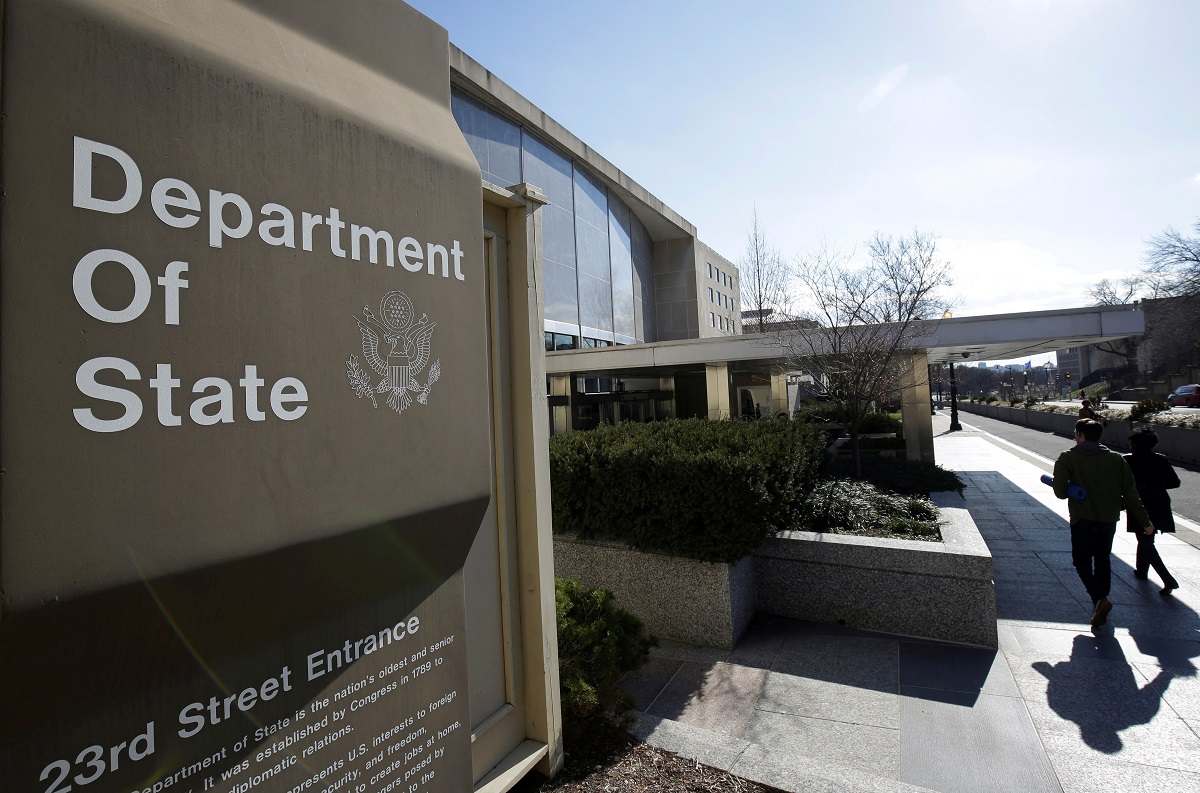
People enter the State Department Building in Washington, U.S., January 26, 2017.
11:05 JST, May 21, 2024
WASHINGTON (Reuters) – The United States on Monday said it had been unable, due largely to logistical reasons, to accept an Iranian request for assistance following a helicopter crash over the weekend that killed President Ebrahim Raisi, as Washington offered its condolences.
The rare request from Iran, which views the United States and Israel as its main adversaries, was disclosed by the State Department at a news briefing.
“We were asked for assistance by the Iranian government. We did make clear to them that we would offer assistance, as we would do in response to any request by a foreign government in this sort of situation,” spokesperson Matthew Miller told reporters.
“Ultimately, largely for logistical reasons, we were unable to provide that assistance,” Miller said, without elaborating.
The charred wreckage of the helicopter which crashed on Sunday carrying Raisi, Foreign Minister Hossein Amirabdollahian and six other passengers and crew, was found early on Monday after an overnight search in blizzard conditions.
Iran has still not provided any official word on the cause of the crash of the U.S.-made Bell 212 helicopter in mountains near the Azerbaijan border.
Asked whether he was concerned that Tehran might blame Washington, U.S. Defense Secretary Lloyd Austin said: “The United States had no part to play in that crash.”
“I can’t speculate on what may have been the cause,” he added.
The crash comes at a time of growing dissent within Iran over an array of political, social and economic crises. Iran’s clerical rulers face international pressure over Tehran’s disputed nuclear program and its deepening military ties with Russia during the war in Ukraine.
Still, Austin played down any U.S. concerns that the crash might have immediate security implications in the Middle East.
“I don’t necessarily see any broader, regional security impact at this point,” he said.
Under the Islamic Republic’s constitution, a new presidential election must be held within 50 days.
Suzanne Maloney, an Iran scholar at the Brookings Institution think tank, said Khamenei and Iran’s security services would seek to avoid any perception of vulnerability during the transition period.
“As a result, I’d expect a skittish, reactive Iran that may be more risk-averse in the near term but paradoxically more dangerous if it perceives itself on the defensive,” Maloney said.







Most Read
Popular articles in the past 24 hours
-

Nidec Chairman Resigns Amid Accounting Scandal at Major Japanese ...
-

Trump’s Address: Confront the Dead End that Authoritarianism Has ...
-

Humbert Humbert: Husband-Wife Vocal Duo Brings Cheerful Singing t...
-

Japan’s Hikonyan Cat Mascot to Celebrate 20th Birthday with Party...
-

Pakistan, Afghan Forces Clash after Days of Hostilities
-

Japan's Kairos Rocket Set to Launch on Sunday After Delays
-

China-linked Actor Tried Using ChatGPT to Target Japan's PM Takai...
-

JR Kyushu Mulls Using Trains for Concertgoer Lodgings; Performanc...
Popular articles in the past week
-

Producer Behind Pop Group XG Arrested for Cocaine Possession
-

Tokyo Skytree's Elevator Stops, Trapping 20 People; All Rescued (...
-
Nepal Bus Crash Kills 19 People, Injures 25 Including One Japanes...
-

Milano Cortina 2026: Japanese Gold Medalist Figure Skater Miura S...
-

Japan’s Major Real Estate Firms Expanding Overseas Businesses to ...
-

Reciprocal Tariffs Ruled Illegal: Judiciary Would Not Tolerate Pr...
-

Japanese High School Student Aims to Share Kaiten History Through...
-

Milano Cortina 2026: Miura-Kihara Duo, Other Japanese Figure Skat...
Popular articles in the past month
-
Producer Behind Pop Group XG Arrested for Cocaine Possession
-

Japan PM Takaichi’s Cabinet Resigns en Masse
-

Man Infected with Measles Reportedly Dined at Restaurant in Tokyo...
-

Israeli Ambassador to Japan Speaks about Japan’s Role in the Reco...
-

Videos Plagiarized, Reposted with False Subtitles Claiming ‘Ryuky...
-

Man Infected with Measles May Have Come in Contact with Many Peop...
-

Prudential Life Insurance Plans to Fully Compensate for Damages C...
-

Woman with Measles Visited Hospital in Tokyo Multiple Times Befor...
Top Articles in News Services
-

Survey Shows False Election Info Perceived as True
-
Hong Kong Ex-Publisher Jimmy Lai’s Sentence Raises International Outcry as China Defends It
-

Japan’s Nikkei Stock Average Touches 58,000 as Yen, Jgbs Rally on Election Fallout (UPDATE 1)
-
Japan’s Nikkei Stock Average Falls as US-Iran Tensions Unsettle Investors (UPDATE 1)
-
Japan’s Nikkei Stock Average Rises on Tech Rally and Takaichi’s Spending Hopes (UPDATE 1)
JN ACCESS RANKING
-
Producer Behind Pop Group XG Arrested for Cocaine Possession
-
Japan PM Takaichi’s Cabinet Resigns en Masse
-
Man Infected with Measles Reportedly Dined at Restaurant in Tokyo Station
-
Israeli Ambassador to Japan Speaks about Japan’s Role in the Reconstruction of Gaza
-
Videos Plagiarized, Reposted with False Subtitles Claiming ‘Ryukyu Belongs to China’; Anti-China False Information Also Posted in Japan