
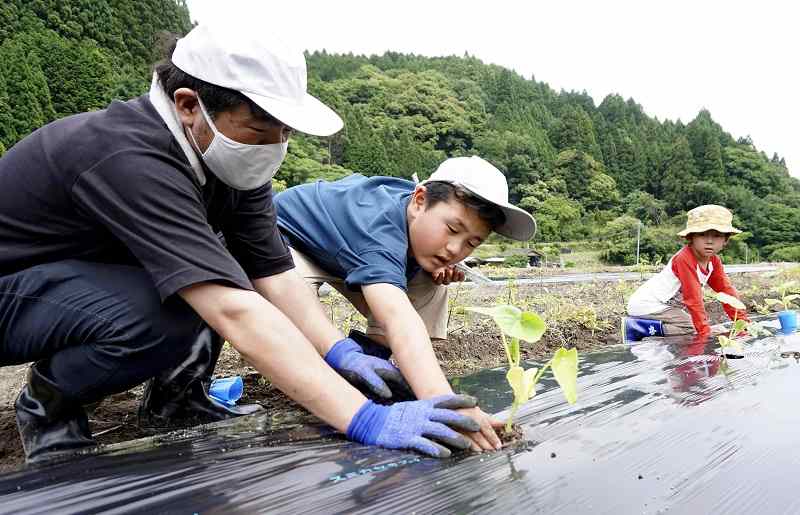
Participants plant seedlings of the “Iitate Yukikko” brand of kabocha in Toho, Fukuoka Prefecture.
23:00 JST, July 24, 2021
TOHO, Fukuoka — Farmers from Iitate, Fukushima Prefecture, who had struggled with the effects of a nuclear accident, donated kabocha pumpkin seeds to Toho, Fukuoka Prefecture, an area that suffered heavy damage from torrential rains and flooding in 2017.
The villagers are determined to make kabocha a symbol of reconstruction by having the vegetable become Toho’s new local specialty. The variety of kabocha given to Toho is called “Iitate Yukikko,” which is characterized by its white rind and its sweet, bright-orange pulp. It was created by Motoichi Kanno, 70, in Iitate, who spent about 30 years improving the variety. It was registered with the agriculture ministry four days after the Tokyo Electric Power Company Holdings, Inc.’s Fukushima No. 1 nuclear power plant disaster on March 11, 2011.
Tomiko Watanabe, 67, a farmer in Iitate who was involved in the development of the Iitate Yukikko variety, has been working to protect the brand in the aftermath of the nuclear accident.
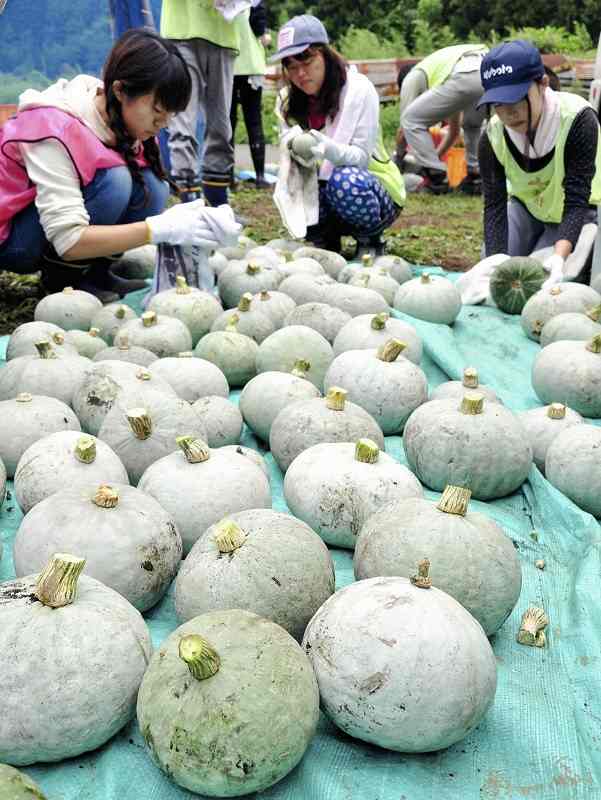
People harvest “Iitate Yukikko” kabocha in Otsuchi, Iwate Prefecture, in September 2013. The brand was grown there because it could not be grown in Iitate, Fukushima Prefecture, because of the nuclear accident.
As the residents of Iitate were temporarily forced to evacuate following the disaster, Watanabe lived in Nagano and Ibaraki prefectures. After moving to a temporary housing complex in Fukushima City in May 2011, she rented a fallow field to cultivate the brand.
In April 2017, when the evacuation order was lifted for most of the village, she returned home and started growing the kabocha variety in the village.
Seiki Wada, 48, from Toho, visited Iitate in March as part of a friendship program for disaster victims. After meeting Watanabe, he wanted to try growing the brand in Toho.
Wada’s house was swept away in the torrential rains in 2017, and he had to live in temporary housing in the village.
“I want to carry on the spirit of the Iitate people, who never gave up no matter how hard it was,” he said.
Wada belongs to a group that works to protect local terraced rice paddies. The group received the kabocha seeds from Watanabe, and on June 6, members of the group and volunteers planted 200 kabocha seedlings in about 700 square meters of the terraced fields.
The vegetable will be harvested in September. The group plans to use kabocha in such recipes as pumpkin cake.
In addition to donating a portion of the harvest to a children’s cafeteria, the group is planning to donate the profits to university students who are struggling because of the coronavirus pandemic.




Most Read
Popular articles in the past 24 hours
-

Business Hotels Expanding into Regional Areas in Japan, Aiming to...
-
6 Injured at Naked Festival in Japan’s Okayama Prefecture; Police...
-

Fiji Defense Minister Hopes Japan Will Support Stabilization of P...
-

Space One Delays Launch of No. 3 Kairos Rocket; Company to Announ...
-

Milano Cortina 2026: Malinin Highlights Dangers of Social Media i...
-

Reciprocal Tariffs Ruled Illegal: Judiciary Would Not Tolerate Pr...
-

Japanese Film, Anymart, Wins Critics’ Award at International Film...
-

3rd Japan Pacific Islands Defense Dialogue to Begin in Tokyo on S...
Popular articles in the past week
-

Japan PM Takaichi’s Cabinet Resigns en Masse
-

Man Infected with Measles Reportedly Dined at Restaurant in Tokyo...
-

Sanae Takaichi Elected Prime Minister of Japan; Keeps All Cabinet...
-

Japan's Govt to Submit Road Map for Growth Strategy in March, PM ...
-

Bus Carrying 40 Passengers Catches Fire on Chuo Expressway; All E...
-

Milano Cortina 2026: Figure Skaters Riku Miura, Ryuichi Kihara Pa...
-

Japan, U.S. Name 3 Inaugural Investment Projects; Reached Agreeme...
-

U.S. Firm to Build Training Hub in Fukushima N-plant for Debris R...
Popular articles in the past month
-
Japan PM Takaichi’s Cabinet Resigns en Masse
-

Japan Institute to Use Domestic Commercial Optical Lattice Clock ...
-

Israeli Ambassador to Japan Speaks about Japan’s Role in the Reco...
-
Man Infected with Measles Reportedly Dined at Restaurant in Tokyo...
-

Videos Plagiarized, Reposted with False Subtitles Claiming ‘Ryuky...
-

Man Infected with Measles May Have Come in Contact with Many Peop...
-

Prudential Life Insurance Plans to Fully Compensate for Damages C...
-

Woman with Measles Visited Hospital in Tokyo Multiple Times Befor...
Top Articles in Society
-
Man Infected with Measles Reportedly Dined at Restaurant in Tokyo Station
-
Man Infected with Measles May Have Come in Contact with Many People in Tokyo, Went to Store, Restaurant Around When Symptoms Emerged
-
Woman with Measles Visited Hospital in Tokyo Multiple Times Before Being Diagnosed with Disease
-
Australian Woman Dies After Mishap on Ski Lift in Nagano Prefecture
-
Foreign Snowboarder in Serious Condition After Hanging in Midair from Chairlift in Nagano Prefecture
JN ACCESS RANKING
-
Japan PM Takaichi’s Cabinet Resigns en Masse
-
Japan Institute to Use Domestic Commercial Optical Lattice Clock to Set Japan Standard Time
-
Israeli Ambassador to Japan Speaks about Japan’s Role in the Reconstruction of Gaza
-
Man Infected with Measles Reportedly Dined at Restaurant in Tokyo Station
-
Videos Plagiarized, Reposted with False Subtitles Claiming ‘Ryukyu Belongs to China’; Anti-China False Information Also Posted in Japan