
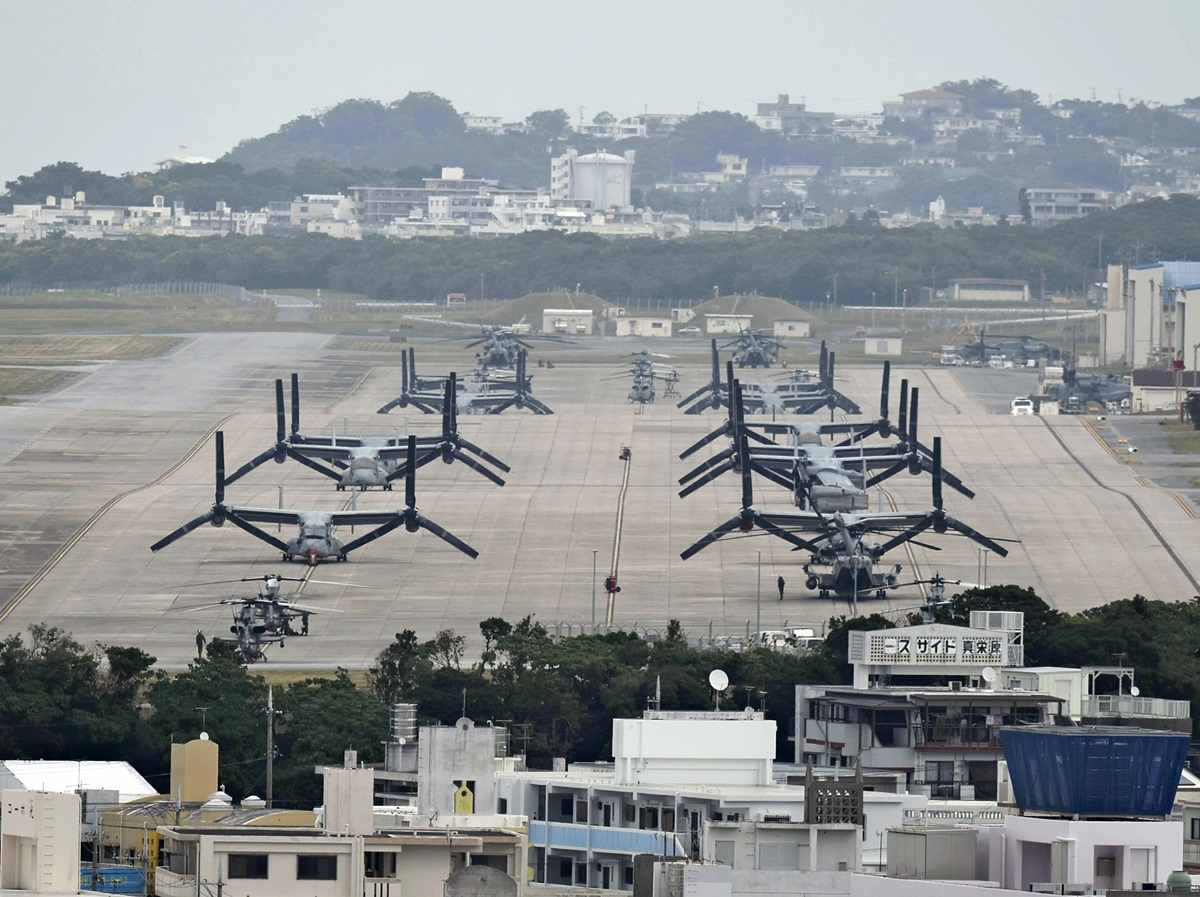
Osprey aircraft are seen at Futenma Air Station in Okinawa Prefecture.
11:38 JST, December 3, 2023
Tokyo (Jiji Press)—It is highly likely that a fire broke out in an engine of the U.S. Air Force CV-22 Osprey transport aircraft that recently crashed off a Japanese island, while it was flying in helicopter mode with the rotor facing up, it has been learned.
The Japanese Self-Defense Forces and the Japan Coast Guard are continuing search operations for seven missing crew members of the CV-22 Osprey.
They are also working hard to find the aircraft, which is believed to have sunk into the sea.
An Osprey has an engine structure integrated with a rotor at the end of the left and right main wings, and the rotor angle can be adjusted. When the rotors are directed upward, vertical takeoffs and landings are possible. High-speed flights are possible when the rotors are tilted forward.
The Air Force CV-22 Osprey crashed off the island of Yakushima in Kagoshima Prefecture, southwestern Japan, on Wednesday. One of its eight crew members was confirmed dead, and the other seven are still unaccounted for.
The aircraft is believed to have fallen into waters 1 kilometer from the coast of the island five minutes after its crew asked for an emergency landing at Yakushima Airport.
A fire was seen in its left engine, and there is information that the aircraft was spinning before it crashed, according to informed sources.
An Osprey operated in fixed-wing mode can continue flying even if one of the two engines stops, according to an official of the Ground SDF, which owns CV-22 Ospreys.
Even if the thrust from both engines is lost, an Osprey can make a landing by gliding.
In helicopter mode, the two rotors are turned in opposite directions to stabilize the aircraft. If one of the two engines stops, the aircraft may spin and become uncontrollable.
A soft landing is possible in autorotation, in which the rotors are spun while the engines are stopped. But this needs to be done immediately after an abnormality occurs.
The crashed CV-22 Osprey may have faced a serious engine problem after it switched to helicopter mode.
The U.S. military and others are investigating the details of the accident.
On Saturday, three Ospreys of the U.S. Marine Corps arrived at Amami Airport in the island of Amami Oshima in Kagoshima to join the search operations.
Earlier on Saturday, the Kagoshima prefectural government said that it has accepted a request from the Marine Corps for the Ospreys’ use of the airport.






Most Read
Popular articles in the past 24 hours
-

6 Injured at Naked Festival in Japan’s Okayama Prefecture; Police...
-

Reciprocal Tariffs Ruled Illegal: Judiciary Would Not Tolerate Pr...
-

Fiji Defense Minister Hopes Japan Will Support Stabilization of P...
-

Space One Delays Launch of No. 3 Kairos Rocket; Company to Announ...
-

Japanese Film, Anymart, Wins Critics’ Award at International Film...
-

India, Brazil Sign Mining Pact As Modi Targets $20 Billion Trade ...
-

3rd Japan Pacific Islands Defense Dialogue to Begin in Tokyo on S...
-

I Am Surprised by My Mother’s Increased Drinking
Popular articles in the past week
-

Japan PM Takaichi’s Cabinet Resigns en Masse
-

Man Infected with Measles Reportedly Dined at Restaurant in Tokyo...
-

Sanae Takaichi Elected Prime Minister of Japan; Keeps All Cabinet...
-

Japan's Govt to Submit Road Map for Growth Strategy in March, PM ...
-

Bus Carrying 40 Passengers Catches Fire on Chuo Expressway; All E...
-

Milano Cortina 2026: Figure Skaters Riku Miura, Ryuichi Kihara Pa...
-

Japan, U.S. Name 3 Inaugural Investment Projects; Reached Agreeme...
-

U.S. Firm to Build Training Hub in Fukushima N-plant for Debris R...
Popular articles in the past month
-
Japan PM Takaichi’s Cabinet Resigns en Masse
-

Japan Institute to Use Domestic Commercial Optical Lattice Clock ...
-

Israeli Ambassador to Japan Speaks about Japan’s Role in the Reco...
-
Man Infected with Measles Reportedly Dined at Restaurant in Tokyo...
-

Videos Plagiarized, Reposted with False Subtitles Claiming ‘Ryuky...
-

Man Infected with Measles May Have Come in Contact with Many Peop...
-

Prudential Life Insurance Plans to Fully Compensate for Damages C...
-

Woman with Measles Visited Hospital in Tokyo Multiple Times Befor...
Top Articles in Politics
-
Japan PM Takaichi’s Cabinet Resigns en Masse
-
Sanae Takaichi Elected Prime Minister of Japan; Keeps All Cabinet Appointees from Previous Term
-
Japan’s Govt to Submit Road Map for Growth Strategy in March, PM Takaichi to Announce in Upcoming Policy Speech
-

LDP Wins Historic Landslide Victory
-

LDP Wins Landslide Victory, Secures Single-party Majority; Ruling Coalition with JIP Poised to Secure Over 300 seats (UPDATE 1)
JN ACCESS RANKING
-
Japan PM Takaichi’s Cabinet Resigns en Masse
-
Japan Institute to Use Domestic Commercial Optical Lattice Clock to Set Japan Standard Time
-
Israeli Ambassador to Japan Speaks about Japan’s Role in the Reconstruction of Gaza
-
Man Infected with Measles Reportedly Dined at Restaurant in Tokyo Station
-
Videos Plagiarized, Reposted with False Subtitles Claiming ‘Ryukyu Belongs to China’; Anti-China False Information Also Posted in Japan