
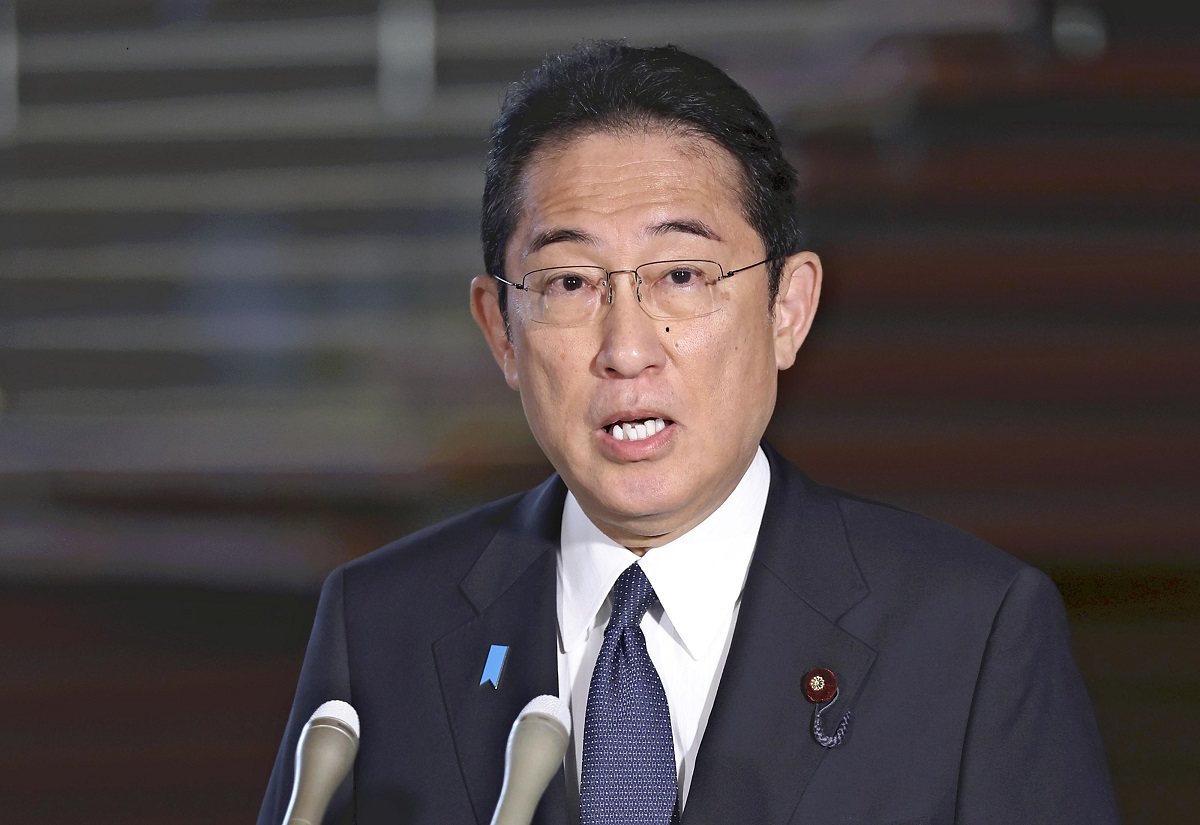
Prime Minister Kishida Fumio Kishida speaks at a press conference early Thursday morning.
17:40 JST, August 24, 2023
North Korea launched a projectile using ballistic missile technology from the northwest of the country toward the south at around 3:51 a.m. Thursday, the Japanese government has announced.
The projectile separated into several parts and fell into three areas outside of Japan’s exclusive economic zone. One part is believed to have passed through the airspace between the main island of Okinawa and Miyakojima island in Okinawa Prefecture.
North Korea said the Thursday launch was a failed attempt to send a military reconnaissance satellite, and that it will make a third try in October.
Pyongyang failed in its first launch attempt on May 31 and had informed Tokyo it would attempt another launch sometime between midnight Wednesday and midnight on Aug. 30. The parts of the projectile fell into the areas that were outside where North Korea had predicted.
Immediately after the latest launch, the Japanese government issued an emergency warning to Okinawa Prefecture through the J-Alert system. No damage has been confirmed in Japan.
Having judged that the projectile was unlikely to fall on Japanese territory, the Self-Defense Forces took no measures to intercept it.
Prime Minister Fumio Kishida told reporters at the Prime Minister’s Office in Tokyo on Thursday that the launch was a “failure.”
According to the Defense Ministry, the projectile was launched from the Tongchang-ri district and separated into multiple pieces in stages.
The first fallen object dropped into the Yellow Sea about 300 kilometers west of the Korean Peninsula at around 3:58 a.m., and the second into the East China Sea about 350 kilometers southwest of the peninsula at around 3:59 a.m.
The third apparently passed through the airspace between the main island of Okinawa and Miyakojima island at around 4 a.m., and fell into the Pacific Ocean about 600 kilometers east of the Philippines at around 4:05 a.m.
According to the official Korean Central News Agency, the projectile was the new-type satellite carrier rocket Chollima-1, loaded with the military reconnaissance satellite Malligyong-1. The first and second stages of the Chollima-1’s flight progressed normally, but the emergency detonation system is believed to have malfunctioned during the third stage.
This is the seventh time since August 1998 that North Korea has launched what it calls a “satellite.”
The Japanese government held a meeting of the National Security Council comprising officials from four ministries to discuss future measures.
Since ballistic missile technology is used for rockets carrying a satellite, Kishida stressed to reporters that the launch “violates U.N. Security Council resolutions.” The Japanese government lodged a stern protest with North Korea via its embassy in Beijing.
On Thursday, South Korean President Yoon Suk Yeol instructed senior officials of the South Korean presidential office and others to share findings from the analysis of the launch with Japan and the United States to prepare for any additional provocations by North Korea.
Foreign chiefs of Japan, the United States and South Korea agreed in telephone talks Thursday to coordinate and work closely on the issue.
Pyongyang apparently aims to acquire, through the launch of satellite, the ability to better monitor U.S. and South Korean forces in South Korea.







Most Read
Popular articles in the past 24 hours
-

Tokyo Skytree's Elevator Stops, Trapping 20 People; All Rescued (...
-

China, India Tapping into Promising African Market; Beijing Annou...
-

Milano Cortina 2026: Miura-Kihara Duo, Other Japanese Figure Skat...
-

Japan’s Major Real Estate Firms Expanding Overseas Businesses to ...
-
Japan, Pacific Island Nations to Work on Deepening Cooperation
-

Ukrainian Ambassador Closely Watching Japan’s Revision of Defense...
-

Emperor Turns 66 Ahead of Disaster Milestones
-
Tokyo Skytree to Close on Monday for Safety Checks after 20 Peopl...
Popular articles in the past week
-

Japan PM Takaichi’s Cabinet Resigns en Masse
-

Man Infected with Measles Reportedly Dined at Restaurant in Tokyo...
-

Sanae Takaichi Elected Prime Minister of Japan; Keeps All Cabinet...
-

Japan's Govt to Submit Road Map for Growth Strategy in March, PM ...
-

Bus Carrying 40 Passengers Catches Fire on Chuo Expressway; All E...
-

Milano Cortina 2026: Figure Skaters Riku Miura, Ryuichi Kihara Pa...
-

Japan, U.S. Name 3 Inaugural Investment Projects; Reached Agreeme...
-

U.S. Firm to Build Training Hub in Fukushima N-plant for Debris R...
Popular articles in the past month
-
Japan PM Takaichi’s Cabinet Resigns en Masse
-

Japan Institute to Use Domestic Commercial Optical Lattice Clock ...
-

Israeli Ambassador to Japan Speaks about Japan’s Role in the Reco...
-
Man Infected with Measles Reportedly Dined at Restaurant in Tokyo...
-

Videos Plagiarized, Reposted with False Subtitles Claiming ‘Ryuky...
-

Man Infected with Measles May Have Come in Contact with Many Peop...
-

Prudential Life Insurance Plans to Fully Compensate for Damages C...
-

Woman with Measles Visited Hospital in Tokyo Multiple Times Befor...
Top Articles in Politics
-
Japan PM Takaichi’s Cabinet Resigns en Masse
-
Sanae Takaichi Elected Prime Minister of Japan; Keeps All Cabinet Appointees from Previous Term
-
Japan’s Govt to Submit Road Map for Growth Strategy in March, PM Takaichi to Announce in Upcoming Policy Speech
-

LDP Wins Historic Landslide Victory
-

LDP Wins Landslide Victory, Secures Single-party Majority; Ruling Coalition with JIP Poised to Secure Over 300 seats (UPDATE 1)
JN ACCESS RANKING
-
Japan PM Takaichi’s Cabinet Resigns en Masse
-
Japan Institute to Use Domestic Commercial Optical Lattice Clock to Set Japan Standard Time
-
Israeli Ambassador to Japan Speaks about Japan’s Role in the Reconstruction of Gaza
-
Man Infected with Measles Reportedly Dined at Restaurant in Tokyo Station
-
Videos Plagiarized, Reposted with False Subtitles Claiming ‘Ryukyu Belongs to China’; Anti-China False Information Also Posted in Japan