
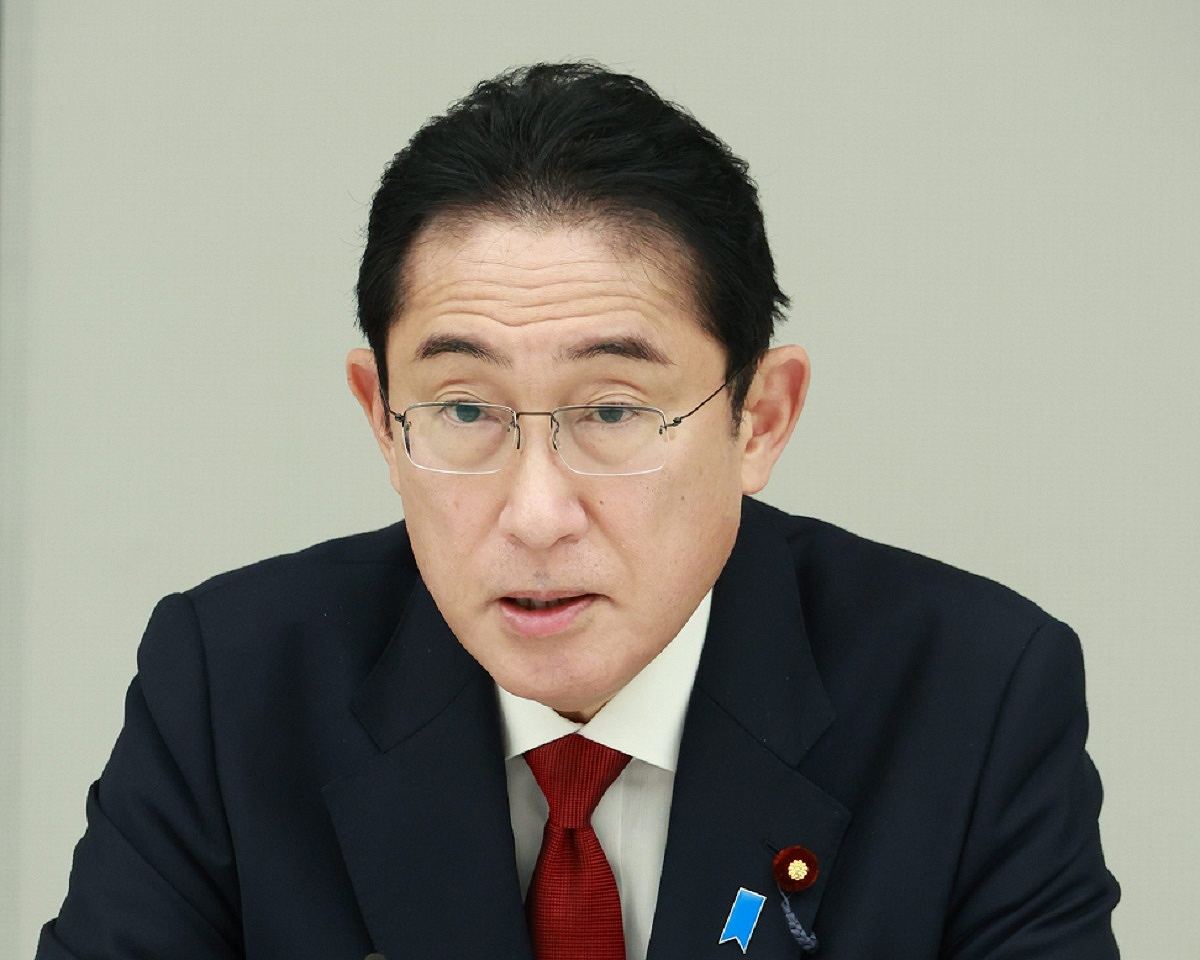
Prime Minister Fumio Kishida speaks at the Prime Minister’s Office on Tuesday.
16:10 JST, January 25, 2023
TOKYO (Jiji Press) — Japan’s Cabinet Office on Tuesday maintained its projection of achieving a primary budget surplus in fiscal 2026 under an optimistic scenario, despite a planned massive increase in defense spending.
The government agency included the projection in its medium- to long-term economic and fiscal forecasts submitted to the Council on Economic and Fiscal Policy, headed by Prime Minister Fumio Kishida.
The government expects ¥43 trillion in total defense spending over the five years from fiscal 2023 as part of efforts to raise the size of its annual defense-related expenditures to 2% of gross domestic product.
As in its previous forecasts released last July, the Cabinet Office said the country will be able to achieve a primary surplus in fiscal 2026 if the Japanese economy continues high growth of some 3% in nominal terms and 2% in inflation-adjusted real terms, citing measures to realize a new form of capitalism, a signature policy of Kishida.
But the assumed economic growth rates are highly optimistic. Since fiscal 1995, the nominal rate exceeded 3% only in fiscal 2015.
In addition, the Kishida administration plans to double the government’s child-related budget, making the primary surplus projection look even more unrealistic.
A primary budget surplus means that the government can cover expenditures other than debt-servicing costs with tax and other revenues without relying on new debt issuance.
In the latest forecasts, the Cabinet Office put the estimated primary balance for fiscal 2025 at a deficit of ¥1.5 trillion, up ¥1 trillion from its previous forecast chiefly due to higher defense spending.
But if the government successfully continues to rationalize spending including by curbing social security cost growth, it would be able to achieve a surplus of ¥1.1 trillion in fiscal 2025, the Cabinet Office also said.
The latest forecasts “have shown that the country would be able to achieve a primary budget surplus in fiscal 2025 if it continues spending reform efforts,” Kishida said at a meeting of the council.
“Although it’s not easy to achieve that amid increasing uncertainties, we will continue our efforts to balance economic revitalization and fiscal reconstruction,” he added.
The Cabinet Office also announced projections under a baseline scenario, which puts both nominal and real economic growth rates around 0.5%.
Under the scenario, the country is expected to log a primary deficit of ¥5.1 trillion in fiscal 2025 and stay in the red after that.






Most Read
Popular articles in the past 24 hours
-
6 Injured at Naked Festival in Japan’s Okayama Prefecture; Police...
-

Fiji Defense Minister Hopes Japan Will Support Stabilization of P...
-

Space One Delays Launch of No. 3 Kairos Rocket; Company to Announ...
-

Reciprocal Tariffs Ruled Illegal: Judiciary Would Not Tolerate Pr...
-

Milano Cortina 2026: Malinin Highlights Dangers of Social Media i...
-

Japanese Film, Anymart, Wins Critics’ Award at International Film...
-
3rd Japan Pacific Islands Defense Dialogue to Begin in Tokyo on S...
-
India, Brazil Sign Mining Pact As Modi Targets $20 Billion Trade ...
Popular articles in the past week
-

Japan PM Takaichi’s Cabinet Resigns en Masse
-

Man Infected with Measles Reportedly Dined at Restaurant in Tokyo...
-

Sanae Takaichi Elected Prime Minister of Japan; Keeps All Cabinet...
-

Japan's Govt to Submit Road Map for Growth Strategy in March, PM ...
-

Bus Carrying 40 Passengers Catches Fire on Chuo Expressway; All E...
-

Milano Cortina 2026: Figure Skaters Riku Miura, Ryuichi Kihara Pa...
-
Japan, U.S. Name 3 Inaugural Investment Projects; Reached Agreeme...
-

U.S. Firm to Build Training Hub in Fukushima N-plant for Debris R...
Popular articles in the past month
-
Japan PM Takaichi’s Cabinet Resigns en Masse
-

Japan Institute to Use Domestic Commercial Optical Lattice Clock ...
-

Israeli Ambassador to Japan Speaks about Japan’s Role in the Reco...
-
Man Infected with Measles Reportedly Dined at Restaurant in Tokyo...
-

Videos Plagiarized, Reposted with False Subtitles Claiming ‘Ryuky...
-

Man Infected with Measles May Have Come in Contact with Many Peop...
-

Prudential Life Insurance Plans to Fully Compensate for Damages C...
-

Woman with Measles Visited Hospital in Tokyo Multiple Times Befor...
Top Articles in Politics
-
Japan PM Takaichi’s Cabinet Resigns en Masse
-
Sanae Takaichi Elected Prime Minister of Japan; Keeps All Cabinet Appointees from Previous Term
-
Japan’s Govt to Submit Road Map for Growth Strategy in March, PM Takaichi to Announce in Upcoming Policy Speech
-

LDP Wins Historic Landslide Victory
-

LDP Wins Landslide Victory, Secures Single-party Majority; Ruling Coalition with JIP Poised to Secure Over 300 seats (UPDATE 1)
JN ACCESS RANKING
-
Japan PM Takaichi’s Cabinet Resigns en Masse
-
Japan Institute to Use Domestic Commercial Optical Lattice Clock to Set Japan Standard Time
-
Israeli Ambassador to Japan Speaks about Japan’s Role in the Reconstruction of Gaza
-
Man Infected with Measles Reportedly Dined at Restaurant in Tokyo Station
-
Videos Plagiarized, Reposted with False Subtitles Claiming ‘Ryukyu Belongs to China’; Anti-China False Information Also Posted in Japan