
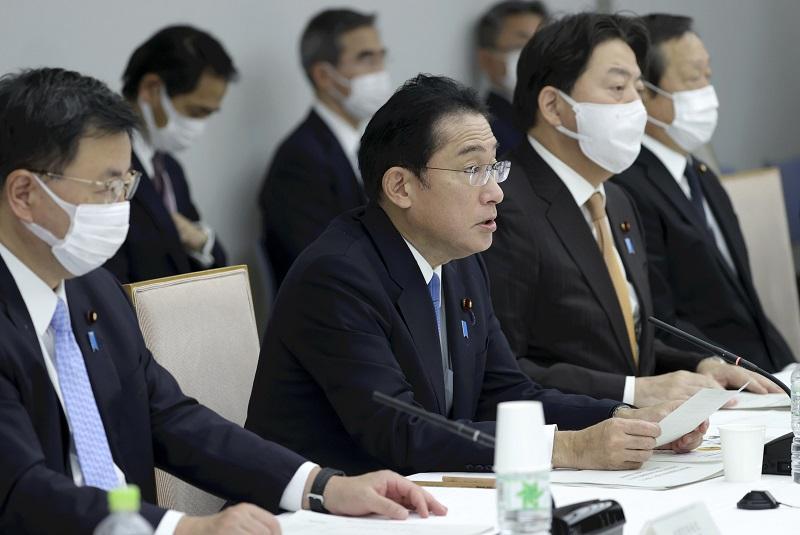
Prime Minister Fumio Kishida, center, addresses an advisory panel in Tokyo on Thursday.
15:00 JST, October 21, 2022
Prime Minister Fumio Kishida has instructed government ministries and agencies to consider a new framework under which budgets related to public infrastructure and research projects would be counted in the nation’s defense-related expenditures.
An advisory panel discussing issues including what equipment the Self-Defense Forces should possess, the size of defense-related budgets and how they will be financed held its second meeting at the Prime Minister’s Office on Thursday.
At the meeting, Kishida said research and development projects and the construction and use of public infrastructure would be “greatly” pushed forward. “It’s vital that related budgets are well used, based on the needs of the Defense Ministry and the Japan Coast Guard,” Kishida stressed.
Japan Science and Technology Agency President Kazuhito Hashimoto and Takahiro Ueyama, a member of the Council for Science, Technology and Innovation (CSTI), proposed establishing research hubs outside universities in a bid to expand scientific and technological research in defense fields.
The National Security Council presented a plan to create a framework under which it would exchange opinions with the CSTI, which sets the direction for distributing science and technology budgets, to channel some of these funds to defense-related purposes.
Member nations of the North Atlantic Treaty Organization aim to spend 2% or more of their gross domestic product on defense. The government also is aiming to increase Japan’s defense-related expenditures to the same level.
Japan’s defense spending in the overall budget for fiscal 2021, including supplementary budgets, came to about 1.24% of GDP under the NATO standard of accounting, which includes expenditures on the coast guard and other outlays. Budgets for public works projects and science and technology projects outside the jurisdiction of the Defense Ministry were not counted as part of Japan’s defense spending.
The government expects to include in defense-related expenditures costs such as those incurred in the construction of port facilities where SDF vessels dock in the Nansei Islands and other public works projects.
The issue of financing these outlays was discussed at Thursday’s meeting. Several panel members stated the government would have to gain the understanding of the public if tax hikes were needed to fund greater defense spending. Increasing the corporate tax rate “could pour cold water on economic growth,” another member said.
Kishida instructed Finance Minister Shunichi Suzuki to report on the status of options being considered for securing the financial resources for defense spending at the panel’s next meeting.





Most Read
Popular articles in the past 24 hours
-
Business Hotels Expanding into Regional Areas in Japan, Aiming to...
-
Milano Cortina 2026: Japan Sees Leap in Olympic Performance Throu...
-
6 Injured at Naked Festival in Japan’s Okayama Prefecture; Police...
-
Fiji Defense Minister Hopes Japan Will Support Stabilization of P...
-

Space One Delays Launch of No. 3 Kairos Rocket; Company to Announ...
-

Milano Cortina 2026: Malinin Highlights Dangers of Social Media i...
-
3rd Japan Pacific Islands Defense Dialogue to Begin in Tokyo on S...
-

Reciprocal Tariffs Ruled Illegal: Judiciary Would Not Tolerate Pr...
Popular articles in the past week
-

Japan PM Takaichi’s Cabinet Resigns en Masse
-

Man Infected with Measles Reportedly Dined at Restaurant in Tokyo...
-

Sanae Takaichi Elected Prime Minister of Japan; Keeps All Cabinet...
-

Japan's Govt to Submit Road Map for Growth Strategy in March, PM ...
-

Bus Carrying 40 Passengers Catches Fire on Chuo Expressway; All E...
-

Milano Cortina 2026: Figure Skaters Riku Miura, Ryuichi Kihara Pa...
-

Japan, U.S. Name 3 Inaugural Investment Projects; Reached Agreeme...
-
U.S. Firm to Build Training Hub in Fukushima N-plant for Debris R...
Popular articles in the past month
-
Japan PM Takaichi’s Cabinet Resigns en Masse
-

Japan Institute to Use Domestic Commercial Optical Lattice Clock ...
-

Israeli Ambassador to Japan Speaks about Japan’s Role in the Reco...
-
Man Infected with Measles Reportedly Dined at Restaurant in Tokyo...
-

Videos Plagiarized, Reposted with False Subtitles Claiming ‘Ryuky...
-

Man Infected with Measles May Have Come in Contact with Many Peop...
-

Prudential Life Insurance Plans to Fully Compensate for Damages C...
-

Woman with Measles Visited Hospital in Tokyo Multiple Times Befor...
Top Articles in Politics
-
Japan PM Takaichi’s Cabinet Resigns en Masse
-
Sanae Takaichi Elected Prime Minister of Japan; Keeps All Cabinet Appointees from Previous Term
-
Japan’s Govt to Submit Road Map for Growth Strategy in March, PM Takaichi to Announce in Upcoming Policy Speech
-

LDP Wins Historic Landslide Victory
-

LDP Wins Landslide Victory, Secures Single-party Majority; Ruling Coalition with JIP Poised to Secure Over 300 seats (UPDATE 1)
JN ACCESS RANKING
-
Japan PM Takaichi’s Cabinet Resigns en Masse
-
Japan Institute to Use Domestic Commercial Optical Lattice Clock to Set Japan Standard Time
-
Israeli Ambassador to Japan Speaks about Japan’s Role in the Reconstruction of Gaza
-
Man Infected with Measles Reportedly Dined at Restaurant in Tokyo Station
-
Videos Plagiarized, Reposted with False Subtitles Claiming ‘Ryukyu Belongs to China’; Anti-China False Information Also Posted in Japan