
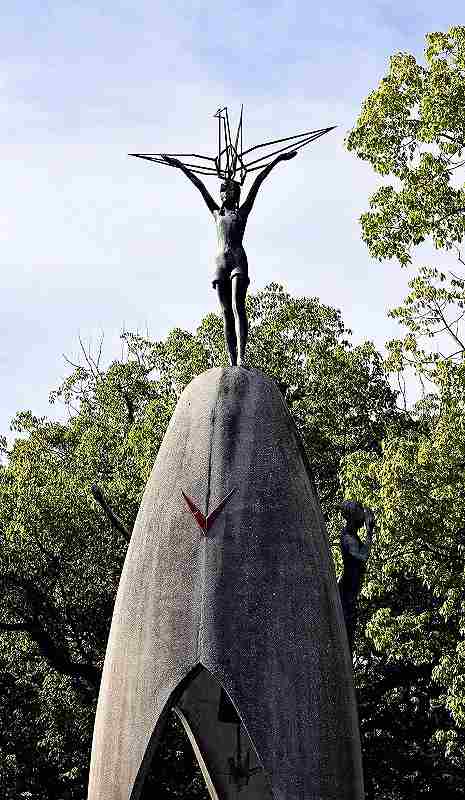
The Children’s Peace Monument at the Hiroshima Peace Memorial Park in Hiroshima
1:00 JST, August 4, 2022
Atomic bomb survivors called on Prime Minister Fumio Kishida to make every effort to help realize a world without nuclear weapons following his speech at the Review Conference of the Parties to the Treaty on the Non-Proliferation of Nuclear Weapons, which began in New York on Monday.
Although the prime minister’s speech was received positively by some, atomic bomb survivors from Hiroshima and Nagasaki prefectures expressed hope for a consensus to be adopted at the conference, with a concrete action plan to realize a nuclear-free world.
Kishida, the first Japanese prime minister to attend the conference, concluded his speech by telling participants about Sadako Sasaki, who was exposed to radiation from the atomic bombing in Hiroshima and died from leukemia in 1955 at the age of 12 after making origami cranes on her sickbed.
Sadako’s brother Masahiro, 81, said he was glad that Kishida let the world know about Sadako as a symbol of peace.
Sadako was 2 years old when the atomic bomb was dropped on Hiroshima. The hypocenter was 1.6 kilometers from her home. In February 1955, when she was in the sixth grade of elementary school, she developed leukemia due to exposure to radiation from the bombing.
She folded more than 1,600 paper cranes until her death in October of the same year, based on an a tradition that states that anyone who folds a thousand origami cranes will be granted a wish.
The Children’s Peace Monument in the Hiroshima Peace Memorial Park was modeled after Sadako, whose classmates raised funds for the construction of the monument.
Kishida, raising an origami crane he had folded, said, “Today, paper cranes have come to symbolize worldwide prayers for peace and a world without nuclear weapons.”
Masahiro expressed his hope that the speech would further spread Sadako’s message of peace and connects people around the world.
The focus of the conference will be whether the participants can reach a consensus on nuclear disarmament while a gap remains between nations with and without nuclear weapons.
“If Japan, as the only atomic-bombed nation, aims to bridge the gap between nuclear weapon states and non-nuclear weapon states, [Kishida] should have called for nuclear disarmament from the nuclear powers in stronger terms,” said Shigemitsu Tanaka, 81, chairman of the Nagasaki Atomic Bomb Survivors Council.
Terumi Tanaka, 90, of Nihon Hidankyo, the Japan Confederation of A- and H-Bomb Sufferers Organizations, said the prime minister’s speech was “nothing more than a performance at this stage.”
“The true value of the conference lies in whether the final document can be adopted,” Tanaka said. “I hope the prime minister will work hard so that a final document that includes his Hiroshima Action Plan is agreed upon.”







Most Read
Popular articles in the past 24 hours
-

Japan, U.S. Name 3 Inaugural Investment Projects; Reached Agreeme...
-

Milano Cortina 2026: Japan’s Kaori Sakamoto Wins Silver; Ami Naka...
-
Japan's PM Takaichi Looks to Establish Dominance as She Follows i...
-
Approval of Takaichi Cabinet Stands at 73%; Yomiuri Survey Finds ...
-
Milano Cortina 2026: Kaori Sakamoto Wins Silver, Ami Nakai Takes ...
-

Anonymous Individual Donates Gold Bars Worth ¥566 Mil. to Osaka M...
-

New Japanese Animated Film ‘A New Dawn’ Applauded at Berlin Inter...
-
Early-Blooming Cherry Blossoms Adorn Former Samurai Residences in...
Popular articles in the past week
-

Japan PM Takaichi’s Cabinet Resigns en Masse
-

Man Infected with Measles Reportedly Dined at Restaurant in Tokyo...
-

Videos Plagiarized, Reposted with False Subtitles Claiming ‘Ryuky...
-

Sanae Takaichi Elected 105th Prime Minister of Japan; Keeps All C...
-

Japan's Govt to Submit Road Map for Growth Strategy in March, PM ...
-

Milano Cortina 2026: Figure Skaters Riku Miura, Ryuichi Kihara Pa...
-

Bus Carrying 40 Passengers Catches Fire on Chuo Expressway; All E...
-

Tokyo’s New Record-Breaking Fountain Named ‘Tokyo Aqua Symphony’
Popular articles in the past month
-
Japan PM Takaichi’s Cabinet Resigns en Masse
-

Japan Institute to Use Domestic Commercial Optical Lattice Clock ...
-

Israeli Ambassador to Japan Speaks about Japan’s Role in the Reco...
-
Man Infected with Measles Reportedly Dined at Restaurant in Tokyo...
-

Man Infected with Measles May Have Come in Contact with Many Peop...
-
Videos Plagiarized, Reposted with False Subtitles Claiming ‘Ryuky...
-

Prudential Life Insurance Plans to Fully Compensate for Damages C...
-

Woman with Measles Visited Hospital in Tokyo Multiple Times Befor...
Top Articles in Politics
-
Japan PM Takaichi’s Cabinet Resigns en Masse
-
Sanae Takaichi Elected 105th Prime Minister of Japan; Keeps All Cabinet Appointees from Previous Term
-
Japan’s Govt to Submit Road Map for Growth Strategy in March, PM Takaichi to Announce in Upcoming Policy Speech
-

LDP Wins Historic Landslide Victory
-

LDP Wins Landslide Victory, Secures Single-party Majority; Ruling Coalition with JIP Poised to Secure Over 300 seats (UPDATE 1)
JN ACCESS RANKING
-
Japan PM Takaichi’s Cabinet Resigns en Masse
-
Japan Institute to Use Domestic Commercial Optical Lattice Clock to Set Japan Standard Time
-
Israeli Ambassador to Japan Speaks about Japan’s Role in the Reconstruction of Gaza
-
Man Infected with Measles Reportedly Dined at Restaurant in Tokyo Station
-
Man Infected with Measles May Have Come in Contact with Many People in Tokyo, Went to Store, Restaurant Around When Symptoms Emerged