
Japan’s Prime Minister Kishida Steps Down as Planned before Likely Successor Ishiba Takes Office
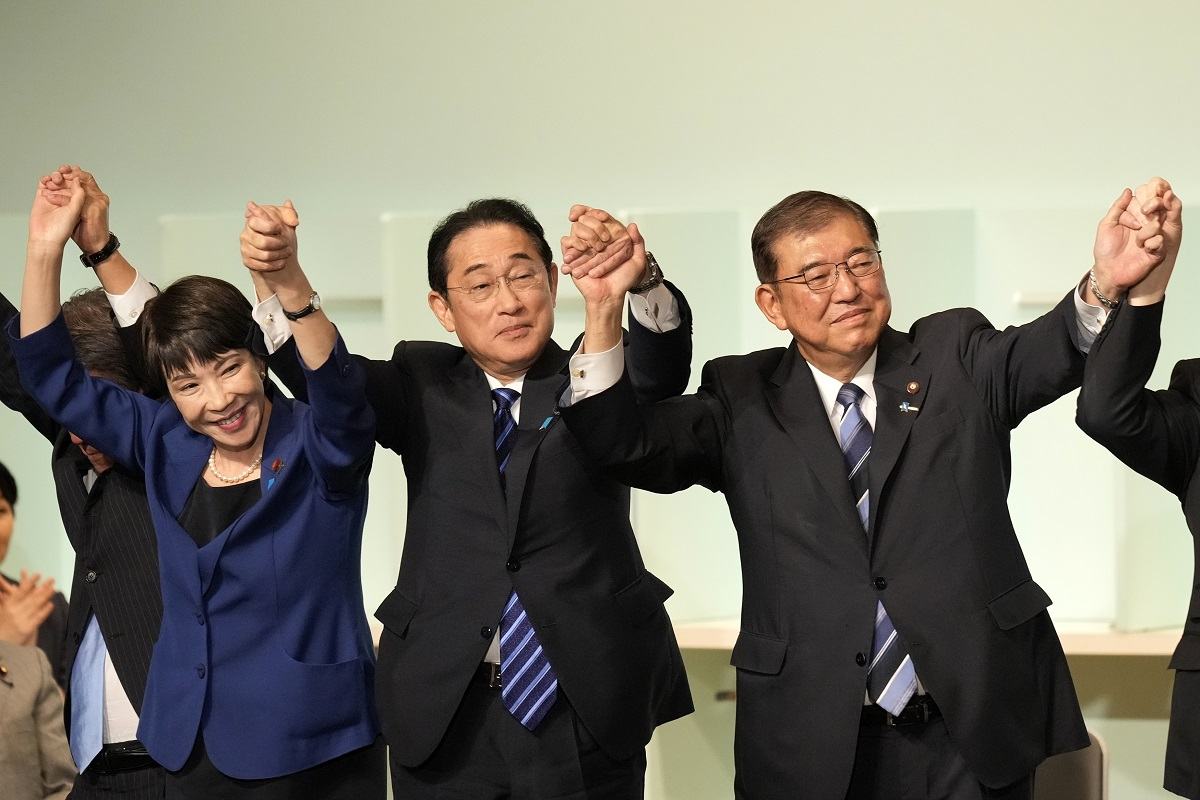
Shigeru Ishiba, right, with Sanae Takaichi, left, and Japan’s Prime Minister Fumio Kishida, center, celebrates after Ishiba was elected as new head of Japan’s ruling party at the Liberal Democratic Party’s leadership election Friday, Sept. 27, 2024, in Tokyo.
10:51 JST, October 1, 2024
TOKYO (AP) — Japan’s Prime Minister Fumio Kishida resigned with his Cabinet, paving the way for his likely successor Shigeru Ishiba to take office.
Chief Cabinet Secretary Yoshimasa Hayashi announced that Kishida and his ministers stepped down at a Cabinet meeting Tuesday.
Ishiba was chosen as the governing Liberal Democratic Party’s leader on Friday to replace Kishida, who announced in August his resignation at the end of his three-year term.
Ishiba is assured to be prime minister later Tuesday in a vote by parliament because it is dominated by his party’s ruling coalition.
Ishiba will then announce his new Cabinet later in the day.
Kishida took office in 2021 but is leaving so his party can have a fresh leader after his government was dogged by scandals.
On Monday, Ishiba said he planned to call a parliamentary election to be held on Oct. 27 after he is formally chosen as prime minister.
“I believe it is important to have the new administration get the public’s judgment as soon as possible,” Ishiba said.
He also announced his party leaders Monday ahead of naming his Cabinet.
He appointed former Environment Minister Shinjiro Koizumi, who came in third in the party leadership race, to head the party’s election task force.
He is expected to name defense experts and his longtime confidantes Takeshi Iwaya as foreign minister and Gen Nakatani as defense chief once he takes office.
Ishiba has proposed an Asian version of the NATO military alliance and more discussion among regional partners about the use of the U.S. nuclear deterrence. He also suggested a more equal Japan-U.S. security alliance, including joint management of U.S. bases in Japan and having Japanese Self Defense Force bases in the United States.
Ishiba outlined his views in an article to the Hudson Institute last week. “The absence of a collective self-defense system like NATO in Asia means that wars are likely to break out because there is no obligation for mutual defense. Under these circumstances, the creation of an Asian version of NATO is essential to deter China by its Western allies,” he wrote.
Ishiba proposes combining of existing security and diplomatic groupings, such as the Quad and other bilateral and multilateral frameworks involving the United States, Australia, New Zealand, South Korea and the Philippines.
He also noted that the Asian version of NATO can also consider sharing of the control of U.S. nuclear weapons in the region as a deterrence against growing threats from China, North Korea and Russia.
Ishiba on Friday stressed Japan needs to reinforce its security, noting recent violations of Japanese airspace by Russian and Chinese warplanes and repeated missile launches by North Korea.
He pledged to continue Kishida’s economic policy aimed at pulling Japan out of deflation and achieving real salary increases, while tackling challenges such as Japan’s declining birthrate and population and resilience to natural disasters.
The LDP has had a nearly unbroken tenure governing Japan since World War II. The party members may have seen Ishiba’s more centrist views as crucial in pushing back challenges by the liberal-leaning opposition and winning voter support as the party reels from corruption scandals that drove down Kishida’s popularity.
Ishiba, first elected to parliament in 1986, has served as defense minister, agriculture minister and in other key Cabinet posts, and was LDP secretary general under former Prime Minister Shinzo Abe.






Most Read
Popular articles in the past 24 hours
-
Japan's Opposition Parties Largely Absent from Social Security-Re...
-
Tourists Ignore Safety Barriers Near Famous Zao ‘Snow Monsters’ i...
-
Showa-era Towers in Kansai’s Big Cities Become Social Media Sensa...
-

Tokyo’s ‘Strawberry War’ Intensifies as Producers Vie to Become ‘...
-

Neil Sedaka, The Singer-Songwriter Behind Dozens of Hits of The 1...
-
Fukui: Effort to Grow Bananas in Snow Bears Fruit; Japanese Farme...
-

Tokyo Measles Patient Visited 3 Udon Restaurants in Kagawa Prefec...
-

Portable Stuffed Wolf Robot Designed to Drive Away Bears While Hi...
Popular articles in the past week
-

Producer Behind Pop Group XG Arrested for Cocaine Possession
-

Nepal Bus Crash Kills 19 People, Injures 25 Including One Japanes...
-
Tokyo Skytree's Elevator Stops, Trapping 20 People; All Rescued (...
-
Milano Cortina 2026: Japanese Gold Medalist Figure Skater Miura S...
-

Japan’s Major Real Estate Firms Expanding Overseas Businesses to ...
-

Reciprocal Tariffs Ruled Illegal: Judiciary Would Not Tolerate Pr...
-

Milano Cortina 2026: Miura-Kihara Duo, Other Japanese Figure Skat...
-
6 Injured at Naked Festival in Japan’s Okayama Prefecture; Police...
Popular articles in the past month
-
Producer Behind Pop Group XG Arrested for Cocaine Possession
-

Japan PM Takaichi’s Cabinet Resigns en Masse
-

Man Infected with Measles Reportedly Dined at Restaurant in Tokyo...
-

Israeli Ambassador to Japan Speaks about Japan’s Role in the Reco...
-

Videos Plagiarized, Reposted with False Subtitles Claiming ‘Ryuky...
-

Man Infected with Measles May Have Come in Contact with Many Peop...
-

Prudential Life Insurance Plans to Fully Compensate for Damages C...
-

Woman with Measles Visited Hospital in Tokyo Multiple Times Befor...
Top Articles in News Services
-
Survey Shows False Election Info Perceived as True
-
Hong Kong Ex-Publisher Jimmy Lai’s Sentence Raises International Outcry as China Defends It
-

Japan’s Nikkei Stock Average Touches 58,000 as Yen, Jgbs Rally on Election Fallout (UPDATE 1)
-
Japan’s Nikkei Stock Average Falls as US-Iran Tensions Unsettle Investors (UPDATE 1)
-
Japan’s Nikkei Stock Average Rises on Tech Rally and Takaichi’s Spending Hopes (UPDATE 1)
JN ACCESS RANKING
-
Producer Behind Pop Group XG Arrested for Cocaine Possession
-
Japan PM Takaichi’s Cabinet Resigns en Masse
-
Man Infected with Measles Reportedly Dined at Restaurant in Tokyo Station
-
Israeli Ambassador to Japan Speaks about Japan’s Role in the Reconstruction of Gaza
-
Videos Plagiarized, Reposted with False Subtitles Claiming ‘Ryukyu Belongs to China’; Anti-China False Information Also Posted in Japan