
Tokyo Exhibition Offers Inside Look at Impressionism; 70 of 100 Works on ‘Interiors’ by Monet, Others on Loan from Paris
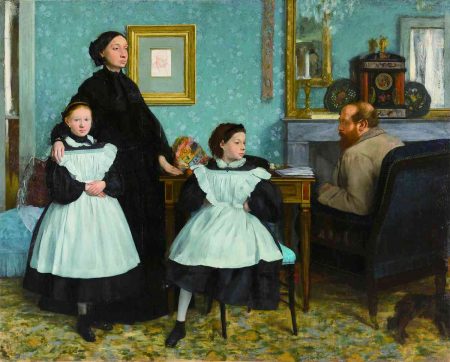
“Family Portrait (The Bellelli Family)” by Edgar Degas,1858-1869
17:42 JST, February 8, 2026
Impressionism is often associated with the outdoors. Even its name, ironically coined by a scathing critic, comes from a Claude Monet painting of a sunrise called “Impression, soleil levant” (“Impression, sunrise”). The movement is also characterized by the desire to move away from prioritizing accuracy and realism, instead choosing to convey the sense or feelings evoked — in other words, an impression.
However, “Impressionist Interiors: Intimacy, Decoration, Modernity” at The National Museum of Western Art in the Ueno district of Tokyo, looks to not only challenge the notion that impressionists were confined to the outdoors, but also showcase how their sensibilities were perfectly suited to capturing the “interiors,” both literal and figurative, of quotidian French life in the 19th century.
Featuring 100 pieces by names familiar even to a non-connoisseur — Monet, Edgar Degas and Pierre-Auguste Renoir, to name a few — around 70 are on loan from the Musee d’Orsay, known worldwide as a home of impressionist works.
Co-organized by The Yomiuri Shimbun, the exhibition marks the largest selection of the Orsay’s collection showcased in Japan in over a decade, with Degas’ masterpiece “Family Portrait (The Bellelli Family)” being displayed in the country for the first time.
The exhibit traces a path through four “chapters”: “Impressionist interiors,” “Scenes of everyday life,” “Making space for nature inside the home” and “Impressionist decorations.” With this curatorial approach, visitors observe works side-by-side, thus highlighting each artist’s unique style.
Happy, unhappy families
Chapter 1 mainly displays portraits, which became central to the impressionist movement by portraying family dynamics unconventionally — or honestly.
Works such as Albert Besnard’s “A Family” reflected loving domesticity at a time when childrearing and marriage trends had only just begun veering toward modern notions of the family unit.
Conversely, Degas, known for his ability to capture movement and body language, drew scandal for the complete opposite with his “Family Portrait (The Bellelli Family),” due to its stiff, unflinching portrayal of an unhappy family.
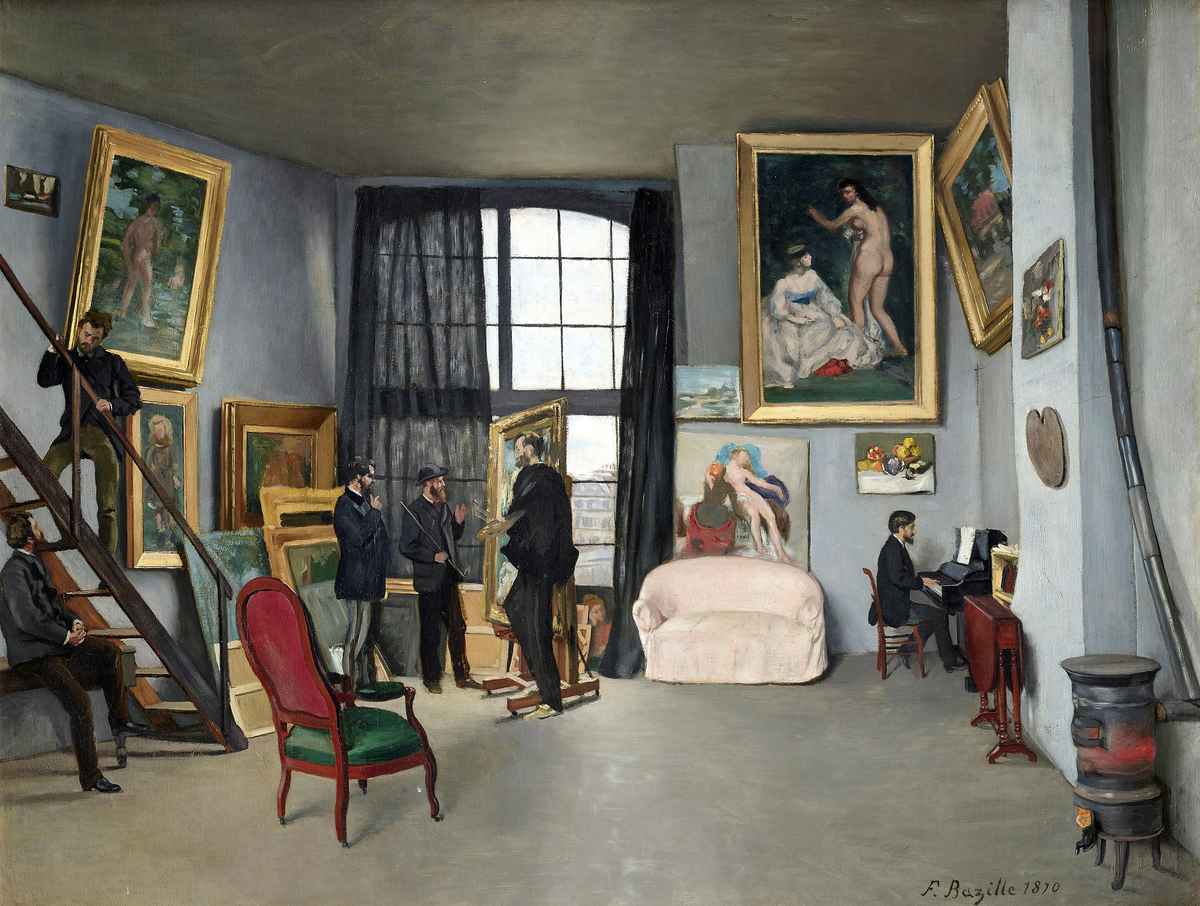
Many pieces, such as Frederic Bazille’s charming “Bazille’s Studio,” also feature the artists painting each other, revealing the camaraderie — and sometimes friction — that accompanied their blossoming careers.
-
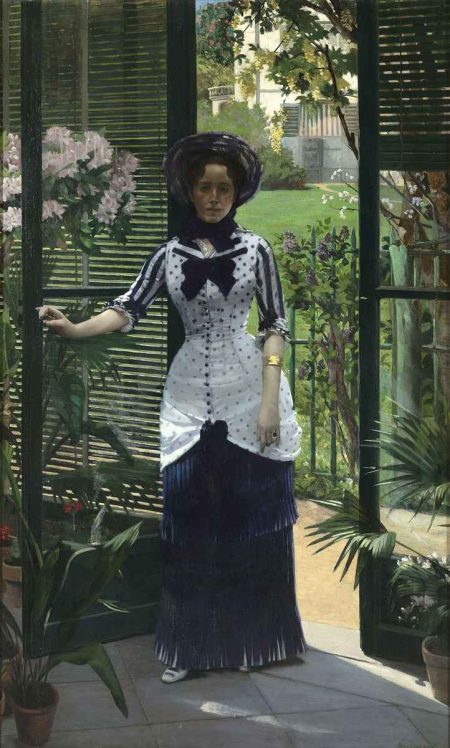
©GrandPalaisRmn (musée d’Orsay) / Hervé Lewandowski / distributed by AMF
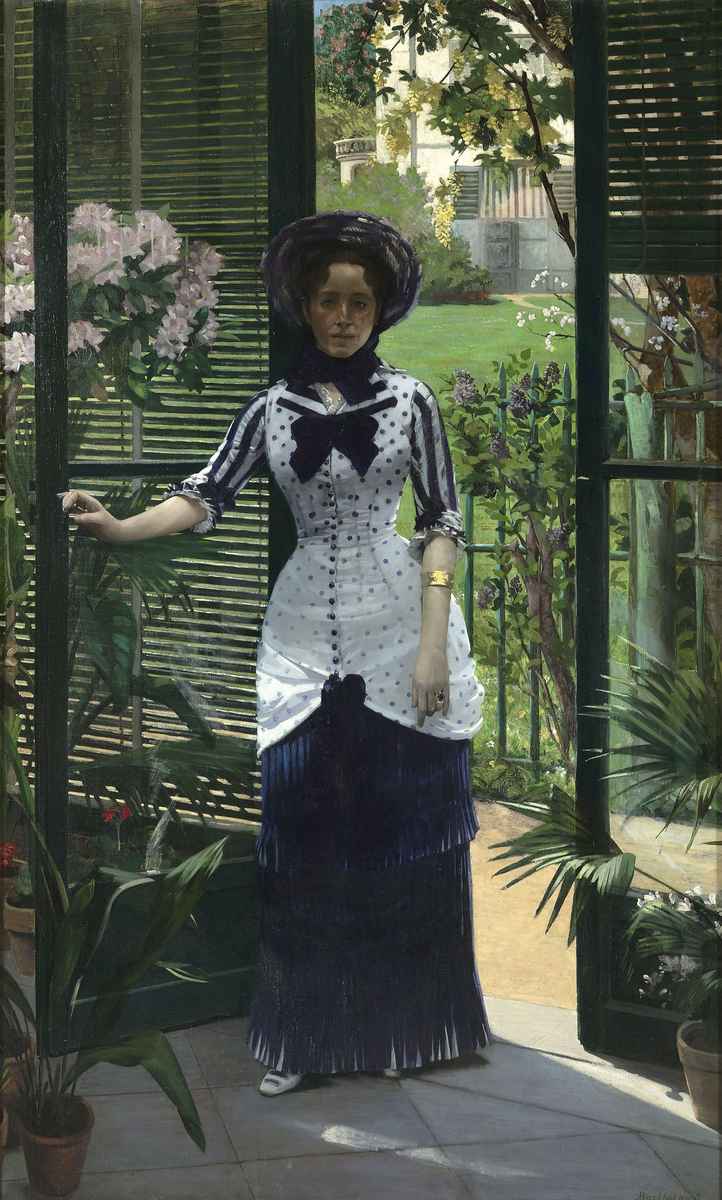
“In the Conservatory” by Albert Bartholomé, c. 1881 -
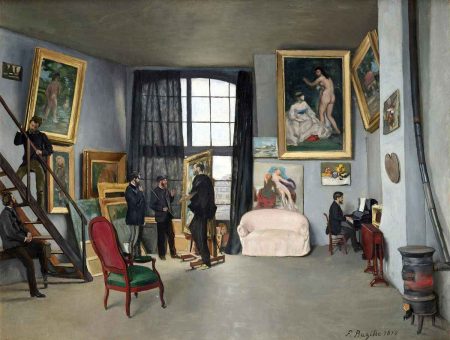
©GrandPalaisRmn (musée d’Orsay) / Gabriel de Carvalho / distributed by AMF
“Bazille’s Studio” by Frédéric Bazille, 1870
Indoor leisure
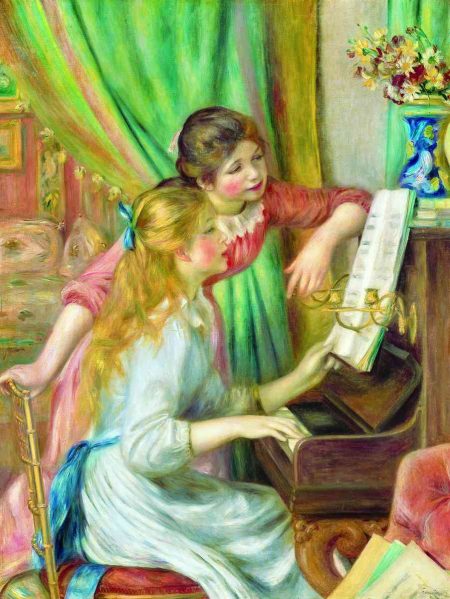
“Young Girls at the Piano” by Pierre-Auguste Renoir, 1892
In Chapter 2, the focus is on the home and leisure, with the delineation between public and private life beginning to take shape at this time.
Many of the works depict young women and girls, given that their pastimes, such as music, embroidery or reading, largely took place in these spaces. Spotlighted in this room is Renoir’s “Young Girls at the Piano” — a highly significant piece in Renoir’s oeuvre that perfectly illustrates his characteristic warm colors.
Another striking piece involving a piano is “Monsieur and Madame Edouard Manet” by Degas. As the story goes, Manet was so furious at the depiction of his wife’s intimate expression that he took a blade to the canvas, cutting away both her face and the piano at which she is sitting, resulting in a famously incomplete painting.
This chapter provides visitors with stunning examples of the impressionists’ mastery of light, applied to indoor scenes, including sunlight streaming through windows or in household objects such as lamps, per the trend of electricity increasingly installed in the homes of the middle classes.
‘Liminal’ interiors, decorations
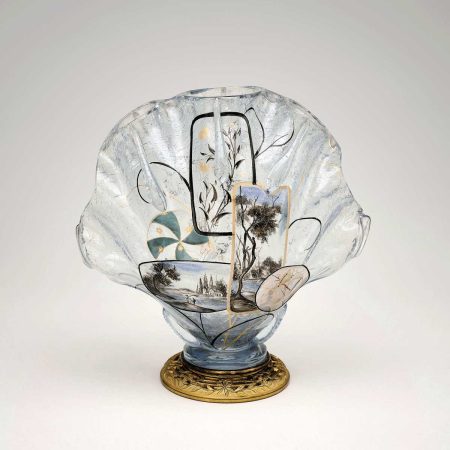
“Flower Holder with Lake Landscape” by Émile Gallé, c. 1878
Similarly, Chapter 3 gives special attention to decorative objects. As noted by the exhibition, many artists took up such work as a pragmatic way to earn income from patrons or commissions. As well as paintings, such as the still lifes by Paul Cezanne and Marie Louise Victoria Dubourg, a key female artist from the period, painted household items such as vases are also displayed.
Additionally, here the exhibition focuses on impressionists’ fascination on “liminal” interior spaces, such as glass greenhouses or balconies — where subjects were both inside and outside at the same time.
Albert Bartholome’s “In the Conservatory,” depicting his wife stepping in from the garden, utilizes an incredible, almost shockingly realistic contrast of light and shadow. Displayed in a glass case alongside the piece is the real dress modeled by his spouse.
This chapter also notes the influence of Japanese aesthetics, which would give birth to the “Japonisme” movement. According to the exhibition, this manifested in a sparser “decorative grammar,” evident in the displayed physical objects, such as delicately painted dinnerware, or the elaborate glasswork of Emile Galle.
The final chapter looks at the impressionists’ role in creating modern wall decorations. Treating visitors to three of Monet’s world-famous “Water Lilies” — out of the 250 he created — the exhibition’s journey through impressionism comes to a close with a reminder of its historic significance.
The gift shop offerings include collaborations with prestige French brands, such as a tin of madeleines from world-famous patisserie Laduree and original tea blends from Mariage Freres.
An audio guide can be rented for ¥650, providing additional historical context. The Japanese narration is provided by actress and singer Mone Kamishiraishi.
You may also like to read
Upcoming Impressionist Exhibition in Tokyo to Focus on Paintings with Interior Settings; Masters of Art Form to be on DisplayThe exhibition runs through Feb. 15. General admission is priced at ¥2,300 for adults, ¥1,400 for college students and ¥1,000 for high school students. Entry for students in junior high school and younger is free.
The museum is open from 9:30 a.m. to 5:30 p.m., with later hours on Fridays and Saturdays. More information can be found on the official website.


Related Tags




Most Read
Popular articles in the past 24 hours
-
Tokyo Spends Big on Children, Wins Over Parents
-

Japan's Opposition Parties Largely Absent from Social Security-Re...
-

Tourists Ignore Safety Barriers Near Famous Zao ‘Snow Monsters’ i...
-
Showa-era Towers in Kansai’s Big Cities Become Social Media Sensa...
-
Tokyo’s ‘Strawberry War’ Intensifies as Producers Vie to Become ‘...
-

Neil Sedaka, The Singer-Songwriter Behind Dozens of Hits of The 1...
-

Fukui: Effort to Grow Bananas in Snow Bears Fruit; Japanese Farme...
-

Tokyo Measles Patient Visited 3 Udon Restaurants in Kagawa Prefec...
Popular articles in the past week
-

Producer Behind Pop Group XG Arrested for Cocaine Possession
-

Nepal Bus Crash Kills 19 People, Injures 25 Including One Japanes...
-

Tokyo Skytree's Elevator Stops, Trapping 20 People; All Rescued (...
-

Milano Cortina 2026: Japanese Gold Medalist Figure Skater Miura S...
-

Japan’s Major Real Estate Firms Expanding Overseas Businesses to ...
-

Reciprocal Tariffs Ruled Illegal: Judiciary Would Not Tolerate Pr...
-

Milano Cortina 2026: Miura-Kihara Duo, Other Japanese Figure Skat...
-

6 Injured at Naked Festival in Japan’s Okayama Prefecture; Police...
Popular articles in the past month
-
Producer Behind Pop Group XG Arrested for Cocaine Possession
-

Japan PM Takaichi’s Cabinet Resigns en Masse
-

Man Infected with Measles Reportedly Dined at Restaurant in Tokyo...
-

Israeli Ambassador to Japan Speaks about Japan’s Role in the Reco...
-

Videos Plagiarized, Reposted with False Subtitles Claiming ‘Ryuky...
-

Man Infected with Measles May Have Come in Contact with Many Peop...
-

Prudential Life Insurance Plans to Fully Compensate for Damages C...
-

Woman with Measles Visited Hospital in Tokyo Multiple Times Befor...
Top Articles in Culture
-

BTS to Hold Comeback Concert in Seoul on March 21; Popular Boy Band Releases New Album to Signal Return
-

Director Naomi Kawase’s New Film Explores Heart Transplants in Japan, Production Involved Real Patients, Families
-
Traditional Japanese Silk Hakama Tradition Preserved by Sole Weaver in Sendai
-
Japanese Byobu Folding Screens Tailored to Meet Modern Lifestyles; Foreign Orders Also Piling up
-
Exhibition Featuring Yoshiharu Tsuge’s Manga World Underway in Chofu, Tokyo; Unique, Surreal Works Draw Steady Crowds
JN ACCESS RANKING
-
Producer Behind Pop Group XG Arrested for Cocaine Possession
-
Japan PM Takaichi’s Cabinet Resigns en Masse
-
Man Infected with Measles Reportedly Dined at Restaurant in Tokyo Station
-
Israeli Ambassador to Japan Speaks about Japan’s Role in the Reconstruction of Gaza
-
Videos Plagiarized, Reposted with False Subtitles Claiming ‘Ryukyu Belongs to China’; Anti-China False Information Also Posted in Japan