
6:00 JST, October 31, 2022
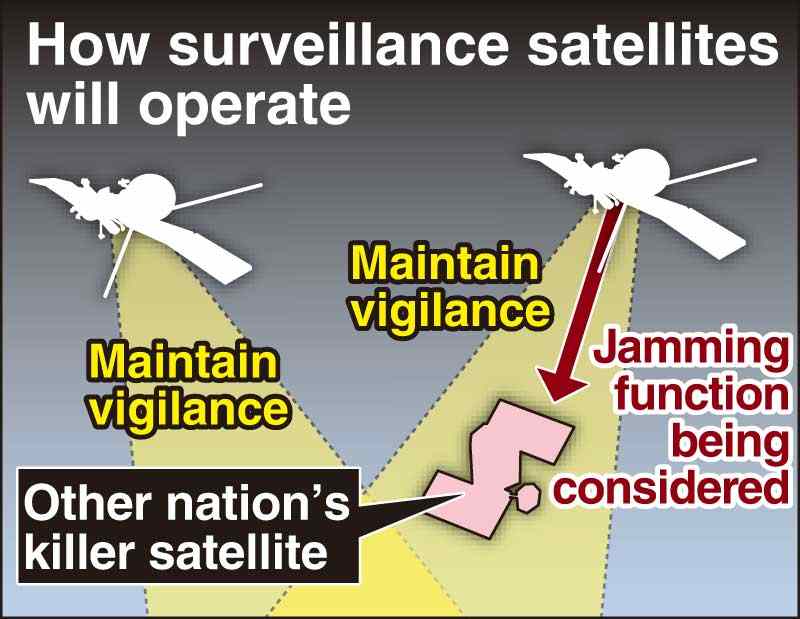
To reinforce vigilance in outer space above Japan, the Defense Ministry has formulated a policy of putting into operation two surveillance satellites. It is also considering adding a function to the second satellite to interfere with the activities of Chinese and Russian killer satellites in orbit, several government sources said.
A killer satellite is a military satellite that can attack other nations’ satellites in outer space. It approaches the target satellite and captures it with its robotic arms or bombards it with electromagnetic waves to disable it.
Since 2010, China has repeatedly conducted tests to move satellites closer together, while Russia is also said to be developing related technology.
The establishment and expansion of a surveillance satellite system will be specified in the National Defense Program Guidelines and the Medium Term Defense Program, both of which will be revised by the end of the year, as one of the pillars of measures to strengthen Japan’s defense capabilities in outer space.
The surveillance satellites will be put into geostationary orbit at an altitude of about 36,000 kilometers. Each will be equipped with an optical telescope to collect information on the movements of killer satellites and the like. Vigilance via ground-based radar is scheduled to begin in the next fiscal year, but more detailed data can be obtained in outer space.
Currently, it has been confirmed that the first unit will be launched by FY2026. However, with the operation of one unit alone, there is a limit in the range of surveillance covered, depending on the angle of the sensor. To cover the entire sky over Japan, multiple satellites are needed. The ministry will verify the operation of the first satellite and then coordinate the timing of the launch of the second satellite.
The need for surveillance satellites was first put forth in the National Defense Program Guidelines and the Medium Term Defense Program for 2018 in response to the development of killer satellites by China and Russia.
As for Japan’s security-related satellites, ones for positioning essential for guiding a missile to its intended target and information-gathering satellites that monitor movements on the ground are among those in operation. If these satellites were incapacitated by a killer satellite, Japan’s defense would be seriously impacted.
For this reason, the second surveillance satellite will be equipped with a jamming device to prevent an attack by a killer satellite. The ministry will begin concrete design work in the next fiscal year.
Regarding attacks on killer satellites, Defense Minister Yasukazu Hamada indicated during a House of Representatives National Security Committee held on Thursday that it is legally possible.
“It must be a measure deemed the minimum necessary for our self-defense,” Hamada said. “We will make a decision based on the specific circumstances of each case.”






Most Read
Popular articles in the past 24 hours
-

Business Hotels Expanding into Regional Areas in Japan, Aiming to...
-

6 Injured at Naked Festival in Japan’s Okayama Prefecture; Police...
-

Fiji Defense Minister Hopes Japan Will Support Stabilization of P...
-

Space One Delays Launch of No. 3 Kairos Rocket; Company to Announ...
-

Milano Cortina 2026: Malinin Highlights Dangers of Social Media i...
-

Reciprocal Tariffs Ruled Illegal: Judiciary Would Not Tolerate Pr...
-

3rd Japan Pacific Islands Defense Dialogue to Begin in Tokyo on S...
-

Japanese Film, Anymart, Wins Critics’ Award at International Film...
Popular articles in the past week
-

Japan PM Takaichi’s Cabinet Resigns en Masse
-

Man Infected with Measles Reportedly Dined at Restaurant in Tokyo...
-

Sanae Takaichi Elected Prime Minister of Japan; Keeps All Cabinet...
-

Japan's Govt to Submit Road Map for Growth Strategy in March, PM ...
-

Bus Carrying 40 Passengers Catches Fire on Chuo Expressway; All E...
-

Milano Cortina 2026: Figure Skaters Riku Miura, Ryuichi Kihara Pa...
-

Japan, U.S. Name 3 Inaugural Investment Projects; Reached Agreeme...
-

U.S. Firm to Build Training Hub in Fukushima N-plant for Debris R...
Popular articles in the past month
-
Japan PM Takaichi’s Cabinet Resigns en Masse
-

Japan Institute to Use Domestic Commercial Optical Lattice Clock ...
-

Israeli Ambassador to Japan Speaks about Japan’s Role in the Reco...
-
Man Infected with Measles Reportedly Dined at Restaurant in Tokyo...
-

Videos Plagiarized, Reposted with False Subtitles Claiming ‘Ryuky...
-

Man Infected with Measles May Have Come in Contact with Many Peop...
-

Prudential Life Insurance Plans to Fully Compensate for Damages C...
-

Woman with Measles Visited Hospital in Tokyo Multiple Times Befor...
Top Articles in Politics
-
Japan PM Takaichi’s Cabinet Resigns en Masse
-
Sanae Takaichi Elected Prime Minister of Japan; Keeps All Cabinet Appointees from Previous Term
-
Japan’s Govt to Submit Road Map for Growth Strategy in March, PM Takaichi to Announce in Upcoming Policy Speech
-

LDP Wins Historic Landslide Victory
-

LDP Wins Landslide Victory, Secures Single-party Majority; Ruling Coalition with JIP Poised to Secure Over 300 seats (UPDATE 1)
JN ACCESS RANKING
-
Japan PM Takaichi’s Cabinet Resigns en Masse
-
Japan Institute to Use Domestic Commercial Optical Lattice Clock to Set Japan Standard Time
-
Israeli Ambassador to Japan Speaks about Japan’s Role in the Reconstruction of Gaza
-
Man Infected with Measles Reportedly Dined at Restaurant in Tokyo Station
-
Videos Plagiarized, Reposted with False Subtitles Claiming ‘Ryukyu Belongs to China’; Anti-China False Information Also Posted in Japan