
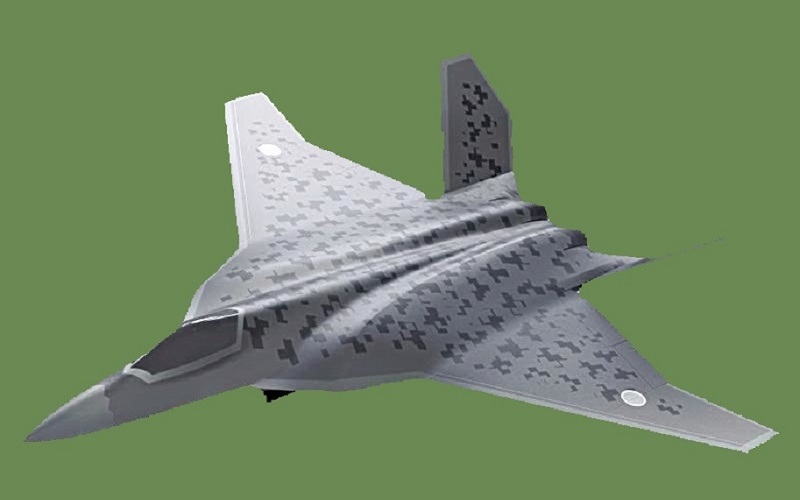
An image of a next-generation fighter jet that the Defense Ministry plans to develop
15:54 JST, October 19, 2022
The government plans to establish a research institute in fiscal 2024 at the earliest to utilize cutting-edge technologies developed by the private sector in the defense field, according to government sources.
The new institute, which will be part of the Acquisition, Technology and Logistics Agency, will identify research in technologies expected to be vital to the future of warfare, in such fields as artificial intelligence and unmanned aerial vehicles.
The institute will aim to link research on advanced technologies that can be used for both defense and civilian purposes in the development of equipment.
Active use of advanced technologies for both military and civilian purposes is common overseas, but a sense of aversion to the defense field persists in Japanese academic circles.
Because public-private research cooperation has not made as much progress in Japan, compared to the United States, China and other countries, the government decided a specialized organization backed by the state was needed to make up the gap.
The new institute will be modeled after the U.S. Department of Defense’s Defense Advanced Research Projects Agency (DARPA) and Defense Innovation Unit (DIU).
The roots of the internet and the Global Positioning System can be traced back to DARPA, which has been involved in supporting the kind of high-risk research that struggles to attract private investment.
The DIU has served as a bridge between the U.S. Department of Defense and the private sector, contributing to the discovery of civilian technologies utilized in the cyber field and unmanned aerial vehicles.
The new institute is expected to provide medium- to long-term research funding to a wide range of companies, research institutes, and universities — from large corporations to start-ups.
In addition to public solicitations, there are expectations that the private sector will also approach the institution for support. The goal is to provide support amounting to about ¥1 trillion annually.
The Acquisition, Technology and Logistics Agency’s national security technology research promotion program subsidizes private-sector research, but its budget is only about ¥10 billion per year, and the period of the subsidy is usually limited to two or three years.
As the program has not achieved any significant results, the new research institute is expected to provide support over a longer period.
Priority fields for support will include AI, drones, quantum technology and electromagnetic waves. The United States and China are fiercely competing for dominance in these fields, which have the potential to drastically change warfare.
The government intends to focus on technological development to strengthen the deterrence of the Japan-U.S. alliance.
The agency will have technical officers who will serve as project managers, responsible for research plans, budgets and quality control, and providing advice to researchers. Some of the project managers are expected to be appointed from the private sector.
The technical officers will also seek out research that has the potential to be commercialized at an early stage and lobby for support, serving as liaisons between the agency and major companies in defense industries to realize mass production of equipment.





Most Read
Popular articles in the past 24 hours
-

Business Hotels Expanding into Regional Areas in Japan, Aiming to...
-
6 Injured at Naked Festival in Japan’s Okayama Prefecture; Police...
-

Fiji Defense Minister Hopes Japan Will Support Stabilization of P...
-

Space One Delays Launch of No. 3 Kairos Rocket; Company to Announ...
-

Milano Cortina 2026: Malinin Highlights Dangers of Social Media i...
-

Reciprocal Tariffs Ruled Illegal: Judiciary Would Not Tolerate Pr...
-

3rd Japan Pacific Islands Defense Dialogue to Begin in Tokyo on S...
-

Japanese Film, Anymart, Wins Critics’ Award at International Film...
Popular articles in the past week
-

Japan PM Takaichi’s Cabinet Resigns en Masse
-

Man Infected with Measles Reportedly Dined at Restaurant in Tokyo...
-

Sanae Takaichi Elected Prime Minister of Japan; Keeps All Cabinet...
-

Japan's Govt to Submit Road Map for Growth Strategy in March, PM ...
-

Bus Carrying 40 Passengers Catches Fire on Chuo Expressway; All E...
-

Milano Cortina 2026: Figure Skaters Riku Miura, Ryuichi Kihara Pa...
-

Japan, U.S. Name 3 Inaugural Investment Projects; Reached Agreeme...
-

U.S. Firm to Build Training Hub in Fukushima N-plant for Debris R...
Popular articles in the past month
-
Japan PM Takaichi’s Cabinet Resigns en Masse
-

Japan Institute to Use Domestic Commercial Optical Lattice Clock ...
-

Israeli Ambassador to Japan Speaks about Japan’s Role in the Reco...
-
Man Infected with Measles Reportedly Dined at Restaurant in Tokyo...
-

Videos Plagiarized, Reposted with False Subtitles Claiming ‘Ryuky...
-

Man Infected with Measles May Have Come in Contact with Many Peop...
-

Prudential Life Insurance Plans to Fully Compensate for Damages C...
-

Woman with Measles Visited Hospital in Tokyo Multiple Times Befor...
Top Articles in Politics
-
Japan PM Takaichi’s Cabinet Resigns en Masse
-
Sanae Takaichi Elected Prime Minister of Japan; Keeps All Cabinet Appointees from Previous Term
-
Japan’s Govt to Submit Road Map for Growth Strategy in March, PM Takaichi to Announce in Upcoming Policy Speech
-

LDP Wins Historic Landslide Victory
-

LDP Wins Landslide Victory, Secures Single-party Majority; Ruling Coalition with JIP Poised to Secure Over 300 seats (UPDATE 1)
JN ACCESS RANKING
-
Japan PM Takaichi’s Cabinet Resigns en Masse
-
Japan Institute to Use Domestic Commercial Optical Lattice Clock to Set Japan Standard Time
-
Israeli Ambassador to Japan Speaks about Japan’s Role in the Reconstruction of Gaza
-
Man Infected with Measles Reportedly Dined at Restaurant in Tokyo Station
-
Videos Plagiarized, Reposted with False Subtitles Claiming ‘Ryukyu Belongs to China’; Anti-China False Information Also Posted in Japan