
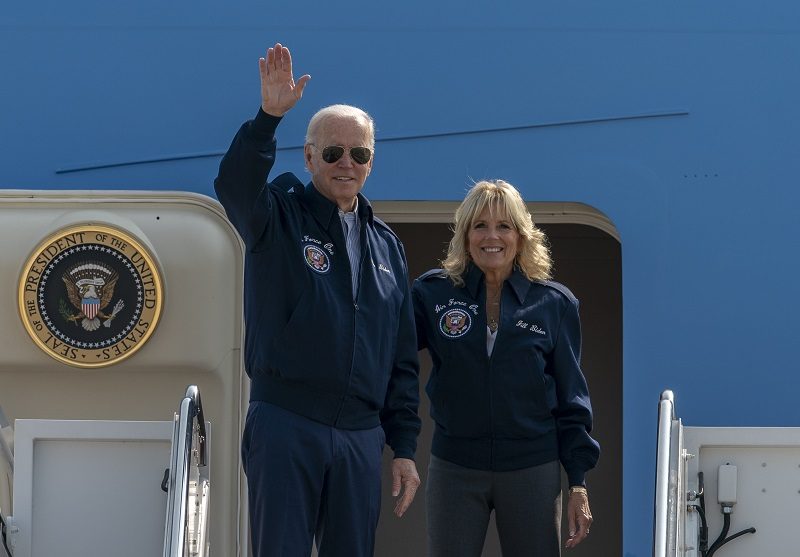
U.S. President Joe Biden waves as first lady Jill Biden watches standing at the top of the steps of Air Force One before boarding at Andrews Air Force Base, Md., on Saturday.
14:09 JST, September 19, 2022
BEIJING (AP) — President Joe Biden says U.S. forces would defend Taiwan if China tries to invade the self-ruled island claimed by Beijing as part of its territory, adding to displays of official American support for the island democracy.
Biden said “yes” when asked during an interview broadcast Sunday on CBS News’s “60 Minutes” program whether “U.S. forces, U.S. men and women, would defend Taiwan in the event of a Chinese invasion.”
CBS News reported the White House said after the interview U.S. policy hasn’t changed. That policy says Washington wants to see Taiwan’s status resolved peacefully but doesn’t say whether U.S. forces might be sent in response to a Chinese attack.
Tension is rising following efforts by Chinese President Xi Jinping’s government to intimidate Taiwan by firing missiles into the nearby sea and flying fighter jets nearby and visits to Taipei by political figures including U.S. House Speaker Nancy Pelosi.
Taiwan’s foreign ministry on Monday expressed “sincere gratitude” to Biden for “affirming the U.S. government’s rock-solid promise of security to Taiwan.”
Taiwan will “resist authoritarian expansion and aggression” and “deepen the close security partnership” with Washington and other governments “with similar thinking” to protect regional stability, the statement said.
Washington is obligated by federal law to see that Taiwan has the means to defend itself but doesn’t say whether U.S. forces would be sent. The United States has no formal relations with the island but maintains informal diplomatic ties.
Taiwan and China split in 1949 after a civil war that ended with the Communist Party in control of the mainland. The two governments say they are one country but dispute which is entitled to be the national leader.
Beijing criticizes official foreign contact with Taiwan’s elected government as encouragement to make its de facto independence permanent, a step the mainland says would lead to war.
Washington says it doesn’t support formal independence for Taiwan, a stance Biden repeated in the interview broadcast Sunday.
“Taiwan makes their own judgments about their independence,” the president said. “We’re not encouraging their being independent.”
In May, Biden said “yes” when asked at a news conference in Tokyo whether he was willing to get involved militarily to defend Taiwan if China invaded.





Most Read
Popular articles in the past 24 hours
-

Business Hotels Expanding into Regional Areas in Japan, Aiming to...
-

Milano Cortina 2026: Japan Sees Leap in Olympic Performance Throu...
-
6 Injured at Naked Festival in Japan’s Okayama Prefecture; Police...
-
Fiji Defense Minister Hopes Japan Will Support Stabilization of P...
-

Space One Delays Launch of No. 3 Kairos Rocket; Company to Announ...
-

Milano Cortina 2026: Malinin Highlights Dangers of Social Media i...
-
3rd Japan Pacific Islands Defense Dialogue to Begin in Tokyo on S...
-

Reciprocal Tariffs Ruled Illegal: Judiciary Would Not Tolerate Pr...
Popular articles in the past week
-

Japan PM Takaichi’s Cabinet Resigns en Masse
-

Man Infected with Measles Reportedly Dined at Restaurant in Tokyo...
-

Sanae Takaichi Elected Prime Minister of Japan; Keeps All Cabinet...
-

Japan's Govt to Submit Road Map for Growth Strategy in March, PM ...
-

Bus Carrying 40 Passengers Catches Fire on Chuo Expressway; All E...
-

Milano Cortina 2026: Figure Skaters Riku Miura, Ryuichi Kihara Pa...
-

Japan, U.S. Name 3 Inaugural Investment Projects; Reached Agreeme...
-

U.S. Firm to Build Training Hub in Fukushima N-plant for Debris R...
Popular articles in the past month
-
Japan PM Takaichi’s Cabinet Resigns en Masse
-

Japan Institute to Use Domestic Commercial Optical Lattice Clock ...
-

Israeli Ambassador to Japan Speaks about Japan’s Role in the Reco...
-
Man Infected with Measles Reportedly Dined at Restaurant in Tokyo...
-

Videos Plagiarized, Reposted with False Subtitles Claiming ‘Ryuky...
-

Man Infected with Measles May Have Come in Contact with Many Peop...
-

Prudential Life Insurance Plans to Fully Compensate for Damages C...
-

Woman with Measles Visited Hospital in Tokyo Multiple Times Befor...
Top Articles in Politics
-
Japan PM Takaichi’s Cabinet Resigns en Masse
-
Sanae Takaichi Elected Prime Minister of Japan; Keeps All Cabinet Appointees from Previous Term
-
Japan’s Govt to Submit Road Map for Growth Strategy in March, PM Takaichi to Announce in Upcoming Policy Speech
-

LDP Wins Historic Landslide Victory
-

LDP Wins Landslide Victory, Secures Single-party Majority; Ruling Coalition with JIP Poised to Secure Over 300 seats (UPDATE 1)
JN ACCESS RANKING
-
Japan PM Takaichi’s Cabinet Resigns en Masse
-
Japan Institute to Use Domestic Commercial Optical Lattice Clock to Set Japan Standard Time
-
Israeli Ambassador to Japan Speaks about Japan’s Role in the Reconstruction of Gaza
-
Man Infected with Measles Reportedly Dined at Restaurant in Tokyo Station
-
Videos Plagiarized, Reposted with False Subtitles Claiming ‘Ryukyu Belongs to China’; Anti-China False Information Also Posted in Japan