
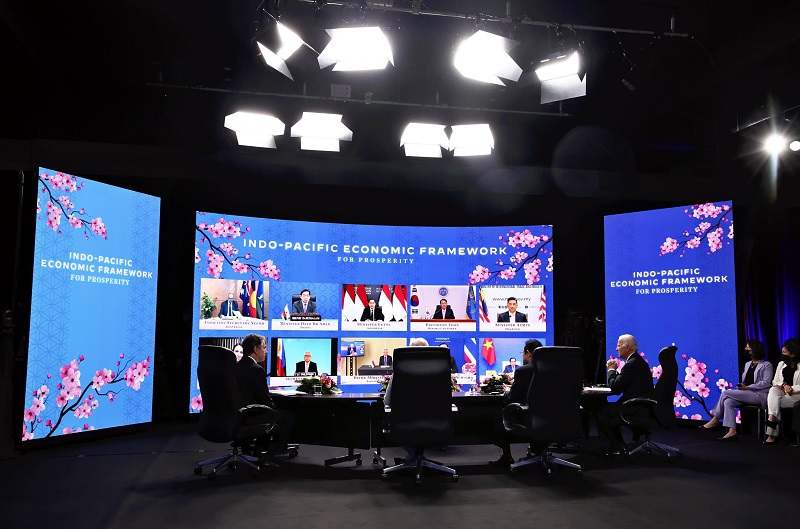
Prime Minister Fumio Kishida, second from right, and U.S. President Joe Biden, far right, face a video screen during the inaugural meeting of the Indo-Pacific Economic Framework in Minato Ward, Tokyo, on May 23.
17:47 JST, September 2, 2022
WASHINGTON — Los Angeles is to host on Sept. 8 and 9. the first in-person meeting of the Indo-Pacific Economic Framework (IPEF), a new U.S.-led trade pact comprising 14 nations including Japan, aimed at strengthening supply chains and promoting cooperation in economic security to counter China.
The main topics in a draft statement seen by The Yomiuri Shimbun ahead of the ministerial-level meeting included supply chains, clean economies, trade and fair economies.
Representatives from all 14 IPEF countries are expected to attend the talks.
According to the draft statement, IPEF members plan to work together to quickly restore supply chains in the event of disruptions caused by a pandemic or conflict. The number of supply sources will be increased and accumulated logistics data will be utilized in preparation for such eventualities.
The document on clean economies is expected to include matters related to energy security.
To help countries decarbonize, technology will be provided to IPEF members lagging behind in the use of hydrogen and ammonia, which do not emit carbon dioxide, easing the shift away from fossil fuel reliance.
On trade, practices such as paperless and electronic customs procedures are expected to be promoted.
Regarding fair economies, IPEF members are expected to confirm the importance of efforts to prevent double corporate taxation and eliminate corruption in order to increase investment in the participating countries. The pact aims to forge values such as compliance with rules by following the example of countries with fewer violations.
Next week’s talks will be the first in-person IPEF meeting and Economy, Trade and Industry Minister Yasutoshi Nishimura is expected to attend.
Partly due to concerns in the United States about the negative impact on industry and employment, the IPEF does not include the reduction or elimination of tariffs as items for negotiation.
Tough negotiations are ongoing among relevant ministers concerning the cross-border exchange of data, as there are still differences of opinion between Japan and the United States, and some of the participating countries.
Nishimura plans to meet with Indonesian ministers in the near future to discuss the issue.
The IPEF comprises 14 countries: Japan, the United States, South Korea, Australia, New Zealand, India, Indonesia, Thailand, Malaysia, Singapore, Vietnam, Brunei, the Philippines and Fiji.
The combined gross domestic product of the participating countries represents about 40% of world GDP.





Most Read
Popular articles in the past 24 hours
-
Business Hotels Expanding into Regional Areas in Japan, Aiming to...
-
Milano Cortina 2026: Japan Sees Leap in Olympic Performance Throu...
-
6 Injured at Naked Festival in Japan’s Okayama Prefecture; Police...
-

Fiji Defense Minister Hopes Japan Will Support Stabilization of P...
-

Milano Cortina 2026: Malinin Highlights Dangers of Social Media i...
-

Space One Delays Launch of No. 3 Kairos Rocket; Company to Announ...
-
3rd Japan Pacific Islands Defense Dialogue to Begin in Tokyo on S...
-

Reciprocal Tariffs Ruled Illegal: Judiciary Would Not Tolerate Pr...
Popular articles in the past week
-

Japan PM Takaichi’s Cabinet Resigns en Masse
-

Man Infected with Measles Reportedly Dined at Restaurant in Tokyo...
-

Sanae Takaichi Elected Prime Minister of Japan; Keeps All Cabinet...
-

Japan's Govt to Submit Road Map for Growth Strategy in March, PM ...
-

Bus Carrying 40 Passengers Catches Fire on Chuo Expressway; All E...
-

Milano Cortina 2026: Figure Skaters Riku Miura, Ryuichi Kihara Pa...
-

Japan, U.S. Name 3 Inaugural Investment Projects; Reached Agreeme...
-
U.S. Firm to Build Training Hub in Fukushima N-plant for Debris R...
Popular articles in the past month
-
Japan PM Takaichi’s Cabinet Resigns en Masse
-

Japan Institute to Use Domestic Commercial Optical Lattice Clock ...
-

Israeli Ambassador to Japan Speaks about Japan’s Role in the Reco...
-
Man Infected with Measles Reportedly Dined at Restaurant in Tokyo...
-

Videos Plagiarized, Reposted with False Subtitles Claiming ‘Ryuky...
-

Man Infected with Measles May Have Come in Contact with Many Peop...
-

Prudential Life Insurance Plans to Fully Compensate for Damages C...
-

Woman with Measles Visited Hospital in Tokyo Multiple Times Befor...
Top Articles in Politics
-
Japan PM Takaichi’s Cabinet Resigns en Masse
-
Sanae Takaichi Elected Prime Minister of Japan; Keeps All Cabinet Appointees from Previous Term
-
Japan’s Govt to Submit Road Map for Growth Strategy in March, PM Takaichi to Announce in Upcoming Policy Speech
-

LDP Wins Historic Landslide Victory
-

LDP Wins Landslide Victory, Secures Single-party Majority; Ruling Coalition with JIP Poised to Secure Over 300 seats (UPDATE 1)
JN ACCESS RANKING
-
Japan PM Takaichi’s Cabinet Resigns en Masse
-
Japan Institute to Use Domestic Commercial Optical Lattice Clock to Set Japan Standard Time
-
Israeli Ambassador to Japan Speaks about Japan’s Role in the Reconstruction of Gaza
-
Man Infected with Measles Reportedly Dined at Restaurant in Tokyo Station
-
Videos Plagiarized, Reposted with False Subtitles Claiming ‘Ryukyu Belongs to China’; Anti-China False Information Also Posted in Japan