
Japan’s Opposition Parties Largely Absent from Social Security-Related National Council Meeting
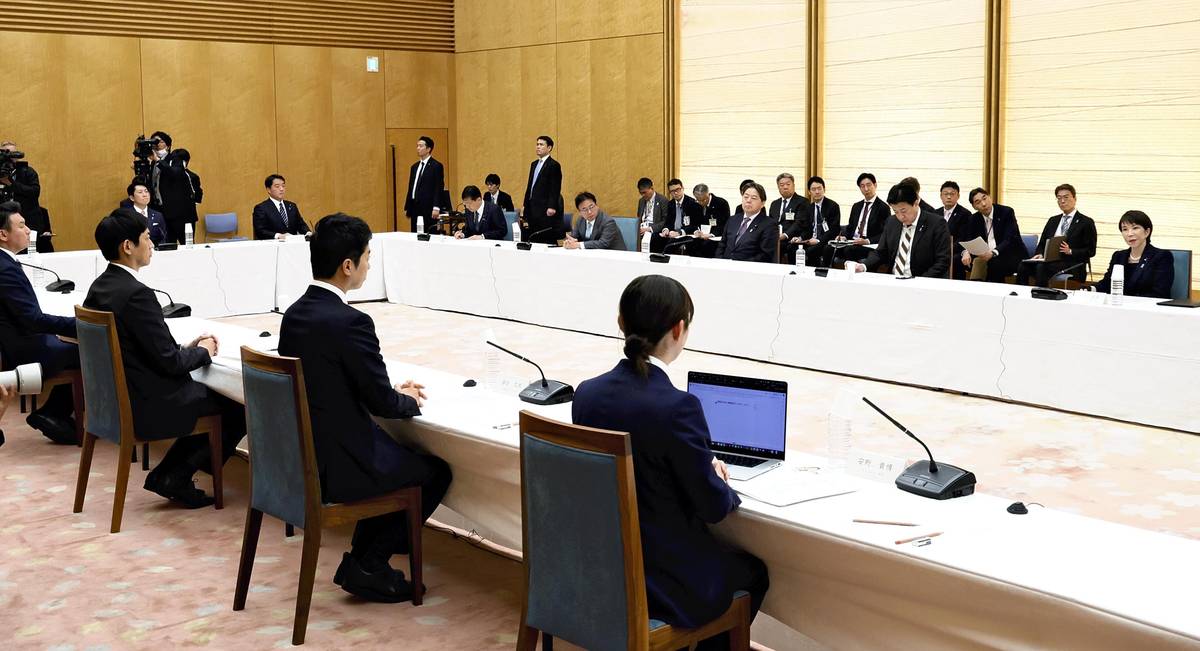
The inaugural meeting of the national council for social security at the Prime Minister’s Office on Thursday
2:00 JST, February 28, 2026
The national council for social security held its inaugural meeting Thursday, but with far fewer attendees than Prime Minister Sanae Takaichi had been hoping for.
Although the government had urged opposition parties to take part, Team Mirai was the only one to come to the table. The council meeting went ahead, despite the lack of buy-in from the opposition camp. Nevertheless, the council aims to compile an interim report before summer and will consider measures such as reducing the consumption tax rate for food items and a “refundable tax credit” system, but many challenges to implementing such policies lie ahead.
Team Mirai was the only party that did not advocate for cutting the consumption tax rate during the recent House of Representatives election. The party’s position was unchanged at the national council meeting. “We oppose lowering the tax rate on food items at the present time,” Team Mirai leader Takahiro Anno declared, keeping discussions on tax cuts in check.
“I’d like to submit the bills as soon as possible,” Takaichi said at the meeting at the Prime Minister’s Office. “Let’s have ruling and opposition parties working together, and hold discussions after assembling the wisdom of outside experts and working-level officials. Let’s take some bold steps.”
Takaichi indicated her strong desire to implement a refundable tax credit system and consumption tax cuts that she has positioned as an interim measure until such a system is put in place.
The prime minister was determined to go ahead with the meeting despite calls to the Centrist Reform Alliance and the Democratic Party for the People to participate receiving a negative response. “If we wait for them, we’ll never be able to do anything,” a close aide to Takaichi told The Yomiuri Shimbun.
The council aims to compile a report on the design of the refundable tax credit system by June, and the government is considering submitting related bills to an extraordinary Diet session to be convened this autumn. Takaichi’s tenure as Liberal Democratic Party president will expire in September 2027. “She’s quickly trying to chalk up achievements with an eye on being reelected,” a former cabinet minister said, sharing a view held within the LDP.
Team Mirai’s participation ensured that the council had the appearance, albeit barely, of being a cross-party body. However, the fact that only a single opposition party participated was probably an unexpected outcome.
The ruling parties do not have a majority in the House of Councillors. A senior LDP official said the national council was a “gambit to form a majority before the bills are submitted.” In a policy speech on Feb. 20, Takaichi called for “cooperation from all opposition parties.” She said this on the assumption that bills relating to cutting the consumption tax rate will be submitted and that progress would be made on coordinating the views of ruling and opposition parties at the national council.
However, adding the single upper house seat held by Team Mirai is not enough to give the ruling bloc a majority.
After the meeting, LDP Policy Research Council chairperson Takayuki Kobayashi indicated his intention to urge the DPFP and other opposition parties to attend future council meetings. “I’ll continue laying the groundwork for as many parties as possible to come to this venue for discussions,” Kobayashi said to reporters. However, it remains unclear if more parties will take up this offer.
The establishment of a national council to help construct a sustainable social security system, that covered such things as medical care and pensions, had been under consideration for some time. Former Prime Minister Shigeru Ishiba had proposed a plan to discuss these issues across party lines.
In a policy speech delivered in October, Takaichi also said, “If we are to overcome the decline in population alongside the shrinking birthrate and aging of society, we need to have a national discussion about what the benefits and burdens associated with the social security system will look like.”
Despite this, materials displayed at Thursday’s meeting indicated discussions would, for the time being, be limited to a consumption tax rate cut and refundable tax credits. After the interim report has been issued, discussions will continue on issues such as the challenges facing the social security system.
Discussing reforms in line with the increased burdens being shouldered by the public is an urgent issue at a time when the population is declining and aging. However, one government official said, “Momentum has faded for full-blooded talks on social security reforms, such as the balance of benefits and burdens.”







Most Read
Popular articles in the past 24 hours
-
Nidec Chairman Resigns Amid Accounting Scandal at Major Japanese ...
-

Record 167 Elementary School Students Harmed Via Social Media in ...
-

Trump’s Address: Confront the Dead End that Authoritarianism Has ...
-

Humbert Humbert: Husband-Wife Vocal Duo Brings Cheerful Singing t...
-

Japan’s Hikonyan Cat Mascot to Celebrate 20th Birthday with Party...
-

Japan's Kairos Rocket Set to Launch on Sunday After Delays
-

Pakistan, Afghan Forces Clash after Days of Hostilities
-

Mizuho to Cut Up to 5,000 Administrative Jobs with AI-Driven Oper...
Popular articles in the past week
-

Producer Behind Pop Group XG Arrested for Cocaine Possession
-

iPS Treatments Pass Key Milestone, but Broader Applications Far f...
-

Tokyo Skytree's Elevator Stops, Trapping 20 People; All Rescued (...
-

Nepal Bus Crash Kills 19 People, Injures 25 Including One Japanes...
-
Milano Cortina 2026: Japanese Gold Medalist Figure Skater Miura S...
-

Japan’s Major Real Estate Firms Expanding Overseas Businesses to ...
-

Reciprocal Tariffs Ruled Illegal: Judiciary Would Not Tolerate Pr...
-

Japanese High School Student Aims to Share Kaiten History Through...
Popular articles in the past month
-
Producer Behind Pop Group XG Arrested for Cocaine Possession
-

Japan PM Takaichi’s Cabinet Resigns en Masse
-

Japan Institute to Use Domestic Commercial Optical Lattice Clock ...
-

Man Infected with Measles Reportedly Dined at Restaurant in Tokyo...
-

Israeli Ambassador to Japan Speaks about Japan’s Role in the Reco...
-

Videos Plagiarized, Reposted with False Subtitles Claiming ‘Ryuky...
-

Man Infected with Measles May Have Come in Contact with Many Peop...
-

Prudential Life Insurance Plans to Fully Compensate for Damages C...
Top Articles in Politics
-
Japan PM Takaichi’s Cabinet Resigns en Masse
-

Sanae Takaichi Elected Prime Minister of Japan; Keeps All Cabinet Appointees from Previous Term
-

Japan’s Govt to Submit Road Map for Growth Strategy in March, PM Takaichi to Announce in Upcoming Policy Speech
-

LDP Wins Historic Landslide Victory
-

LDP Wins Landslide Victory, Secures Single-party Majority; Ruling Coalition with JIP Poised to Secure Over 300 seats (UPDATE 1)
JN ACCESS RANKING
-
Producer Behind Pop Group XG Arrested for Cocaine Possession
-
Japan PM Takaichi’s Cabinet Resigns en Masse
-
Man Infected with Measles Reportedly Dined at Restaurant in Tokyo Station
-
Israeli Ambassador to Japan Speaks about Japan’s Role in the Reconstruction of Gaza
-
Videos Plagiarized, Reposted with False Subtitles Claiming ‘Ryukyu Belongs to China’; Anti-China False Information Also Posted in Japan