
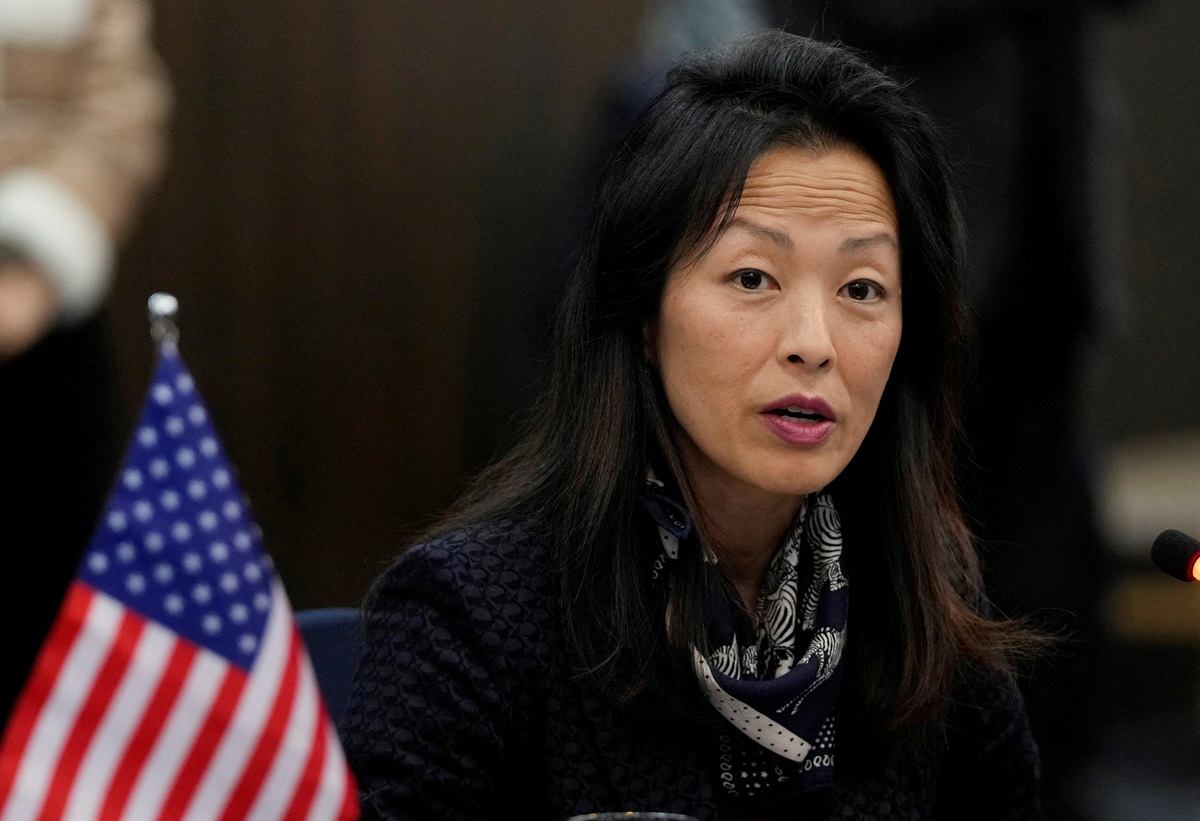
U.S. Deputy Special Representative Jung Pak speaks in Seoul on Thursday.
10:39 JST, May 10, 2024
WASHINGTON (Reuters) — The senior U.S. official for North Korea discussed the country with her Chinese counterpart in Tokyo on Thursday, and expressed concerns about the forcible repatriation of North Koreans from China, the U.S. State Department said.
The discussions between Jung Pak and China’s Special Representative on Korean Peninsula Affairs Liu Xiaoming followed a visit to Beijing last month by U.S. Secretary of State Antony Blinken, the department said in a statement
Pak noted North Korea’s “provocative and irresponsible rhetoric toward its neighbors,” and stressed concern about its deepening military cooperation with Russia. She said Russia’s veto of a mandate extension for a U.N. panel that monitored North Korea sanctions would hamper efforts to implement U.N. Security Council resolutions, the statement said.
She also expressed continued U.S. concerns regarding the forcible repatriation of North Koreans, including asylum seekers, to the DPRK and called on Beijing to uphold its non-refoulement obligations, the statement, said, referring to North Korea by the initials of its official name.
The U.N. principle of non-refoulement is supposed to guarantee that “no one should be returned to a country where they would face torture, cruel, inhuman or degrading treatment or punishment and other irreparable harm.”
A South Korea-based human rights group reported in December that up to 600 North Koreans had “vanished” after being forcibly deported by China and warned they may face imprisonment, torture, sexual violence and execution in North Korea.
That report by the Transitional Justice Working Group came about two months after South Korea lodged a protest with China over the suspected repatriation of a large number of North Koreans who were trying to flee to South Korea.
Beijing’s foreign ministry said in October there were no North Korean “defectors” in China but North Koreans had illegally entered for economic reasons and that China always handled the issue according to the law.
Pak last spoke to Liu in February following a previous Feb. 16 meeting between Blinken and Chinese Foreign Minister Wang Yi in which the U.S. side said the two “affirmed the importance of continued communication on (North Korea) issues at all levels.”
Sino-U.S. relations have shown signs of improvement in recent months with steps to re-establish communication channels after ties sank to their lowest levels in decades, but many points of friction remain, including China’s close relations with Russia.
In Tokyo, Pak also discussed North Korea with South Korean and Japanese counterparts and underscored the importance of maintaining close trilateral cooperation in addressing the threat it posed, a separate U.S. statement said.




Most Read
Popular articles in the past 24 hours
-

Business Hotels Expanding into Regional Areas in Japan, Aiming to...
-

6 Injured at Naked Festival in Japan’s Okayama Prefecture; Police...
-

Fiji Defense Minister Hopes Japan Will Support Stabilization of P...
-

Space One Delays Launch of No. 3 Kairos Rocket; Company to Announ...
-

Milano Cortina 2026: Malinin Highlights Dangers of Social Media i...
-

Reciprocal Tariffs Ruled Illegal: Judiciary Would Not Tolerate Pr...
-

Japanese Film, Anymart, Wins Critics’ Award at International Film...
-
3rd Japan Pacific Islands Defense Dialogue to Begin in Tokyo on S...
Popular articles in the past week
-

Japan PM Takaichi’s Cabinet Resigns en Masse
-

Man Infected with Measles Reportedly Dined at Restaurant in Tokyo...
-

Sanae Takaichi Elected Prime Minister of Japan; Keeps All Cabinet...
-
Japan's Govt to Submit Road Map for Growth Strategy in March, PM ...
-

Bus Carrying 40 Passengers Catches Fire on Chuo Expressway; All E...
-

Milano Cortina 2026: Figure Skaters Riku Miura, Ryuichi Kihara Pa...
-

Japan, U.S. Name 3 Inaugural Investment Projects; Reached Agreeme...
-

U.S. Firm to Build Training Hub in Fukushima N-plant for Debris R...
Popular articles in the past month
-
Japan PM Takaichi’s Cabinet Resigns en Masse
-

Japan Institute to Use Domestic Commercial Optical Lattice Clock ...
-

Israeli Ambassador to Japan Speaks about Japan’s Role in the Reco...
-
Man Infected with Measles Reportedly Dined at Restaurant in Tokyo...
-

Videos Plagiarized, Reposted with False Subtitles Claiming ‘Ryuky...
-

Man Infected with Measles May Have Come in Contact with Many Peop...
-

Prudential Life Insurance Plans to Fully Compensate for Damages C...
-

Woman with Measles Visited Hospital in Tokyo Multiple Times Befor...
Top Articles in Politics
-
Japan PM Takaichi’s Cabinet Resigns en Masse
-
Sanae Takaichi Elected Prime Minister of Japan; Keeps All Cabinet Appointees from Previous Term
-
Japan’s Govt to Submit Road Map for Growth Strategy in March, PM Takaichi to Announce in Upcoming Policy Speech
-

LDP Wins Historic Landslide Victory
-

LDP Wins Landslide Victory, Secures Single-party Majority; Ruling Coalition with JIP Poised to Secure Over 300 seats (UPDATE 1)
JN ACCESS RANKING
-
Japan PM Takaichi’s Cabinet Resigns en Masse
-
Japan Institute to Use Domestic Commercial Optical Lattice Clock to Set Japan Standard Time
-
Israeli Ambassador to Japan Speaks about Japan’s Role in the Reconstruction of Gaza
-
Man Infected with Measles Reportedly Dined at Restaurant in Tokyo Station
-
Videos Plagiarized, Reposted with False Subtitles Claiming ‘Ryukyu Belongs to China’; Anti-China False Information Also Posted in Japan