
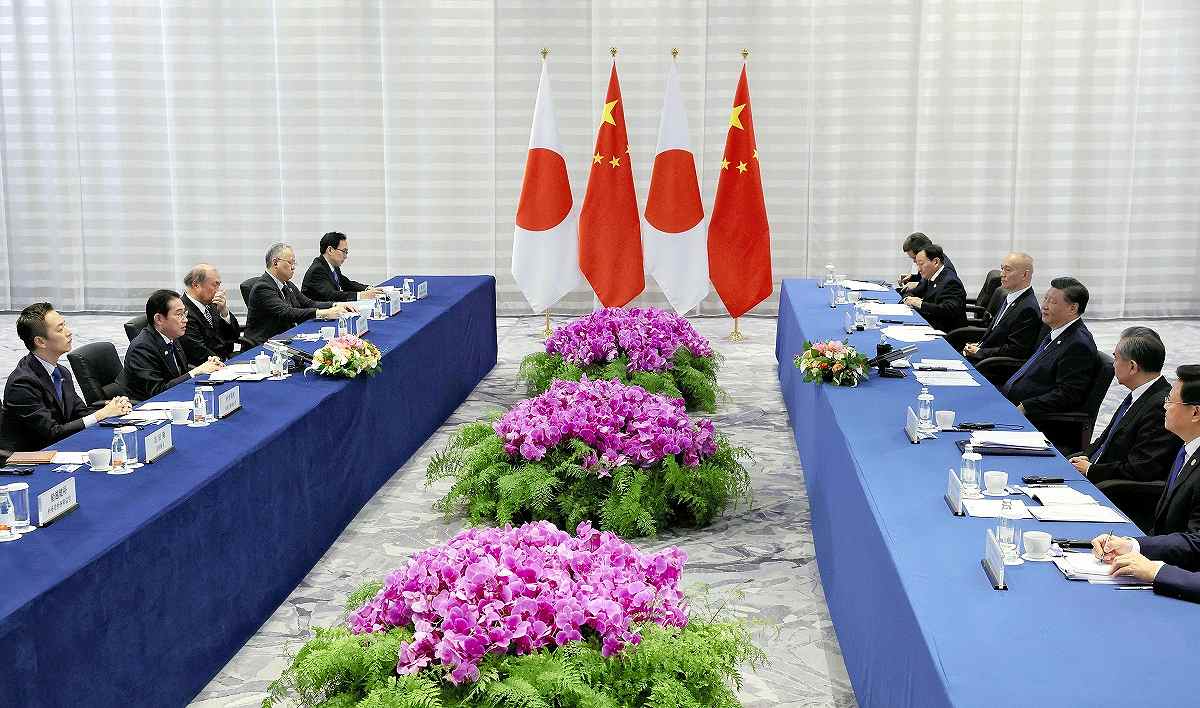
Prime Minister Fumio Kishida, second from left, and Chinese President Xi Jinping, third from right, meeting during a summit in San Francisco on Thursday.
16:55 JST, November 18, 2023
SAN FRANCISCO — Chinese President Xi Jinping called for deepening economic cooperation between Japan and China during talks with Prime Minister Fumio Kishida in San Francisco on Thursday.
China is promoting “a high-level opening-up, which will bring unprecedented opportunities to countries around the world including Japan,” Xi is quoted as telling Kishida.
Xi’s decision to meet with his Japanese counterpart amid a busy schedule of international meetings was apparently aimed at restoring economic exchanges with neighboring Japan — and hence attracting investment in China — against the backdrop of China’s increasingly slowing economy.
According to sources involved in the talks, the Chinese side suddenly approached the Japanese side about a summit immediately after Foreign Minister Wang Yi, a member of the Politburo of the Communist Party, visited the United States in late October.
China has failed to get its economy back on track even with the end of the pandemic. Direct investment by foreign companies during the July-September quarter recorded negative figures for the first time since comparable data became available in 1998.
Beijing reacted unilaterally and harshly over the release of treated water from the Fukushima No. 1 nuclear plant. With China wanting to save face and unwilling to quickly compromise, it led to stagnation in Japan-China economic exchanges.
The Chinese side thought that Xi’s arranging of a summit would send a signal within China itself that entities could proceed with exchanges with Japan. The fact that this year marks the 45th anniversary of the signing of the Japan-China Treaty of Peace and Friendship helped smooth the way to realize the talks.
“[Japan-China] bilateral relations have maintained a momentum of development through thick and thin, playing a positive role in regional peace, development and prosperity,” Xi said in flattering Japan.
There also was a political motive. In the Taiwan presidential election to be held in January, Beijing foresees a potential win by the Democratic Progressive Party (DPP) candidate, which it sees as pro-independence.
Sources knowledgeable in Japan-China relations say that China believes that “if relations with the United States and Japan are unstable, it will embolden pro-independence elements in Taiwan.” Therefore, Beijing needs to move to stabilize relations with Japan.
China is also seen as working to distance Japan from the United States as the latter becomes preoccupied with the Ukraine and the Middle East. By softening its stance toward Japan, China hopes Japan would not automatically side with the U.S. on matters pertaining to China.
Xi reportedly told Kishida that the trend of “decoupling” does not benefit anyone, and urged that Tokyo take a separate approach from the United States as the latter leads the restricting of exports to and investment in China in high-tech fields such as semiconductors.





Most Read
Popular articles in the past 24 hours
-
Nidec Chairman Resigns Amid Accounting Scandal at Major Japanese ...
-

Hokkaido's Shiretoko Peninsula Offers Unique Drift Ice Walking To...
-

Humbert Humbert: Husband-Wife Vocal Duo Brings Cheerful Singing t...
-

Trump’s Address: Confront the Dead End that Authoritarianism Has ...
-

Japan’s Hikonyan Cat Mascot to Celebrate 20th Birthday with Party...
-

6 of Japan's Remote Islands to Be Added to Govt List for Priority...
-

Pakistan, Afghan Forces Clash after Days of Hostilities
-
JR Kyushu Mulls Using Trains for Concertgoer Lodgings; Performanc...
Popular articles in the past week
-

Producer Behind Pop Group XG Arrested for Cocaine Possession
-

Nepal Bus Crash Kills 19 People, Injures 25 Including One Japanes...
-

Tokyo Skytree's Elevator Stops, Trapping 20 People; All Rescued (...
-
Milano Cortina 2026: Japanese Gold Medalist Figure Skater Miura S...
-

Japan’s Major Real Estate Firms Expanding Overseas Businesses to ...
-

Reciprocal Tariffs Ruled Illegal: Judiciary Would Not Tolerate Pr...
-
Japanese High School Student Aims to Share Kaiten History Through...
-

Milano Cortina 2026: Miura-Kihara Duo, Other Japanese Figure Skat...
Popular articles in the past month
-
Producer Behind Pop Group XG Arrested for Cocaine Possession
-

Japan PM Takaichi’s Cabinet Resigns en Masse
-

Man Infected with Measles Reportedly Dined at Restaurant in Tokyo...
-

Israeli Ambassador to Japan Speaks about Japan’s Role in the Reco...
-

Videos Plagiarized, Reposted with False Subtitles Claiming ‘Ryuky...
-

Man Infected with Measles May Have Come in Contact with Many Peop...
-

Prudential Life Insurance Plans to Fully Compensate for Damages C...
-

Woman with Measles Visited Hospital in Tokyo Multiple Times Befor...
Top Articles in World
-
Israeli Ambassador to Japan Speaks about Japan’s Role in the Reconstruction of Gaza
-
Videos Plagiarized, Reposted with False Subtitles Claiming ‘Ryukyu Belongs to China’; Anti-China False Information Also Posted in Japan
-
Chinese Embassy in Japan Reiterates Call for Chinese People to Refrain from Traveling to Japan; Call Comes in Wake of ¥400 Mil. Robbery
-
Nepal Bus Crash Kills 19 People, Injures 25 Including One Japanese National
-
Russia: Visa Required for Visiting Graves in Northern Territories, Lifting of Sanctions Also Necessary
JN ACCESS RANKING
-
Producer Behind Pop Group XG Arrested for Cocaine Possession
-
Japan PM Takaichi’s Cabinet Resigns en Masse
-
Man Infected with Measles Reportedly Dined at Restaurant in Tokyo Station
-
Israeli Ambassador to Japan Speaks about Japan’s Role in the Reconstruction of Gaza
-
Videos Plagiarized, Reposted with False Subtitles Claiming ‘Ryukyu Belongs to China’; Anti-China False Information Also Posted in Japan