
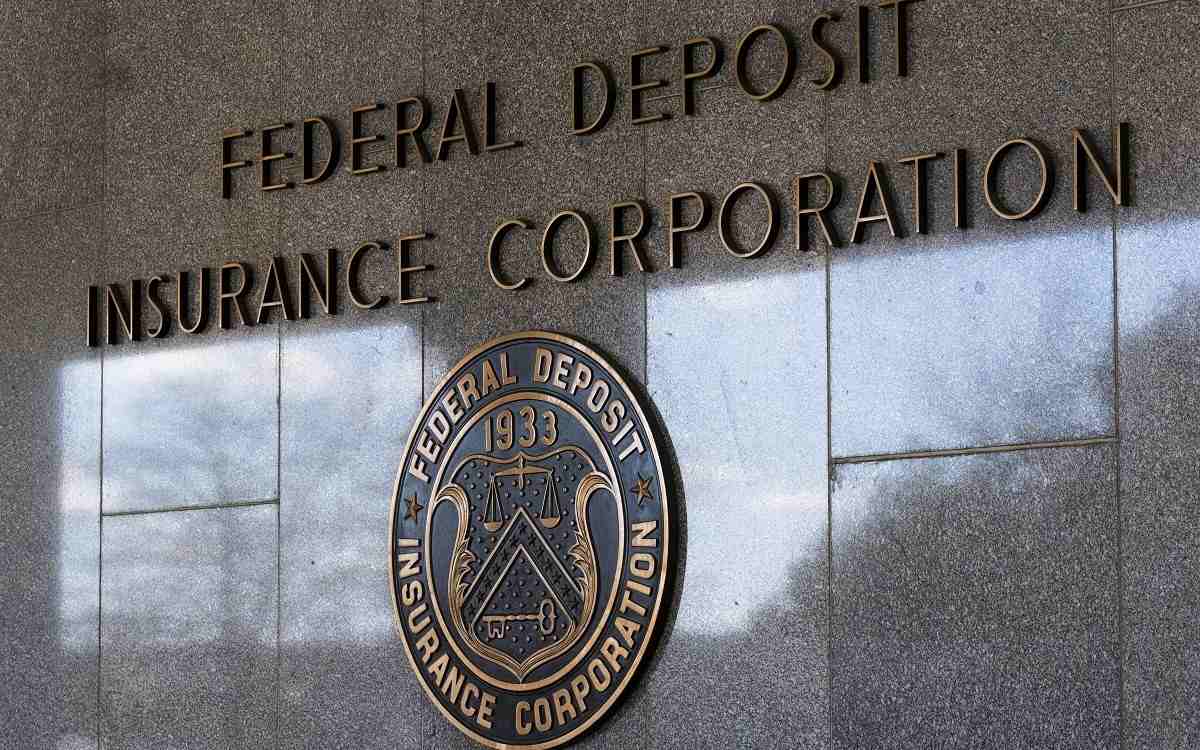
The Federal Deposit Insurance Corporation (FDIC) seal is shown outside its headquarters, March 14, 2023, in Washington.
11:01 JST, May 2, 2023
NEW YORK (AP) — U.S. businesses might be able to secure bank deposit insurance for accounts holding more than $250,000 if Congress agrees with the Federal Deposit Insurance Corp.’s new proposal to ease the industry turmoil that has sparked three bank failures in the past two months.
The FDIC recommended the change Monday, rethinking the decades-old limit and seeking more flexibility to cover higher deposits on a “targeted” basis. Raising the insurance limit for business accounts that pay for company operations such as payroll would shore up accounts that pose the most risk to financial stability, the FDIC said.
The proposed change appears to openly acknowledge that the FDIC is looking for ways to calm both depositors and markets as the agency contends with the third bank run this year. First Republic Bank became the second largest failure in history Monday when regulators seized it and JP Morgan Chase stepped up as a buyer.
“The recent failures of Silicon Valley Bank and Signature Bank, and the decision to approve Systemic Risk Exceptions to protect the uninsured depositors at those institutions, raised fundamental questions about the role of deposit insurance in the United States banking system,” FDIC Chairman Martin J. Gruenberg said in a statement accompanying the regulator’s recommendations.
The FDIC is a government agency formed during the Great Depression to restore faith in U.S. banking institutions.
As of December, more than 99% of U.S. deposit accounts held less than $250,000, and so were automatically covered by existing FDIC insurance, Gruenberg said.
However, the system remains subject to the sort of bank runs that brought down First Republic, despite a consortium of big lenders having pooled $30 billion in cash to stabilize the bank as recently as March.
Last Monday, First Republic reported its first-quarter results, shocking investors when it revealed that depositors had withdrawn $100 billion, most in mid-March immediately after Silicon Valley Bank and Signature Bank failed. First Republic’s stock plunged more than 50% the day after the report.
U.S. Rep. Patrick McHenry, who leads the House Financial Services Committee, issued a statement Monday noting that the FDIC “used its available tools to resolve First Republic Bank” but the congressman didn’t immediately address the agency’s recommendations for change.
In seeking additional powers to insure business accounts, the FDIC said technological advances both hasten the speed of information and let depositors quickly take their money elsewhere at the first sign of trouble. Both factors can spur “faster, and more costly, bank runs,” the agency said.
But insuring more deposits doesn’t come without a downside. Deposit insurance can encourage banks to take on greater risk if they know their deposits are covered. Targeted coverage to protect businesses would be the most cost effective way for regulators to meet their stability objectives, Gruenberg said.









Most Read
Popular articles in the past 24 hours
-

Tokyo Spends Big on Children, Wins Over Parents
-

Japan’s Miura, Kihara Announce Withdrawal from Figure Skating Wor...
-

Japan's Opposition Parties Largely Absent from Social Security-Re...
-

Hokkaido's Shiretoko Peninsula Offers Unique Drift Ice Walking To...
-

6 of Japan's Remote Islands to Be Added to Govt List for Priority...
-

Showa-era Towers in Kansai’s Big Cities Become Social Media Sensa...
-

Emperor to Attend World Baseball Classic Match When Japan Takes o...
-

Tourists Ignore Safety Barriers Near Famous Zao ‘Snow Monsters’ i...
Popular articles in the past week
-

Producer Behind Pop Group XG Arrested for Cocaine Possession
-

Nepal Bus Crash Kills 19 People, Injures 25 Including One Japanes...
-

Tokyo Skytree's Elevator Stops, Trapping 20 People; All Rescued (...
-

Milano Cortina 2026: Japanese Gold Medalist Figure Skater Miura S...
-

Japan’s Major Real Estate Firms Expanding Overseas Businesses to ...
-

Reciprocal Tariffs Ruled Illegal: Judiciary Would Not Tolerate Pr...
-

Japanese High School Student Aims to Share Kaiten History Through...
-

Milano Cortina 2026: Miura-Kihara Duo, Other Japanese Figure Skat...
Popular articles in the past month
-
Producer Behind Pop Group XG Arrested for Cocaine Possession
-

Japan PM Takaichi’s Cabinet Resigns en Masse
-

Man Infected with Measles Reportedly Dined at Restaurant in Tokyo...
-

Israeli Ambassador to Japan Speaks about Japan’s Role in the Reco...
-

Videos Plagiarized, Reposted with False Subtitles Claiming ‘Ryuky...
-

Man Infected with Measles May Have Come in Contact with Many Peop...
-

Prudential Life Insurance Plans to Fully Compensate for Damages C...
-

Woman with Measles Visited Hospital in Tokyo Multiple Times Befor...
Top Articles in News Services
-
Survey Shows False Election Info Perceived as True
-

Hong Kong Ex-Publisher Jimmy Lai’s Sentence Raises International Outcry as China Defends It
-

Japan’s Nikkei Stock Average Touches 58,000 as Yen, Jgbs Rally on Election Fallout (UPDATE 1)
-
Japan’s Nikkei Stock Average Falls as US-Iran Tensions Unsettle Investors (UPDATE 1)
-
Japan’s Nikkei Stock Average Rises on Tech Rally and Takaichi’s Spending Hopes (UPDATE 1)
JN ACCESS RANKING
-
Producer Behind Pop Group XG Arrested for Cocaine Possession
-
Japan PM Takaichi’s Cabinet Resigns en Masse
-
Man Infected with Measles Reportedly Dined at Restaurant in Tokyo Station
-
Israeli Ambassador to Japan Speaks about Japan’s Role in the Reconstruction of Gaza
-
Videos Plagiarized, Reposted with False Subtitles Claiming ‘Ryukyu Belongs to China’; Anti-China False Information Also Posted in Japan