
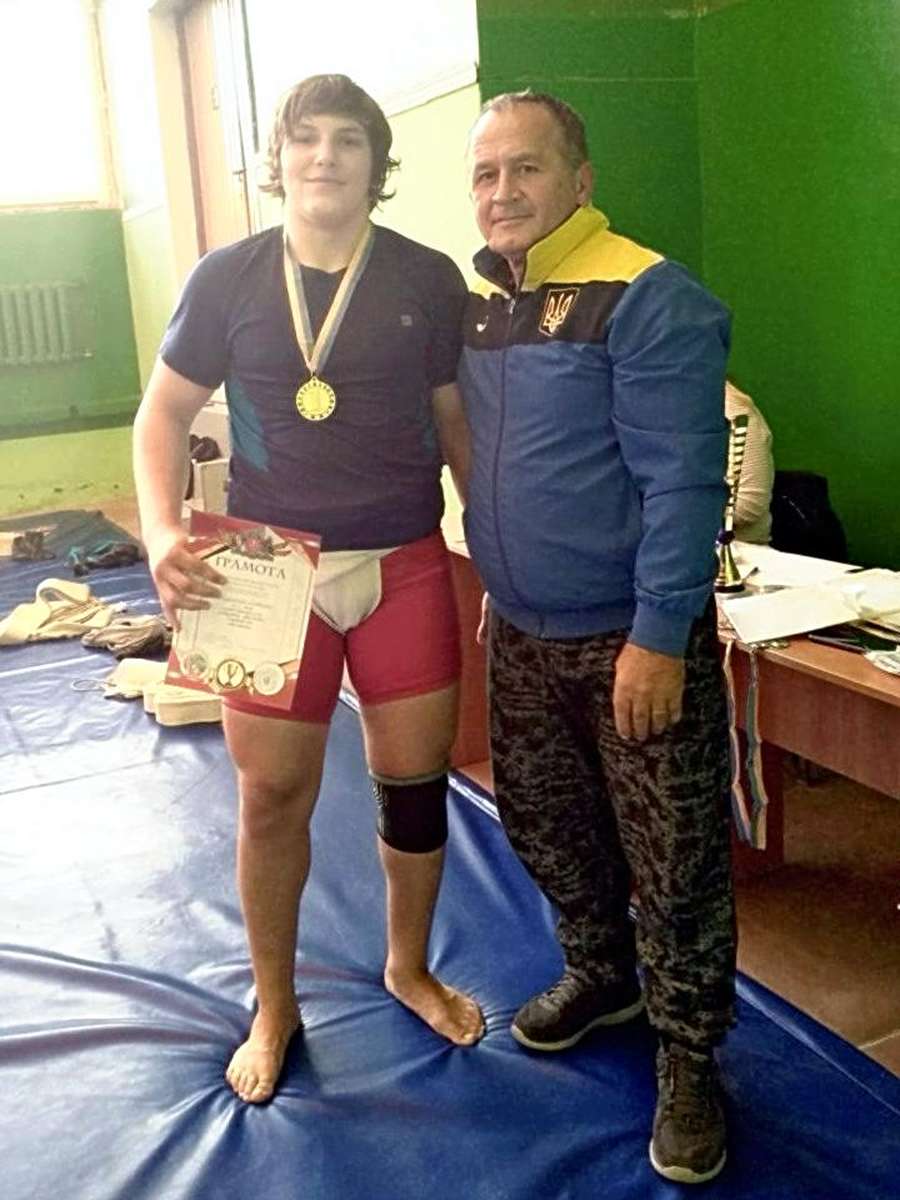
Aonishiki, left, is seen in Ukraine in 2019, with his mentor Vazha Daiauri.
2:00 JST, December 1, 2025
ROME — After Ukrainian sumo wrestler Aonishiki clinched his first championship at the Kyushu Grand Sumo Tournament, his friends in his homeland, still ravaged by war, erupted with joy over his remarkable achievement.
With his win of the tournament, the 21-year-old wrestler, whose real name is Danylo Yavhusishyn, secured his promotion to ozeki, the second highest rank.
“He’s given courage to the Ukrainian people,” said Vazha Daiauri, Aonishiki’s mentor in Ukraine, who guided him toward the sumo path. “I want to express my gratitude to Japan for nurturing him.”
“Today, both the news and social media are completely dominated by sumo talk,” Daiauri, 64, told The Yomiuri Shimbun over the phone on Monday, the day after Aonishiki won.
Daiauri trained Yavhusishyn for 10 years starting at the age of 7 in Vinnytsia, central Ukraine. The teenager fled to Japan in the spring of 2022, shortly after Russia’s aggression against Ukraine began.
“I never imagined he’d achieve results this quickly,” Daiauri said.
Yavhusishyn began wrestling around the age of 6 at a local sports club. Daiauri, a wrestling coach, encouraged him to try sumo.
“Sumo is simple yet spectacular to watch, and the matches are decided quickly,” he told the boy, who started sumo the following year.
Daiauri said the young Aonishiki was “just an ordinary kid” until the age of 15 and even skipped practice sometimes. But he became very serious about sumo when he was 16. He constantly asked Daiauri questions like “How can I get better?” and steadily improved his skills.
When the Russia’s aggression against Ukraine began, Yavhusishyn, then 17, temporarily evacuated to Germany with his mother. However, it did not have a good environment to train for sumo.
The young Aonishiki wanted to fight great wrestlers. He decided to go to Japan by asking help from Arata Yamanaka, a Japanese university student whom he met at an international sumo tournament. Yavhusishyn’s shikona ring name, Aonishiki Arata, partly comes from his friend’s name.
Daiauri said when Yavhusishyn told him about him going to Japan, he told his student, “Never neglect your training.”
Months later, a public facility in central Vinnytsia was bombed by Russian forces, shattering the windows of the dojo adjacent to it. Since then, the area has experienced frequent power outages and is repeatedly hit by air strikes.
Yet about 80 children continue to practice sumo, using flashlights to light their space, aspiring to become the next Aonishiki.
Daiauri said that Aonishiki, through his victories, “has drawn attention to Ukraine, which is at war, and to the fascinating sport of sumo.”
“His achievements also demonstrate a victory for Japan, which continues to support Ukraine through deep friendship,” Daiauri added.







Most Read
Popular articles in the past 24 hours
-
JR Tokai Breaks Ground on Yamanashi Maglev Station; Will Be Part ...
-
‘King Kazu’ Discusses His Connection to Fukushima
-

Japan’s Gunma Official Suspended For Unauthorized Absence From Wo...
-

Milano Cortina 2026: Japan’s Alpine Skier Muraoka Extends P...
-
Rising Kabuki Star Works to Ensure Deaf Audience's Enjoyment of P...
-

Lady Bess: Iroha Okuda, Mayuko Kominami Discuss Performing Elizab...
-

Trump Discourages Iranian Soccer Team from Attending the World Cu...
-
Driver Dies in Collision with Express Train at Crossing in Mito; ...
Popular articles in the past week
-
Japan Figure Skating Legend Yuzuru Hanyu Is Proud Disaster Surviv...
-

Nippon Life Insurance's U.S. Arm Sues OpenAI Over Legal Assistanc...
-
Govt to Utilize ODA for Ensuring Economic Security; Securing Ener...
-
Massive Sewer Pipe Found Jutting Out of Highway in Osaka
-
15 Measles Patients Confirmed in Tokyo in Past 6 Days; 1 May Have...
-
Beckoning Cats Get Makeover to Fit Modern Lifestyles with Sleek D...
-

Japan Govt to Tighten Requirements to Receive Permanent Residency...
-
Japan Govt Survey Finds Just 10% of Workers Want Working Hours to...
Popular articles in the past month
-

Producer Behind Pop Group XG Arrested for Cocaine Possession
-

Japan PM Takaichi’s Cabinet Resigns en Masse
-

Man Infected with Measles Reportedly Dined at Restaurant in Tokyo...
-

Videos Plagiarized, Reposted with False Subtitles Claiming ‘Ryuky...
-
Japan Figure Skating Legend Yuzuru Hanyu Is Proud Disaster Surviv...
-

iPS Treatments Pass Key Milestone, but Broader Applications Far f...
-

Sanae Takaichi Elected Prime Minister of Japan; Keeps All Cabinet...
-

Nepal Bus Crash Kills 19 People, Injures 25 Including One Japanes...
Top Articles in Sports
-
Japan Figure Skating Legend Yuzuru Hanyu Is Proud Disaster Survivor and Gold Medalist, Vows to Continue Support Efforts
-

Milano Cortina 2026: Figure Skaters Riku Miura, Ryuichi Kihara Pair Win Gold; Dramatic Comeback from 5th Place in SP
-
Milano Cortina 2026: Japanese Gold Medalist Figure Skater Miura Says When Kihara Retires ‘I Retire Too’
-
Milano Cortina 2026: Riku Miura, Ryuichi Kihara Clinch Japan’s 1st Gold in Pairs Figure Skating, Rebounding from Disappointing Short Program
-
Milano Cortina 2026: Japan’s Mari Fukada Wins Gold in Women’s Snowboard Slopestyle; Japan’s Kokomo Murase in Bronze
JN ACCESS RANKING
-
Producer Behind Pop Group XG Arrested for Cocaine Possession
-
Japan PM Takaichi’s Cabinet Resigns en Masse
-
Man Infected with Measles Reportedly Dined at Restaurant in Tokyo Station
-
Videos Plagiarized, Reposted with False Subtitles Claiming ‘Ryukyu Belongs to China’; Anti-China False Information Also Posted in Japan
-
Japan Figure Skating Legend Yuzuru Hanyu Is Proud Disaster Survivor and Gold Medalist, Vows to Continue Support Efforts