
12:51 JST, May 28, 2023
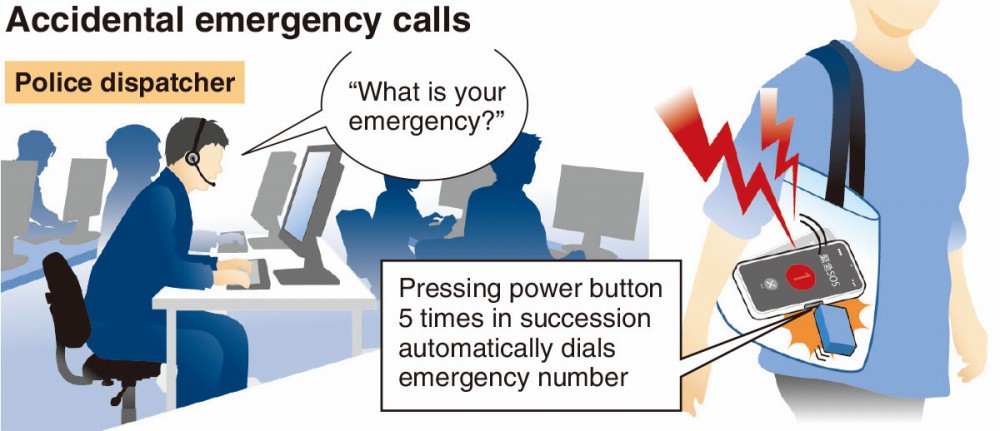
An SOS function in Google’s Android smartphone operating system has been blamed for a surge in accidental emergency service calls that have disrupted police operations.
When Okayama prefectural police received an emergency call in March, the handler repeatedly asked for the purpose of the call but heard no response, only rustling sounds.
The police called the number back more than 10 times, but no one answered. They also checked the smartphone’s location data to determine the caller’s location.
Police officers established the call had been made from a home in Okayama City, and when they rushed to the location they found an elderly woman who said she might have accidentally triggered the phone function without her knowledge.
An hour had elapsed from the time of the initial call to the confirmation of the woman’s safety.
“Even if there’s a possibility it’s a mistake, we do everything we can until we’ve confirmed the caller’s safety,” a police officer said. “However, if as a result of such checks, we’re late responding to a real emergency, that is a problem.”
Last year, the National Police Agency received 9.37 million emergency calls, of which 1,587,066 were either made by mistake or there was silence at the end of the line. In the previous year, such calls totaled 973,944.
One factor thought to be behind the surge in accidental emergency calls is the launch of an SOS feature on Android devices in October 2021.
On smartphones running Android 12 or newer versions, pressing the power button five or more times in succession automatically dials an emergency contact number.
In Japan, the default is set to “110,” the police emergency number.
Confusing the power button for the volume button while handling a smartphone in a bag, for example, could inadvertently trigger an SOS call on devices with the function enabled.
In many of the accidental cases linked to Android devices, callers were unaware of the function.
More than 90% of the about 300 accidental emergency calls received by the Nagano prefectural police were linked to smartphones running Android, according to data compiled by the police force.
The function is often on by default, but it can be turned off manually.
According to a 2022 survey by the Tokyo-based Mobile Marketing Data Labo, 51% of smartphone users in Japan use Android devices.
Last November, the NPA asked mobile carriers to inform users about the SOS function and urge them to turn it off if they do not need it. Carriers have notified users on their websites, but awareness of the function does not appear to be widespread.
Some smartphone manufacturers have started shipping devices with the SOS function turned off, but as it is considered to be an effective tool in an emergency, a unified approach is yet to be adopted.
“Calling for help in front of a victimizer is a terrifying prospect,” said Mieko Miyata, a representative of a child safety nonprofit organization. “The function is useful for adult and child victims of sexual assault.”








Most Read
Popular articles in the past 24 hours
-

University of Tsukuba Hospital to Introduce Working Dog Next Year...
-
Record 167 Elementary School Students Harmed Via Social Media in ...
-

Nidec Chairman Resigns Amid Accounting Scandal at Major Japanese ...
-

Japan’s Hikonyan Cat Mascot to Celebrate 20th Birthday with Party...
-

Humbert Humbert: Husband-Wife Vocal Duo Brings Cheerful Singing t...
-

Japan's Kairos Rocket Set to Launch on Sunday After Delays
-

Mizuho to Cut Up to 5,000 Administrative Jobs with AI-Driven Oper...
-

Trump’s Address: Confront the Dead End that Authoritarianism Has ...
Popular articles in the past week
-

Producer Behind Pop Group XG Arrested for Cocaine Possession
-

iPS Treatments Pass Key Milestone, but Broader Applications Far f...
-

Tokyo Skytree's Elevator Stops, Trapping 20 People; All Rescued (...
-

Nepal Bus Crash Kills 19 People, Injures 25 Including One Japanes...
-

Milano Cortina 2026: Japanese Gold Medalist Figure Skater Miura S...
-

Japan’s Major Real Estate Firms Expanding Overseas Businesses to ...
-

Milano Cortina 2026: Japanese Figure Skater Kaori Sakamoto’...
-

Reciprocal Tariffs Ruled Illegal: Judiciary Would Not Tolerate Pr...
Popular articles in the past month
-
Producer Behind Pop Group XG Arrested for Cocaine Possession
-

Japan PM Takaichi’s Cabinet Resigns en Masse
-

Japan Institute to Use Domestic Commercial Optical Lattice Clock ...
-

Man Infected with Measles Reportedly Dined at Restaurant in Tokyo...
-

Israeli Ambassador to Japan Speaks about Japan’s Role in the Reco...
-

Videos Plagiarized, Reposted with False Subtitles Claiming ‘Ryuky...
-

Man Infected with Measles May Have Come in Contact with Many Peop...
-

Prudential Life Insurance Plans to Fully Compensate for Damages C...
Top Articles in Society
-
Producer Behind Pop Group XG Arrested for Cocaine Possession
-
Man Infected with Measles Reportedly Dined at Restaurant in Tokyo Station
-
Man Infected with Measles May Have Come in Contact with Many People in Tokyo, Went to Store, Restaurant Around When Symptoms Emerged
-

Woman with Measles Visited Hospital in Tokyo Multiple Times Before Being Diagnosed with Disease
-

Australian Woman Dies After Mishap on Ski Lift in Nagano Prefecture
JN ACCESS RANKING
-
Producer Behind Pop Group XG Arrested for Cocaine Possession
-
Japan PM Takaichi’s Cabinet Resigns en Masse
-
Man Infected with Measles Reportedly Dined at Restaurant in Tokyo Station
-
Israeli Ambassador to Japan Speaks about Japan’s Role in the Reconstruction of Gaza
-
Videos Plagiarized, Reposted with False Subtitles Claiming ‘Ryukyu Belongs to China’; Anti-China False Information Also Posted in Japan