
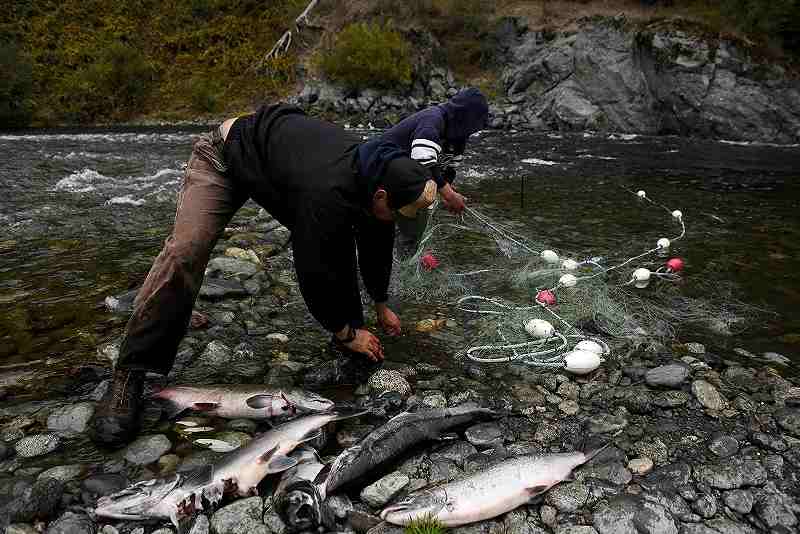
Ernie Marshal, right, and his nephew Joseph Marshal fish for salmon with a net on the Trinity River on the Hoopa Valley Reservation in Hoopa, California, in October , 2021.
14:25 JST, December 9, 2022
A U.S. agency seeking to restore habitat for endangered fish gave final approval on Nov. 17 to decommission four dams straddling the California-Oregon border, the largest dam removal undertaking in U.S. history.
Dam removal is expected to improve the health of the Klamath River, the route that Chinook salmon and endangered coho salmon take from the Pacific Ocean to their upstream spawning grounds, and from where the young fish return to the sea.
The U.S. Federal Energy Regulatory Commission issued an order surrendering the dam licenses and approving removal of the dams.
The project has long been a goal of several native tribes whose ancestors have lived off the salmon for centuries but whose way of life was disrupted by European settlement and the demand for rural electrification in the 20th Century.
“The Klamath salmon are coming home,” Joseph James, chairman of the Yurok Tribe, said in a statement. “The people have earned this victory and with it, we carry on our sacred duty to the fish that have sustained our people since the beginning of time.”
Climate change and drought have also stressed the salmon habitat; the river has become too warm and too full of parasites for many fish to survive.
The dams on federal land, which at full capacity provide enough electricity for 70,000 homes, will be surrendered by power utility PacifiCorp, a unit of Warren Buffett’s Berkshire Hathaway.
Faced with costly new regulations that included building fish screens and ladders, the company instead entered an agreement with the tribes and the U.S. government to decommission the dams.
PacifiCorp is contributing $200 million toward dam removal, paid for by a surcharge on its customers in Oregon and California, said Bob Gravely, a company spokesperson, and California voters approved a bond measure for the state to provide an additional $250 million.




Most Read
Popular articles in the past 24 hours
-

Japan Govt Aims for 10-Fold Increase in Computing Power of Superc...
-

Reopened Fukushima Municipalities Lure New Residents with Educati...
-
Kesennuma, Miyagi Pref., Locals Raise Carp Streamers as Symbol of...
-

Iran Situation: Significance of Rule of Law Must Be Conveyed
-

Trump Says Iran Had a New Site for Developing Nuclear Weapons
-
2 People Reportedly Found on Mt. Fuji; Hiking Trail Currently Clo...
-
Japan's TEPCO to Raise Electricity Rates for Corporations in Apri...
-

Toyota Advancing Plant-Based Biofuel Development in Fukushima Tow...
Popular articles in the past week
-

Ibaraki Pref.'s 1st Foreign Bus Driver Hired in Tsukuba
-

Amid Strait of Hormuz Blockade, Shipping Companies Scramble to Ge...
-
Govt to Utilize ODA for Ensuring Economic Security; Securing Ener...
-
Japan Govt Survey Finds Just 10% of Workers Want Working Hours to...
-

Japan's 2nd Round of U.S. Investments May Be Worth Over $100 Bill...
-

Imperial Family Watches World Baseball Classic Game Against Austr...
-

Donald Keene’s Drinking Buddy and Translator Yukio Kakuchi Pays T...
-

Nippon Life Insurance's U.S. Arm Sues OpenAI Over Legal Assistanc...
Popular articles in the past month
-

Producer Behind Pop Group XG Arrested for Cocaine Possession
-

Japan PM Takaichi’s Cabinet Resigns en Masse
-

Man Infected with Measles Reportedly Dined at Restaurant in Tokyo...
-

Videos Plagiarized, Reposted with False Subtitles Claiming ‘Ryuky...
-

iPS Treatments Pass Key Milestone, but Broader Applications Far f...
-

Sanae Takaichi Elected Prime Minister of Japan; Keeps All Cabinet...
-

Nepal Bus Crash Kills 19 People, Injures 25 Including One Japanes...
-

Japan's Govt to Submit Road Map for Growth Strategy in March, PM ...
Top Articles in Science & Nature
-
iPS Treatments Pass Key Milestone, but Broader Applications Far from Guaranteed
-

Record 700 Startups to Gather at SusHi Tech Tokyo in April; Event Will Center on Themes Like Artificial Intelligence and Robotics
-
iPS Cell Products for Parkinson’s, Heart Disease OK’d for Commercialization by Japan Health Ministry Panel
-

Japan to Ban Use of Power Banks on Airplanes
-
Mt. Meakan in Japan’s Hokkaido Erupts, Plume Reaches 100 Meters
JN ACCESS RANKING
-
Producer Behind Pop Group XG Arrested for Cocaine Possession
-
Japan PM Takaichi’s Cabinet Resigns en Masse
-
Man Infected with Measles Reportedly Dined at Restaurant in Tokyo Station
-
Videos Plagiarized, Reposted with False Subtitles Claiming ‘Ryukyu Belongs to China’; Anti-China False Information Also Posted in Japan
-
iPS Treatments Pass Key Milestone, but Broader Applications Far from Guaranteed