

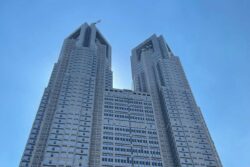
The Prime Minister’s Office in Tokyo
20:03 JST, June 25, 2025
In the wake of Iran’s implied threat to blockade the Strait of Hormuz, attention has turned to the circumstances that would be necessary for deploying the Self-Defense Forces — specifically, an official decision by Japan’s government that the nation’s peace and security are under threat.
The strait is a critical artery for Japan through which 80% of the country’s crude oil imports pass. Should it be blockaded by actions such as mine-laying, the United States could request Japan’s cooperation in mine-sweeping operations.
However, stringent conditions must be met before Japan can determine that its peace and security are in danger. The decision demands a high level of political judgment.
“We will monitor [developments in the Strait of Hormuz] with the utmost vigilance, as they will have a serious impact on the stable supply of energy,” Prime Minister Shigeru Ishiba said at a press conference on Monday.
Addressing the issue of whether Japan’s peace and security would be considered under threat should a blockade occur, Ishiba indicated the need for careful judgment. “Whether it would be considered [equivalent to] an attack on our country is a critical issue,” he said.
Under the security-related laws enacted in 2015, the right to collective self-defense can be exercised in situations that significantly impact Japan’s peace and security. This enables the SDF to be mobilized for defense purposes and for it to use force.
International law views the removal of mines during wartime as an act of force against the country that planted them. Therefore, the government would have to officially decide that the situation constituted a threat to Japan for Maritime Self-Defense Force minesweeping units to be dispatched.
The government would have to determine that “Japan’s survival is threatened and that there is a clear danger to the people’s fundamental right to life, liberty and the pursuit of happiness.” After that, Diet approval would have to be obtained.
During deliberations on the security-related laws, the government said it would comprehensively consider “serious impacts affecting the lives and deaths of the people, such as the disruption of lifelines, beyond just economic effects.”
Japan has an eight-month supply of oil reserves, so it cannot be definitively said that an immediate, critical impact would result from a blockade. Officially determining that Japan’s peace and security is under threat requires a high degree of political judgment.
Though Diet approval can be obtained retroactively in emergencies, then Prime Minister Shinzo Abe clarified during deliberations on the security-related laws that prior approval would be required for the Strait of Hormuz, which is geographically distant.
Diet approval could be challenging under a minority government. Additionally, the MSDF is now fully deploying its vessels, including mine sweepers, in the East China Sea for vigilance and surveillance purposes, creating operational hurdles.



Most Read
Popular articles in the past 24 hours
-
Tokyo Skytree's Elevator Stops, Trapping 20 People; All Rescued (...
-

Japan’s Major Real Estate Firms Expanding Overseas Businesses to ...
-

Ukrainian Ambassador Closely Watching Japan’s Revision of Defense...
-
Emperor Turns 66 Ahead of Disaster Milestones
-

Milano Cortina 2026: Sakamoto Serves as Flag Bearer; Japan Earns ...
-

Milano Cortina 2026: There Were Cheers across the Country, after ...
-

Luna Sea Drummer Shinya Dies at 56; Powerful Drummer Behind ‘Desi...
-

Milano Cortina 2026: Riku-Ryu Duo Stick Together During Closing C...
Popular articles in the past week
-

Japan PM Takaichi’s Cabinet Resigns en Masse
-

Man Infected with Measles Reportedly Dined at Restaurant in Tokyo...
-

Sanae Takaichi Elected Prime Minister of Japan; Keeps All Cabinet...
-
Japan's Govt to Submit Road Map for Growth Strategy in March, PM ...
-
Bus Carrying 40 Passengers Catches Fire on Chuo Expressway; All E...
-

Milano Cortina 2026: Figure Skaters Riku Miura, Ryuichi Kihara Pa...
-
Japan, U.S. Name 3 Inaugural Investment Projects; Reached Agreeme...
-
U.S. Firm to Build Training Hub in Fukushima N-plant for Debris R...
Popular articles in the past month
-
Japan PM Takaichi’s Cabinet Resigns en Masse
-

Japan Institute to Use Domestic Commercial Optical Lattice Clock ...
-

Israeli Ambassador to Japan Speaks about Japan’s Role in the Reco...
-
Man Infected with Measles Reportedly Dined at Restaurant in Tokyo...
-

Videos Plagiarized, Reposted with False Subtitles Claiming ‘Ryuky...
-

Man Infected with Measles May Have Come in Contact with Many Peop...
-

Prudential Life Insurance Plans to Fully Compensate for Damages C...
-
Woman with Measles Visited Hospital in Tokyo Multiple Times Befor...
Top Articles in Politics
-
Japan PM Takaichi’s Cabinet Resigns en Masse
-
Sanae Takaichi Elected Prime Minister of Japan; Keeps All Cabinet Appointees from Previous Term
-
Japan’s Govt to Submit Road Map for Growth Strategy in March, PM Takaichi to Announce in Upcoming Policy Speech
-

LDP Wins Historic Landslide Victory
-

LDP Wins Landslide Victory, Secures Single-party Majority; Ruling Coalition with JIP Poised to Secure Over 300 seats (UPDATE 1)
JN ACCESS RANKING
-
Japan PM Takaichi’s Cabinet Resigns en Masse
-
Japan Institute to Use Domestic Commercial Optical Lattice Clock to Set Japan Standard Time
-
Israeli Ambassador to Japan Speaks about Japan’s Role in the Reconstruction of Gaza
-
Man Infected with Measles Reportedly Dined at Restaurant in Tokyo Station
-
Videos Plagiarized, Reposted with False Subtitles Claiming ‘Ryukyu Belongs to China’; Anti-China False Information Also Posted in Japan