
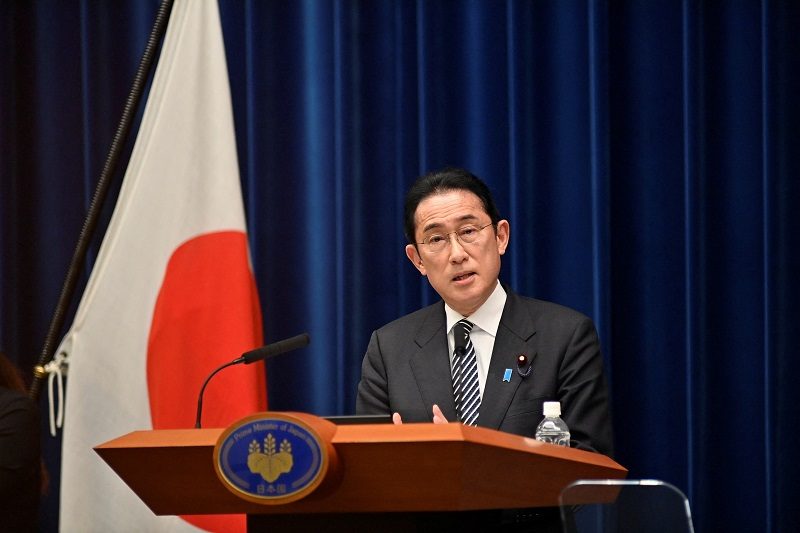
Japan’s Prime Minister Fumio Kishida attends a news conference in Tokyo on Tuesday.
20:20 JST, April 26, 2022
TOKYO, April 26 (Reuters) – Japan has prepared an emergency relief package worth $103 billion to cushion the economic blow from rising raw material costs, and plans further steps later this year to promote long-term reforms, Prime Minister Fumio Kishida said on Tuesday.
Kishida is under pressure to ramp up fiscal spending ahead of an upper house election scheduled to take place in July, putting Japan out of sync with many Western economies that are gradually phasing out crisis-mode stimulus measures.
The 13.2-trillion-yen ($103 billion) relief package, to be funded mostly by reserves set aside under the current fiscal year’s budget, will consist of steps to deal with the immediate hit from rising prices such as subsidies to gasoline wholesalers and cash payouts to low-income households with children.
Of the total, direct government spending will amount to 6.2 trillion yen. The rest consists of non-direct spending measures such as private-sector lending.
The government will compile an extra budget and pass it through the current parliament session to replenish reserves and secure funds to deal with any resurgence in COVID-19 infections or prolonged rises in fuel costs, Kishida said.
“We must prevent rising fuel and raw material costs from disrupting a recovery in economic and social activity from the pandemic,” Kishida told a news conference.
Aside from the relief package, the government will lay out after the upper house election a “comprehensive” package of measures to spear-head change in Japan’s society, Kishida said.
The package will include steps to help Japan achieve a carbon-neutral society and measures to promote the administration’s economic policy focusing on wealth re-distribution, Kishida said, without providing details.
“We need to act pre-emptively looking at the medium- to long-term horizon,” he said.
Analysts expect the government to compile a second extra budget later this year to fund additional spending measures, which could well exceed the size of spending for the relief package announced on Tuesday.
“The government will likely compile a second extra budget in autumn or later this year,” said Chotaro Morita, chief bond strategist at SMBC Nikko Securities.
Given the ruling Liberal Democratic Party’s (LDP) coalition ally, the Komeito party, has demanded an extra budget of up to 20 trillion yen, the second round of spending could be a little short of 20 trillion yen involving additional debt, he said.
That could further strain Japan’s borrowings, the industrial world’s heaviest public debt, at more than twice the size of its $5 trillion economy.



Most Read
Popular articles in the past 24 hours
-

Man Infected with Measles Reportedly Dined at Restaurant in Tokyo...
-
Record 700 Startups to Gather at SusHi Tech Tokyo in April; Event...
-
“The Tale of Genji” Back-Translation Project Led to Touching Enco...
-

Munich Security Conference: Japan Has Growing Role To Play in Reb...
-

Myaku-Myaku Fan Event Held in Osaka; ‘Its Butt is so Cute!’ Says ...
-
Takaichi Chats with Tunku Tunku, Interactive Mascot for Internati...
-
Taisei Unveils ‘Zero-Carbon Building’ in Japan's Saitama Prefectu...
-

Milano Cortina 2026: Riku Miura and Ryuichi Kihara Win Japan̵...
Popular articles in the past week
-

Videos Plagiarized, Reposted with False Subtitles Claiming ‘Ryuky...
-

Woman with No Overseas Travel History Infected with Measles in Na...
-
Tokyo’s New Record-Breaking Fountain Named ‘Tokyo Aqua Symphony’
-

Milano Cortina 2026: Kokomo Murase Comes Out on Top After Overcom...
-

Milano Cortina 2026: Figure Skaters Riku Miura, Ryuichi Kihara Pa...
-
CRA Leadership Election Will Center on Party Rebuilding; Lower Ho...
-
Crime in Japan Ticks Up for 4th Straight Year
-
Japanese Constitutional Revision Debate Expected to be Revived Af...
Popular articles in the past month
-

Japan Institute to Use Domestic Commercial Optical Lattice Clock ...
-

Israeli Ambassador to Japan Speaks about Japan’s Role in the Reco...
-

Man Infected with Measles May Have Come in Contact with Many Peop...
-
China Eyes Rare Earth Foothold in Malaysia to Maintain Dominance,...
-

Prudential Life Insurance Plans to Fully Compensate for Damages C...
-

Woman with Measles Visited Hospital in Tokyo Multiple Times Befor...
-
Australian Woman Dies After Mishap on Ski Lift in Nagano Prefectu...
-
Foreign Snowboarder in Serious Condition After Hanging in Midair ...
Top Articles in Politics
-

LDP Wins Historic Landslide Victory
-

LDP Wins Landslide Victory, Secures Single-party Majority; Ruling Coalition with JIP Poised to Secure Over 300 seats (UPDATE 1)
-
CRA Leadership Election Will Center on Party Rebuilding; Lower House Defeat Leaves Divisions among Former CDPJ, Komeito Members
-
Japan Tourism Agency Calls for Strengthening Measures Against Overtourism
-

Voters Using AI to Choose Candidates in Japan’s Upcoming General Election; ChatGPT, Other AI Services Found Providing Incorrect Information
JN ACCESS RANKING
-
Japan Institute to Use Domestic Commercial Optical Lattice Clock to Set Japan Standard Time
-
Israeli Ambassador to Japan Speaks about Japan’s Role in the Reconstruction of Gaza
-
Man Infected with Measles May Have Come in Contact with Many People in Tokyo, Went to Store, Restaurant Around When Symptoms Emerged
-
Prudential Life Insurance Plans to Fully Compensate for Damages Caused by Fraudulent Actions Without Waiting for Third-Party Committee Review
-
Woman with Measles Visited Hospital in Tokyo Multiple Times Before Being Diagnosed with Disease