
Focus of Japan Election to Be Whether Ruling Parties Can Secure Majority; LDP-only Majority Viewed as Out of Reach

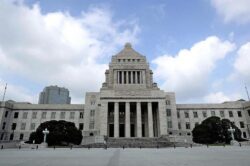
The Diet Building
14:48 JST, January 27, 2026
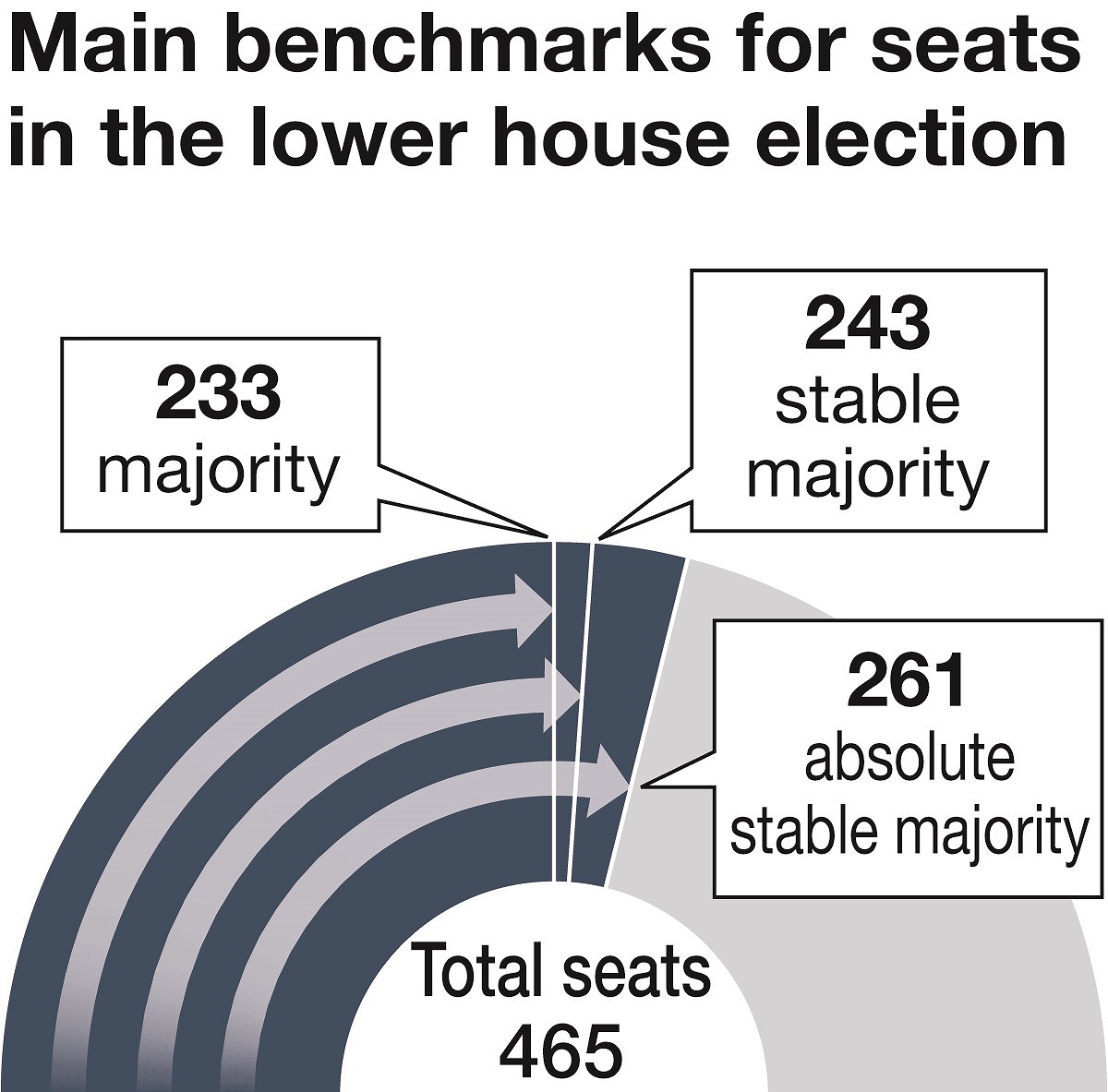
The focus of the upcoming House of Representatives election will be whether the ruling coalition of the Liberal Democratic Party and its partner the Japan Innovation Party can secure the 233 seats needed for a majority in the 465-seat lower house.
The LDP, which has struggled to manage the Diet as a minority ruling party since its crushing defeat in the last lower house election, aims to extend the number of seats it holds with its coalition partner beyond a simple majority in this election, for which official campaigning kicked off on Tuesday.
On the other hand, opposition parties such as the Centrist Reform Alliance are seeking to gain seats as a counter to the ruling coalition.
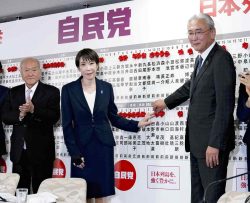
Prime Minister Sanae Takaichi, who is also the LDP president, emphasized the importance of securing a majority during a party leaders’ debate at the Japan National Press Club in Tokyo on Monday.
“It’s extremely unstable if important bills can’t pass when just one or two lawmakers are absent, which is the current state of things,” Takaichi said.
When the lower house was dissolved, the ruling coalition held 230 seats — 196 by the LDP and 34 by the JIP — three seats short of the majority.
The ruling coalition finally regained the majority in November when three independent lawmakers joined an LDP parliamentary group in the lower house, but that coalition has been on a tightrope in Diet debates.
“Frankly, the goal is simply to secure a majority without asking too much so that we can ensure a stable administration,” said a source close to the prime minister.
However, some voices within the LDP, such as LDP Election Strategy Committee Chairperson Keiji Furuya, advocate “to aim for an LDP-only majority.” That would require the LDP to gain an additional 37 seats on its own. Since support from Komeito, the LDP’s former coalition partner, is off the table this time, many within the LDP view this as a high hurdle.
The next benchmark after a simple majority is a “stable majority” with 243 seats — enough to hold half the seats on all 17 standing committees in the lower house and monopolize the committee chair positions.
Previously, a stable majority required 244 seats, but some committees will have their member numbers reduced at the Diet after the lower house election, resulting in the new figure.
With the dissolution occurring at the start of the ordinary Diet session, submission of the government’s initial budget proposal for the new fiscal year has been delayed. Debate over that proposal now awaits in a special Diet session to be convened following the election.
Passing a budget proposal within the current fiscal year will be difficult. The government and ruling coalition aim to do so around the Golden Week holiday season, which starts in late April. However, the chairperson of the Budget Committee, the main arena for debates, was part of the opposition. If the ruling coalition can secure a stable majority this time, regaining that chairmanship will be within reach.
Beyond a stable majority, there is an “absolute stable majority” with 261 seats, which would also enable the party to have a majority among committee members. Most recently, the LDP achieved this alone in the 2021 lower house election held under the Cabinet of then Prime Minister Fumio Kishida.
Furthermore, 310 seats — equivalent to two-thirds of the total lower house seats — constitute the power needed to pass bills rejected in the House of Councillors.
It is also the number of seats required to initiate constitutional amendments. However, the last time this was achieved was in the 2017 lower house election by the then ruling coalition of the LDP and Komeito.


Related Tags




Most Read
Popular articles in the past 24 hours
-
Seeking Nuclear Waste Site, Japan Eyes Remote Island of Minami-To...
-

Artisans from Disaster-Hit Areas Work Together to Keep Memories o...
-

Japan Tourist Spot's Capsule Toys Made from Recycled Materials Pr...
-

Japan’s Space One Kairos 3rd Flight Rocket Launched, but Mission ...
-

NTT Docomo to Discontinue 3G Service in March
-

Person Apparently Caught in Avalanche on Mt. Kamifurano in Hokkai...
-

LCC Greater Bay Airlines to Launch Regular Service on Fukuoka-Hon...
-

Space One's No. 3 Kairos Rocket Terminates Mid-Flight
Popular articles in the past week
-
Tokyo Spends Big on Children, Wins Over Parents
-

South Korea Tightens Rules on Foreigners Buying Homes in Seoul Me...
-

Japan’s Miura, Kihara Announce Withdrawal from Figure Skating Wor...
-

BOJ Keeping Eye on Economy and Takaichi's ‘Proactive Fiscal Polic...
-
2 Unpublished Early Novellas by Japan's Kenzaburo Oe Discovered, ...
-

Strait of Hormuz Closure Shakes Markets; Prolonged Closure Could ...
-
Nidec Chairman Resigns Amid Accounting Scandal at Major Japanese ...
-

Tourists Ignore Safety Barriers Near Famous Zao ‘Snow Monsters’ i...
Popular articles in the past month
-

Producer Behind Pop Group XG Arrested for Cocaine Possession
-

Japan PM Takaichi’s Cabinet Resigns en Masse
-

Man Infected with Measles Reportedly Dined at Restaurant in Tokyo...
-

Israeli Ambassador to Japan Speaks about Japan’s Role in the Reco...
-

Videos Plagiarized, Reposted with False Subtitles Claiming ‘Ryuky...
-

Prudential Life Insurance Plans to Fully Compensate for Damages C...
-

Woman with Measles Visited Hospital in Tokyo Multiple Times Befor...
-

iPS Treatments Pass Key Milestone, but Broader Applications Far f...
Top Articles in Politics
-
Japan PM Takaichi’s Cabinet Resigns en Masse
-

Sanae Takaichi Elected Prime Minister of Japan; Keeps All Cabinet Appointees from Previous Term
-

Japan’s Govt to Submit Road Map for Growth Strategy in March, PM Takaichi to Announce in Upcoming Policy Speech
-

LDP Wins Landslide Victory, Secures Single-party Majority; Ruling Coalition with JIP Poised to Secure Over 300 seats (UPDATE 1)
-

LDP Wins Historic Landslide Victory
JN ACCESS RANKING
-
Producer Behind Pop Group XG Arrested for Cocaine Possession
-
Japan PM Takaichi’s Cabinet Resigns en Masse
-
Man Infected with Measles Reportedly Dined at Restaurant in Tokyo Station
-
Israeli Ambassador to Japan Speaks about Japan’s Role in the Reconstruction of Gaza
-
Videos Plagiarized, Reposted with False Subtitles Claiming ‘Ryukyu Belongs to China’; Anti-China False Information Also Posted in Japan