
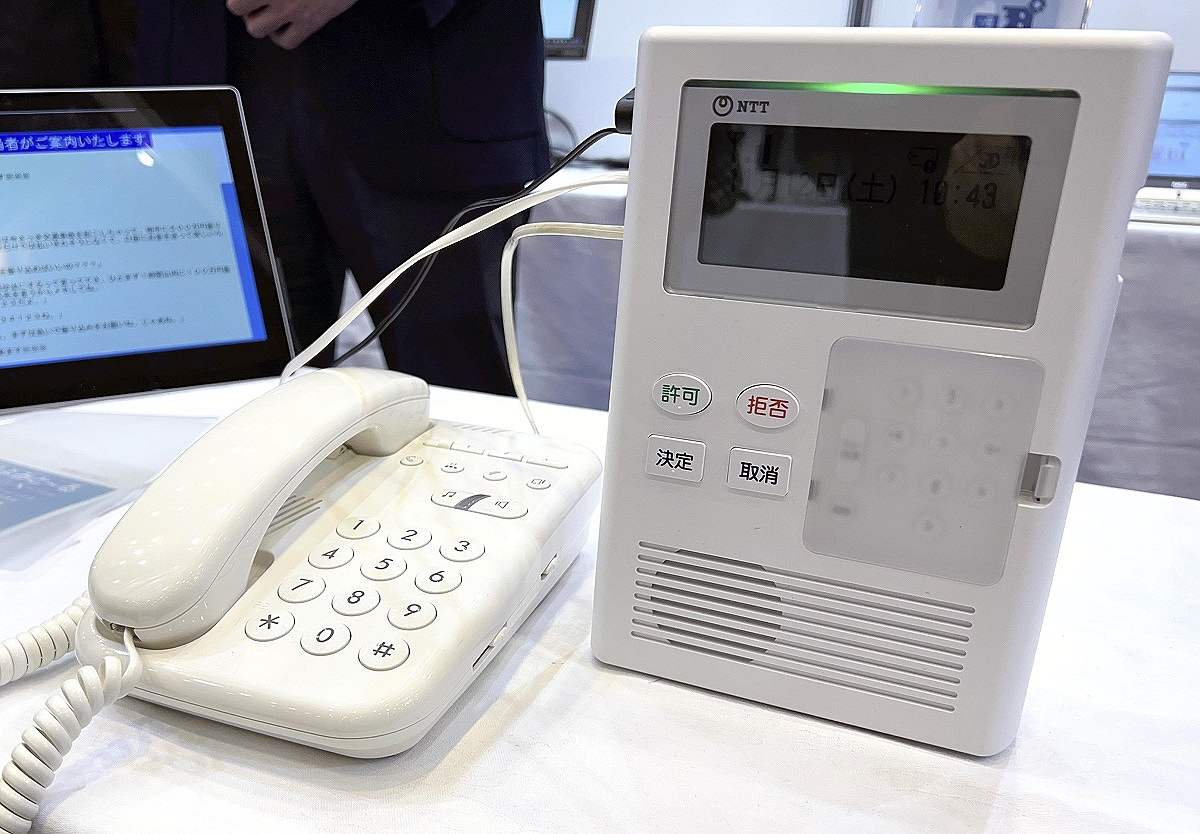
A device to detect fraud connected to a land-line telephone
10:26 JST, April 8, 2023
A series of high-profile break-ins in which culprits phoned ahead of time to get private information on assets and family situation has left people skittish about talking on the phone or even answering it in the first place.
For campaign offices aiming to solicit votes for the upcoming unified local elections, the heightened consciousness about crime has made them scramble for other ways than over the time-tested method of phoning.
“How did you get my phone number? I don’t remember ever telling you.”
That was the angry response from an elderly man to a female campaign staff member in her 40s of an incumbent running for a Hokkaido prefectural assembly. She had called from a list of the candidate’s supporters.
The exchange came in mid-February, just after four suspects were deported from the Philippines to Japan for allegedly masterminding a string of robberies around the nation involving the use of “dark” part-time jobs solicited on social media.
Under the Public Offices Election Law, phoning people to appeal for votes is allowed during the campaign period, while calls related to the activities of supporters’ groups are allowed even before the period.
The camp of the incumbent male candidate running for a seat in Sapporo has encountered trouble with phone solicitations more than a few times. Calls often go directly to voicemail, or are disconnected via security functions.
“This is because of the recent series of robberies,” the candidate said with a downtrodden look. He and his staff had called voters to solicit their support during past campaigns, but has abandoned doing so this time.
The campaign office of another candidate in Sapporo for the prefectural assembly election said calls have provoked responses such as “I don’t recall joining the supporters’ group,” or “Why are you calling me?” far more than they did four years ago during the previous unified local elections.
The Hokkaido prefectural police said that since early February, there has been a rash of suspicious phone calls meant to determine if a resident was home. By March 31, 477 such calls were confirmed mainly in Sapporo in which the caller said, “I’m on my way home” or “I’ll visit you now.”
Police said these calls could have been made by a criminal group doing the prep work for a break-in or robbery, or could be part of a fraud scheme.
According to the Internal Affairs and Communications Ministry, there were 51.11 million fixed telephone land lines as of the end of December 2022, a decrease of about 10% over the past 10 years due to the shift to mobile phones.
“Phone calls to voters are an important means for solidifying our base, but it may be no longer suited to the times,” said the incumbent candidate who has stopped making calls.








Most Read
Popular articles in the past 24 hours
-

Business Hotels Expanding into Regional Areas in Japan, Aiming to...
-

Milano Cortina 2026: Japan Sees Leap in Olympic Performance Throu...
-

6 Injured at Naked Festival in Japan’s Okayama Prefecture; Police...
-

Fiji Defense Minister Hopes Japan Will Support Stabilization of P...
-

Milano Cortina 2026: Malinin Highlights Dangers of Social Media i...
-

Space One Delays Launch of No. 3 Kairos Rocket; Company to Announ...
-

3rd Japan Pacific Islands Defense Dialogue to Begin in Tokyo on S...
-

Reciprocal Tariffs Ruled Illegal: Judiciary Would Not Tolerate Pr...
Popular articles in the past week
-

Japan PM Takaichi’s Cabinet Resigns en Masse
-

Man Infected with Measles Reportedly Dined at Restaurant in Tokyo...
-

Sanae Takaichi Elected Prime Minister of Japan; Keeps All Cabinet...
-

Japan's Govt to Submit Road Map for Growth Strategy in March, PM ...
-

Bus Carrying 40 Passengers Catches Fire on Chuo Expressway; All E...
-

Milano Cortina 2026: Figure Skaters Riku Miura, Ryuichi Kihara Pa...
-

Japan, U.S. Name 3 Inaugural Investment Projects; Reached Agreeme...
-

U.S. Firm to Build Training Hub in Fukushima N-plant for Debris R...
Popular articles in the past month
-
Japan PM Takaichi’s Cabinet Resigns en Masse
-

Japan Institute to Use Domestic Commercial Optical Lattice Clock ...
-

Israeli Ambassador to Japan Speaks about Japan’s Role in the Reco...
-
Man Infected with Measles Reportedly Dined at Restaurant in Tokyo...
-

Videos Plagiarized, Reposted with False Subtitles Claiming ‘Ryuky...
-

Man Infected with Measles May Have Come in Contact with Many Peop...
-

Prudential Life Insurance Plans to Fully Compensate for Damages C...
-

Woman with Measles Visited Hospital in Tokyo Multiple Times Befor...
Top Articles in Politics
-
Japan PM Takaichi’s Cabinet Resigns en Masse
-
Sanae Takaichi Elected Prime Minister of Japan; Keeps All Cabinet Appointees from Previous Term
-
Japan’s Govt to Submit Road Map for Growth Strategy in March, PM Takaichi to Announce in Upcoming Policy Speech
-

LDP Wins Historic Landslide Victory
-

LDP Wins Landslide Victory, Secures Single-party Majority; Ruling Coalition with JIP Poised to Secure Over 300 seats (UPDATE 1)
JN ACCESS RANKING
-
Japan PM Takaichi’s Cabinet Resigns en Masse
-
Japan Institute to Use Domestic Commercial Optical Lattice Clock to Set Japan Standard Time
-
Israeli Ambassador to Japan Speaks about Japan’s Role in the Reconstruction of Gaza
-
Man Infected with Measles Reportedly Dined at Restaurant in Tokyo Station
-
Videos Plagiarized, Reposted with False Subtitles Claiming ‘Ryukyu Belongs to China’; Anti-China False Information Also Posted in Japan