
Restrictions to Be Needed as Government Eyes Abolition of ‘5-Category’ Defense Rule
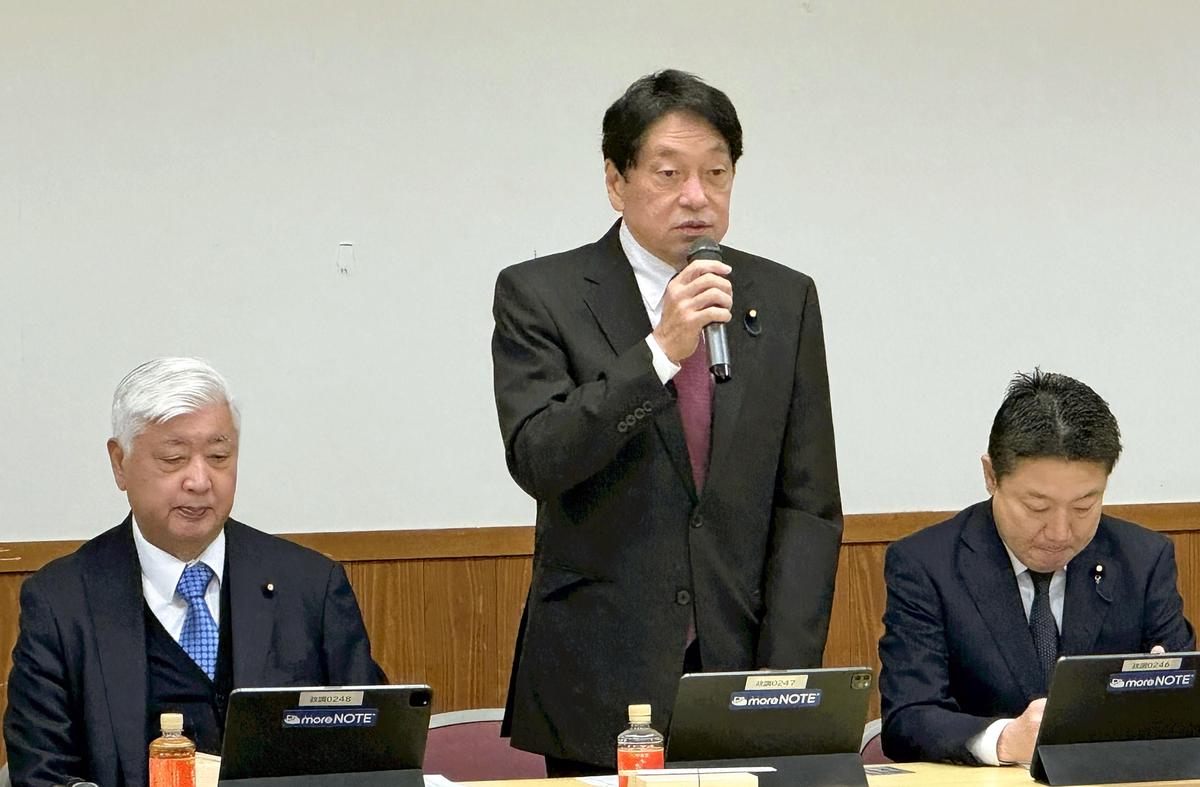
Former Defense Minister Itsunori Onodera addresses the Liberal Democratic Party’s Security Research Commission at party headquarters on Monday.
7:00 JST, December 3, 2025
Setting limits on exports of defense equipment will be a key element of discussions aimed at abolishing the “five-category” rule that is currently applied to such exports.
The Liberal Democratic Party’s coalition partner has changed from the cautious Komeito to the more proactive Japan Innovation Party, prompting concern to spread within the LDP over who will act as a brake. How discussions proceed will likely set a precedent for the new ruling coalition’s handling of security matters as a whole.
‘Long-sought goal’
The LDP’s Research Commission on Security heard opinions on Monday from executives of defense equipment maker Mitsubishi Electric Corp. and experts on the current state of defense equipment exports. After the meeting, commission Chairman Itsunori Onodera expressed his intention to expedite discussions toward abolishing the five-category rule.
“We want to prioritize discussions on equipment transfers. Hearing opinions from experts confirmed the need to review [the regulations],” Onodera told reporters.
The current implementation guidelines for the Three Principles on Transfer of Defense Equipment and Technology permit exports of finished defense equipment only when the partner country’s intended use falls within the “five categories” of rescue, transport, vigilance, surveillance and minesweeping.
Since this system began in 2014, Japan has exported only a surveillance radar system to the Philippines in 2023.
“The limited categories make it difficult to meet the needs of partner countries,” a government official said.
The framework for “international joint development and production” outlined in the guidelines allows exports beyond the five categories, but in that case the partner country must have technological capabilities and information protection standards equivalent to Japan’s.
Current partners are limited to advanced nations such as the United Kingdom and Italy for developing next-generation fighter aircraft, and Australia for new naval vessels.
Given these circumstances, abolishing the five categories rule is a “long-sought goal,” in the words of an LDP senior member. Backers of abolition want to promote wide-ranging equipment cooperation with emerging and developing nations, which have increased their presence in the international community.
The phantom idea
According to government sources, a “10-category” rule was once suggested under the LDP-Komeito administration, in which categories such as mine clearance would be added to the existing five. This stemmed from caution on the part of Komeito, which sees itself as a party of peace, over a rapid expansion of exports.
The 10-category rule was ultimately shelved when the current coalition government with the security-focused JIP was formed. Discussions are now moving toward abolishing the five categories and making exports possible in principle.
This has heightened the importance on having certain restrictions to prevent uncontrolled exports, such as stricter screening.
Under the LDP-Komeito administration, various safeguards were incorporated at Komeito’s request, in tandem with the gradual easing of the guidelines. These included prohibiting exports to countries engaged in combat and mandating Cabinet approval for exporting next-generation fighter jets under joint development to third countries other than the United Kingdom and Italy.
The key focus now is how much of this framework will remain after the five categories are abolished.
Litmus test
Support for restrictions has spread within the LDP, with a veteran defense lawmaker asking, “Is it really wise to immediately veer right the moment Komeito leaves?”
To this, a young JIP member responded: “Team up with Komeito if you need someone to act as the brakes. You’re with the wrong party.”
If coordination between the LDP and the JIP proceeds smoothly, the government will aim to revise the guidelines and abolish the five categories in April 2026. Ruling party discussions on revising the three core security documents are approaching in spring or later, and whether a swift consensus can be reached in that debate will serve as a litmus test.
Defense Minister Shinjiro Koizumi spoke on an internet program on Sunday about the need for safeguards alongside abolishing the five categories. “There is undoubtedly the issue of how to reconcile the matter with Japan’s history as a peaceful nation,” Koizumi said.
The government is facing the challenge of balancing a reformist stance and consistency in its policies.








Most Read
Popular articles in the past 24 hours
-

Lady Bess: Iroha Okuda, Mayuko Kominami Discuss Performing Elizab...
-

Japan Considering Taking Part in U.S. ‘Golden Dome’ Defense Syste...
-

Japan's TEPCO Releases Footage from Fukushima N-Plant Reactor
-

Oil Reserve Releases: G7 Members Unite against Growing Threat
-

46 Evacuated from UAE, Oman on Japanese Govt-chartered Flight
-

Japan's Sanyo Shinkansen Suspended Again; Between Okayama, Aioi S...
-

Driver Dies in Collision with Express Train at Crossing in Mito; ...
-
Raise Interest Rate, Stop Yen’s Fall to Stabilize Prices
Popular articles in the past week
-

Japan Figure Skating Legend Yuzuru Hanyu Is Proud Disaster Surviv...
-

Nippon Life Insurance's U.S. Arm Sues OpenAI Over Legal Assistanc...
-

Govt to Utilize ODA for Ensuring Economic Security; Securing Ener...
-
15 Measles Patients Confirmed in Tokyo in Past 6 Days; 1 May Have...
-

Massive Sewer Pipe Found Jutting Out of Highway in Osaka
-

Japan Govt to Tighten Requirements to Receive Permanent Residency...
-

Beckoning Cats Get Makeover to Fit Modern Lifestyles with Sleek D...
-

Japan's 2nd Round of U.S. Investments May Be Worth Over $100 Bill...
Popular articles in the past month
-

Producer Behind Pop Group XG Arrested for Cocaine Possession
-

Japan PM Takaichi’s Cabinet Resigns en Masse
-

Man Infected with Measles Reportedly Dined at Restaurant in Tokyo...
-

Videos Plagiarized, Reposted with False Subtitles Claiming ‘Ryuky...
-
Japan Figure Skating Legend Yuzuru Hanyu Is Proud Disaster Surviv...
-

iPS Treatments Pass Key Milestone, but Broader Applications Far f...
-

Sanae Takaichi Elected Prime Minister of Japan; Keeps All Cabinet...
-

Nepal Bus Crash Kills 19 People, Injures 25 Including One Japanes...
Top Articles in Politics
-
Japan PM Takaichi’s Cabinet Resigns en Masse
-
Sanae Takaichi Elected Prime Minister of Japan; Keeps All Cabinet Appointees from Previous Term
-

Japan’s Govt to Submit Road Map for Growth Strategy in March, PM Takaichi to Announce in Upcoming Policy Speech
-
LDP Begins Training New Lawmakers to Avoid Scandal, Gaffes; Historic Victory in Latest Election Heightens Focus on Party
-

Japan PM Sanae Takaichi Welcomes Peach Ambassadors Koga Momo Musume to Official Residence
JN ACCESS RANKING
-
Producer Behind Pop Group XG Arrested for Cocaine Possession
-
Japan PM Takaichi’s Cabinet Resigns en Masse
-
Man Infected with Measles Reportedly Dined at Restaurant in Tokyo Station
-
Videos Plagiarized, Reposted with False Subtitles Claiming ‘Ryukyu Belongs to China’; Anti-China False Information Also Posted in Japan
-
Japan Figure Skating Legend Yuzuru Hanyu Is Proud Disaster Survivor and Gold Medalist, Vows to Continue Support Efforts