
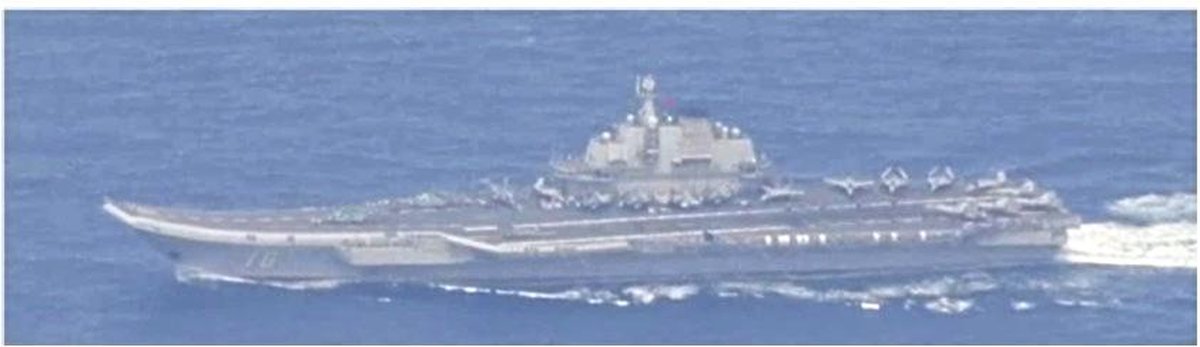
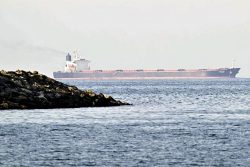
The Chinese Navy aircraft carrier Liaoning is seen in the waters near Iwoto Island on Sunday.
16:36 JST, June 16, 2025
TOKYO (Jiji Press) — Japan’s Defense Ministry suspects that Chinese aircraft carriers recently found operating in the Pacific may have conducted drills for countering U.S. forces in the event of a Taiwan contingency.
The ministry last week announced for the first time that it had spotted two Chinese aircraft carriers operating simultaneously in Pacific waters near Japan.
The vessels sailed within Japan’s exclusive economic zone near remote islands that are part of the Ogasawara chain. In addition, there were incidents in which a Chinese fighter jet based on one of the flattops flew dangerously close to a Maritime Self-Defense Force plane.
The ministry is analyzing China’s intentions behind these operations, sources said.
Of the Chinese aircraft carriers, the Liaoning crossed for the first time the so-called second island chain, which links the Ogasawara Islands and the U.S. territory of Guam, sailing within the EEZ around Minamitorishima on June 7.
China is said to regard the second island chain as a defense line to keep at bay U.S. aircraft carriers and submarines coming from Guam and elsewhere in the event of a Taiwan contingency.
According to ministry sources, the Liaoning and the other flattop, Shandong, may have conducted exercises for countering U.S. forces in the event of a Taiwan contingency, with one playing the role of a U.S. aircraft carrier and the other practicing intercepting it.
Regarding the close encounters between the Japanese and Chinese planes, some observers say that China may have made the moves because it did not want Japanese aircraft to approach the air defense zone established by the carrier fleet.
The Shandong operated in the EEZ around Okinotorishima on June 9, with the departures and arrivals of carrier-based aircraft confirmed.
In the EEZ around Okinotorishima, a Chinese marine research ship operated without Japan’s consent in late May. Although the Japanese government protested, China maintained its position of not recognizing the EEZ, saying that Okinotorishima is not an island but rocks.
“It is necessary to examine whether there is any connection between the marine research ship and the Chinese military behavior in the EEZ,” a ruling party member said.
The sea area around Minamitorishima where the Liaoning sailed is believed to hold significant seabed resources.
According to the International Seabed Authority, China plans to test-mine for manganese nodules, which contain minor metals, from the seabed in international waters outside Japan’s EEZ around Minamitorishima under exploration rights granted by the ISA.
“We will take all possible measures for warning and surveillance and deter any attempts to unilaterally change the status quo by force,” Defense Minister Gen Nakatani told a press conference Friday.
“We will proceed with a detailed analysis” of the latest movements of Chinese aircraft carriers, he added.









Most Read
Popular articles in the past 24 hours
-
Artisans from Disaster-Hit Areas Work Together to Keep Memories o...
-
Japan Tourist Spot's Capsule Toys Made from Recycled Materials Pr...
-
Japan’s Space One Kairos 3rd Flight Rocket Launched, but Mission ...
-

Person Apparently Caught in Avalanche on Mt. Kamifurano in Hokkai...
-

NTT Docomo to Discontinue 3G Service in March
-
Space One's No. 3 Kairos Rocket Terminates Mid-Flight
-
LCC Greater Bay Airlines to Launch Regular Service on Fukuoka-Hon...
-

Former Unification Church: Proceed Steadily with Liquidation to P...
Popular articles in the past week
-
Tokyo Spends Big on Children, Wins Over Parents
-

South Korea Tightens Rules on Foreigners Buying Homes in Seoul Me...
-

Japan’s Miura, Kihara Announce Withdrawal from Figure Skating Wor...
-
2 Unpublished Early Novellas by Japan's Kenzaburo Oe Discovered, ...
-
Strait of Hormuz Closure Shakes Markets; Prolonged Closure Could ...
-

Nidec Chairman Resigns Amid Accounting Scandal at Major Japanese ...
-
Tourists Ignore Safety Barriers Near Famous Zao ‘Snow Monsters’ i...
-

Iran Situation: Japan Must Exert Diplomatic Efforts without Merel...
Popular articles in the past month
-

Producer Behind Pop Group XG Arrested for Cocaine Possession
-

Japan PM Takaichi’s Cabinet Resigns en Masse
-

Man Infected with Measles Reportedly Dined at Restaurant in Tokyo...
-

Israeli Ambassador to Japan Speaks about Japan’s Role in the Reco...
-

Videos Plagiarized, Reposted with False Subtitles Claiming ‘Ryuky...
-

Prudential Life Insurance Plans to Fully Compensate for Damages C...
-

Woman with Measles Visited Hospital in Tokyo Multiple Times Befor...
-

iPS Treatments Pass Key Milestone, but Broader Applications Far f...
Top Articles in Politics
-
Japan PM Takaichi’s Cabinet Resigns en Masse
-

Sanae Takaichi Elected Prime Minister of Japan; Keeps All Cabinet Appointees from Previous Term
-

Japan’s Govt to Submit Road Map for Growth Strategy in March, PM Takaichi to Announce in Upcoming Policy Speech
-

LDP Wins Landslide Victory, Secures Single-party Majority; Ruling Coalition with JIP Poised to Secure Over 300 seats (UPDATE 1)
-

LDP Wins Historic Landslide Victory
JN ACCESS RANKING
-
Producer Behind Pop Group XG Arrested for Cocaine Possession
-
Japan PM Takaichi’s Cabinet Resigns en Masse
-
Man Infected with Measles Reportedly Dined at Restaurant in Tokyo Station
-
Israeli Ambassador to Japan Speaks about Japan’s Role in the Reconstruction of Gaza
-
Videos Plagiarized, Reposted with False Subtitles Claiming ‘Ryukyu Belongs to China’; Anti-China False Information Also Posted in Japan