
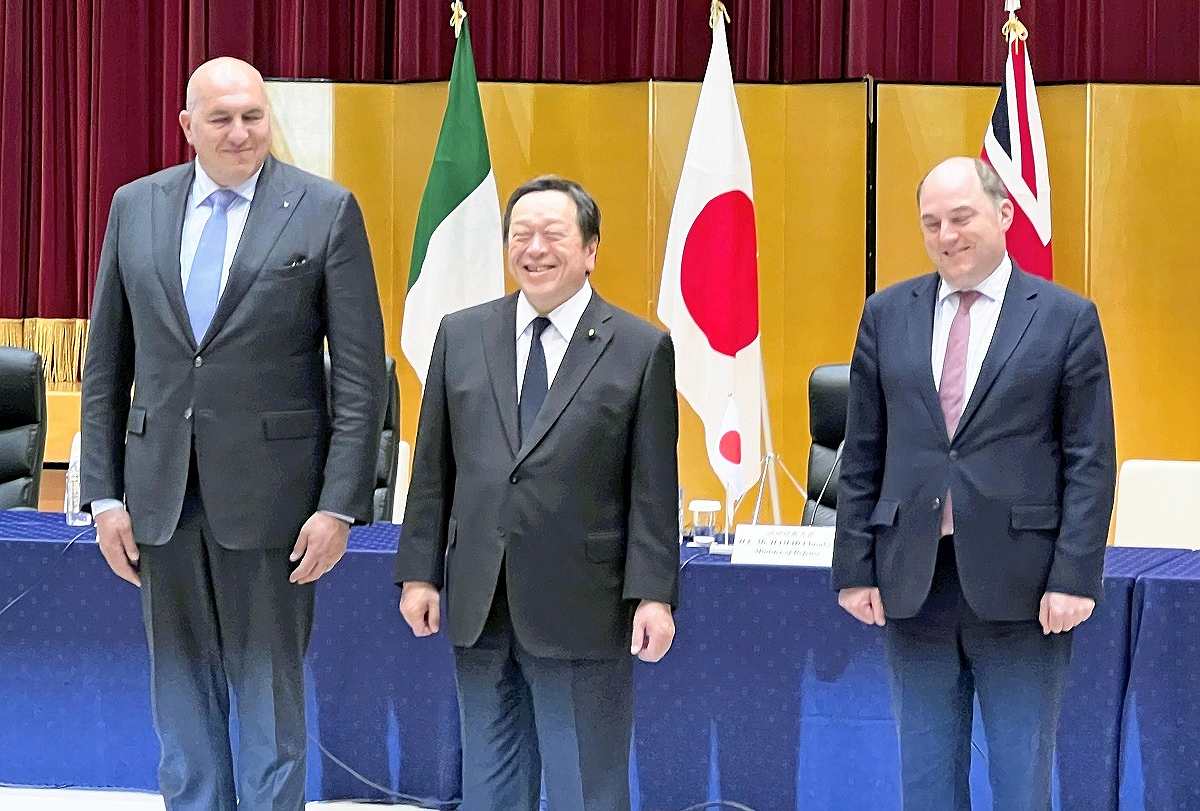
Defense Minister Yasukazu Hamada, center, British Defense Minister Ben Wallace, right, and Italian Defense Minister Guido Crosetto attend a press conference in Tokyo on Thursday.
10:55 JST, March 17, 2023
Tokyo —The defense ministers of Japan, Britain and Italy on Thursday agreed to deepen cooperation among the three countries over the joint development of a next-generation fighter jet.
In December last year, the three countries reached an agreement on the joint development. They plan to draw up a basic design by 2024.
In Thursday’s meeting in Tokyo, Japanese Defense Minister Yasukazu Hamada said that the development of a cutting-edge fighter jet by the three countries will greatly contribute to strengthening global security.
British Defense Secretary Ben Wallace and his Italian counterpart, Guido Crosetto, underlined the need for cooperation among the three countries amid a severe security environment.
Japan aims to deploy the new jet by 2035 as a successor to the Air Self-Defense Force’s F-2 fighter.
The meeting was joined by executives of Japan’s Mitsubishi Heavy Industries Ltd. , Britain’s BAE Systems PLC and Italy’s Leonardo SpA, the companies that will lead the new fighter development.








Most Read
Popular articles in the past 24 hours
-

10 Foreign Tourists Sustain Injuries After Fire at Capsule Hotel ...
-

World Baseball Classic: Venezuela Beats Japan in Nail-biting Back...
-

Zelenskiy Says Ukraine Wants Money, Technology in Return for Midd...
-

Rapid Services Resume on JR Chuo Line; Suspension Caused by Accid...
-

Rapid Services on JR Chuo Line Suspended; Accident at Kokubunji S...
-

World Baseball Classic: Venezuela Beats Japan in Back-and-Forth Q...
-

World Baseball Classic: Red Sox’s Abreu Hits 3-run Homer, Giving ...
-

Rich Local Ingredients Make Nagato Oden Popular Dish
Popular articles in the past week
-

Japan Figure Skating Legend Yuzuru Hanyu Is Proud Disaster Surviv...
-
15 Measles Patients Confirmed in Tokyo in Past 6 Days; 1 May Have...
-
Massive Sewer Pipe Found Jutting Out of Highway in Osaka
-

Japan Govt to Tighten Requirements to Receive Permanent Residency...
-
Power Outage Forces About 980 Passengers in Yokohama to Walk to T...
-
JR Tokai Breaks Ground on Yamanashi Maglev Station; Will Be Part ...
-

Parents in Japan to Get Instagram Notifications When Teens Repeat...
-
'World's Oldest Bio-Business' Is Japan's Seed Koji Retailing, Mol...
Popular articles in the past month
-

Producer Behind Pop Group XG Arrested for Cocaine Possession
-

Japan PM Takaichi’s Cabinet Resigns en Masse
-

Man Infected with Measles Reportedly Dined at Restaurant in Tokyo...
-
Japan Figure Skating Legend Yuzuru Hanyu Is Proud Disaster Surviv...
-

iPS Treatments Pass Key Milestone, but Broader Applications Far f...
-

Sanae Takaichi Elected Prime Minister of Japan; Keeps All Cabinet...
-

South Korea Tightens Rules on Foreigners Buying Homes in Seoul Me...
-

Nepal Bus Crash Kills 19 People, Injures 25 Including One Japanes...
Top Articles in Politics
-
Japan PM Takaichi’s Cabinet Resigns en Masse
-
Sanae Takaichi Elected Prime Minister of Japan; Keeps All Cabinet Appointees from Previous Term
-
Japan’s Govt to Submit Road Map for Growth Strategy in March, PM Takaichi to Announce in Upcoming Policy Speech
-
LDP Begins Training New Lawmakers to Avoid Scandal, Gaffes; Historic Victory in Latest Election Heightens Focus on Party
-

Japan PM Sanae Takaichi Welcomes Peach Ambassadors Koga Momo Musume to Official Residence
JN ACCESS RANKING
-
Producer Behind Pop Group XG Arrested for Cocaine Possession
-
Japan PM Takaichi’s Cabinet Resigns en Masse
-
Man Infected with Measles Reportedly Dined at Restaurant in Tokyo Station
-
Japan Figure Skating Legend Yuzuru Hanyu Is Proud Disaster Survivor and Gold Medalist, Vows to Continue Support Efforts
-
iPS Treatments Pass Key Milestone, but Broader Applications Far from Guaranteed