
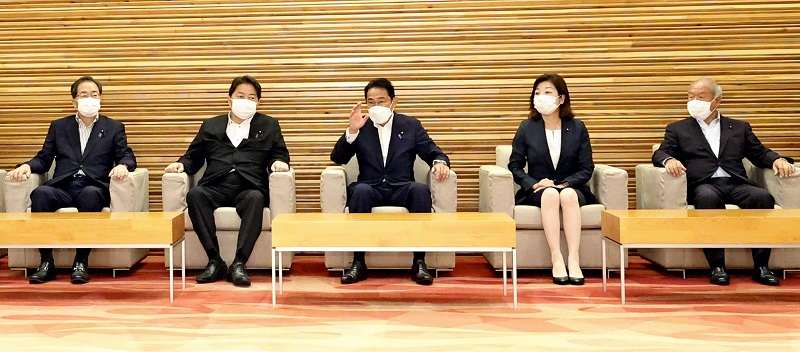
Prime Minister Fumio Kishida, center, is seen before a Cabinet meeting in Tokyo on Friday.
17:12 JST, July 22, 2022
The government condemned Russia’s invasion of Ukraine in its 2022 defense white paper approved at a Cabinet meeting on Friday.
The white paper stated that Moscow’s aggression must “never be tolerated,” and warned that Russia, with its declining national power, may deepen military ties with China.
The report, which featured a section dedicated to Russia’s invasion of Ukraine, also included a hypothetical invasion of Taiwan by China for the first time.
Russia’s offensive in the initial phase of the Ukraine conflict was assessed as a failure in the white paper, which included an analysis of the factors that led to Russia’s decision to attack, including Moscow’s “optimistic estimates of Ukraine’s willingness to resist and its military capabilities.”
The white paper also highlighted Russia’s lack of capabilities to accurately identify missile strike targets and questioned the Russian military’s ability to conduct large-scale warfare.
The report stated that “medium- and long-term prospects for Russia’s national strength may deteriorate and the military balance with neighboring regions may change” as a result of damage caused by a prolonged war in Ukraine.
The white paper also mentioned the possibility of Russia deepening ties with China and increasing the activities of its strategic nuclear submarines in the Far East.
The section on Taiwan has doubled in size compared to last year’s edition of the white paper.
The report includes a hypothetical scenario prepared by Taipei, which expects an invasion to be divided into several phases, beginning with China gathering its military forces on the Chinese coast under the guise of drills and the spread of disinformation; followed by strikes on key facilities with missiles and cyber attacks; and finally a landing operation.
The white paper states that China “is stepping up various kinds of pressure on Taiwan.”
The paper retained the description of “strong security concerns” regarding China, but in light of that country’s increased activities around Japan, the latest edition also stresses that “the situation has become even more tense in recent years.”
Regarding North Korea, which is advancing its nuclear and missile development programs, the paper maintained its previous wording, describing the isolated nation as a “serious and imminent threat,” but added that, as with China, the situation is intensifying.
The Japanese government plans to revise three security-related documents by the end of the year, including the National Security Strategy, in order to strengthen defense capabilities in light of the severe security environment.
The white paper stressed that “the use of force by Japan after an enemy has initiated an armed attack should not be confused with a preemptive strike,” regarding “counterattack capabilities,” an expression the government uses to describe the ability to destroy missile launch bases and other enemy facilities for self-defense purposes.



Most Read
Popular articles in the past 24 hours
-

Japan’s Nikkei Stock Average Rises on Tech Rally and Takaichi's S...
-

Security Services Law Unconstitutional: Do Not Restrict Career Ch...
-
Takaichi Expected to Express Desire for Constitutional Revision P...
-
New Leader of Japan's CRA Opposition Party Faces Challenge of For...
-
Japanese Man Living in Iraq Suspected of Illegally Entering U.S. ...
-

Tokyo Exhibition Featuring VR Walk Through 2025 Osaka-Kansai Expo...
-

Milano Cortina 2026: Snowboarding Star Fukada Wins Gold in Hard-F...
-

Milano Cortina 2026: Fukada Wins Gold, Murase Bronze in WomenR...
Popular articles in the past week
-

Japan PM Takaichi’s Cabinet Resigns en Masse
-

Man Infected with Measles Reportedly Dined at Restaurant in Tokyo...
-

Videos Plagiarized, Reposted with False Subtitles Claiming ‘Ryuky...
-

Sanae Takaichi Elected 105th Prime Minister of Japan; Keeps All C...
-

Japan's Govt to Submit Road Map for Growth Strategy in March, PM ...
-

Milano Cortina 2026: Figure Skaters Riku Miura, Ryuichi Kihara Pa...
-

Tokyo’s New Record-Breaking Fountain Named ‘Tokyo Aqua Symphony’
-

Bus Carrying 40 Passengers Catches Fire on Chuo Expressway; All E...
Popular articles in the past month
-
Japan PM Takaichi’s Cabinet Resigns en Masse
-

Japan Institute to Use Domestic Commercial Optical Lattice Clock ...
-

Israeli Ambassador to Japan Speaks about Japan’s Role in the Reco...
-
Man Infected with Measles Reportedly Dined at Restaurant in Tokyo...
-

Man Infected with Measles May Have Come in Contact with Many Peop...
-

Prudential Life Insurance Plans to Fully Compensate for Damages C...
-
Videos Plagiarized, Reposted with False Subtitles Claiming ‘Ryuky...
-

Woman with Measles Visited Hospital in Tokyo Multiple Times Befor...
Top Articles in Politics
-
Japan PM Takaichi’s Cabinet Resigns en Masse
-
Sanae Takaichi Elected 105th Prime Minister of Japan; Keeps All Cabinet Appointees from Previous Term
-
Japan’s Govt to Submit Road Map for Growth Strategy in March, PM Takaichi to Announce in Upcoming Policy Speech
-

LDP Wins Historic Landslide Victory
-

LDP Wins Landslide Victory, Secures Single-party Majority; Ruling Coalition with JIP Poised to Secure Over 300 seats (UPDATE 1)
JN ACCESS RANKING
-
Japan PM Takaichi’s Cabinet Resigns en Masse
-
Japan Institute to Use Domestic Commercial Optical Lattice Clock to Set Japan Standard Time
-
Israeli Ambassador to Japan Speaks about Japan’s Role in the Reconstruction of Gaza
-
Man Infected with Measles Reportedly Dined at Restaurant in Tokyo Station
-
Man Infected with Measles May Have Come in Contact with Many People in Tokyo, Went to Store, Restaurant Around When Symptoms Emerged