
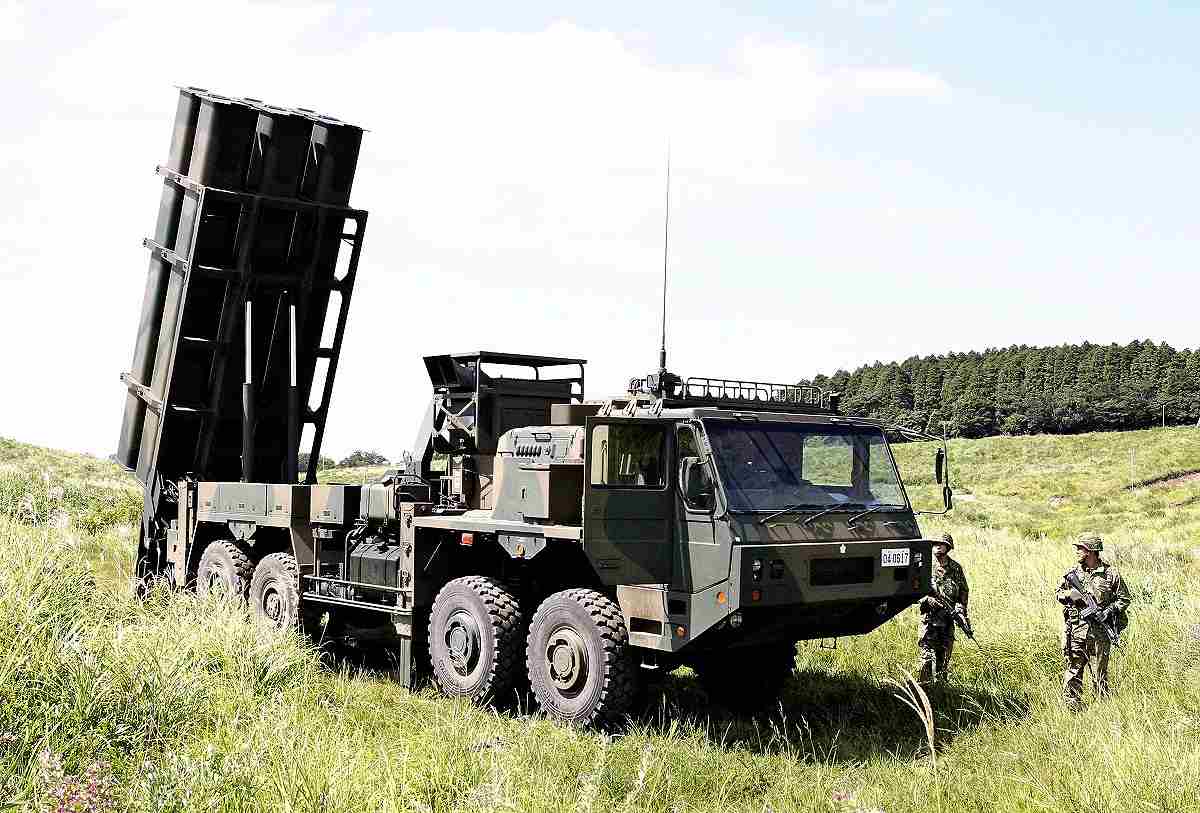
Self-Defense Forces personnel participate in a Japan-U.S. joint exercise with Type-12 surface-to-ship missiles in Kumamoto Prefecture in September 2019.
16:32 JST, December 9, 2020
The government plans to develop a long-range cruise missile that can strike beyond the range of enemy weapons, The Yomiuri Shimbun has learned.
The move is part of a new missile defense policy to be drawn up by the end of this year, under which the government will improve the Type 12 surface-to-ship missile so that it can be launched from naval vessels and aircraft, and strike ground targets. The Cabinet will approve the plan as early as next week.
The Type 12 has a range of more than 100 kilometers. The new missile is expected to have a range of several hundred kilometers, according to sources.
The aim is to provide a certain level of stealth capabilities. It is thought that the missile could be used to attack enemy bases in the future.
The Defense Ministry will earmark ¥33.5 billion in the next fiscal year’s budget for related expenses. The ministry aims to complete the development within five years by making improvements to the Type 12, such as increasing the size and adding wings.
The Defense Ministry also plans to introduce U.S.-made standoff missiles, such as the JASSM air-to-ground missile with a range of about 900 kilometers, to be mounted on F-15 fighters, in response to the improved missile attack capabilities of China and other countries.
The government aims to enhance deterrence by developing a cruise missile that can be launched from land and naval vessels. However, it has given up on plans to draft a policy by the end of the year on acquiring equipment to attack enemy bases. Discussions are expected to continue next year.
The development of the new cruise missile is seen as an attempt to strengthen its capability in anticipation of future policy changes.
The government is also considering installing SM-6 multifunctional antiaircraft missiles on the two Aegis-equipped ships that will replace the abandoned plan for the ground-based Aegis Ashore interceptor system.
Under the abandoned plan, the system would only be able to intercept ballistic missiles. The SM-6, which is capable of intercepting enemy cruise missiles, would enhance the capabilities of the Self-Defense Forces.
The government plans to allocate nearly ¥2 billion in the next fiscal year’s budget for research and other expenses to determine the specific functions and equipment of the two Aegis-equipped ships.
The Cabinet is also expected to approve a review of relevant parts of the National Defense Program Guidelines and the Mid-Term Defense Program.






Most Read
Popular articles in the past 24 hours
-

Lady Bess: Iroha Okuda, Mayuko Kominami Discuss Performing Elizab...
-

Japan Considering Taking Part in U.S. ‘Golden Dome’ Defense Syste...
-

Japan's TEPCO Releases Footage from Fukushima N-Plant Reactor
-

Oil Reserve Releases: G7 Members Unite against Growing Threat
-
46 Evacuated from UAE, Oman on Japanese Govt-chartered Flight
-

Japan's Sanyo Shinkansen Suspended Again; Between Okayama, Aioi S...
-

Driver Dies in Collision with Express Train at Crossing in Mito; ...
-

Paw Patrol: Larry Marks 15 Years at 10 Downing Street
Popular articles in the past week
-

Japan Figure Skating Legend Yuzuru Hanyu Is Proud Disaster Surviv...
-

Nippon Life Insurance's U.S. Arm Sues OpenAI Over Legal Assistanc...
-
Govt to Utilize ODA for Ensuring Economic Security; Securing Ener...
-
15 Measles Patients Confirmed in Tokyo in Past 6 Days; 1 May Have...
-
Massive Sewer Pipe Found Jutting Out of Highway in Osaka
-

Japan Govt to Tighten Requirements to Receive Permanent Residency...
-

Beckoning Cats Get Makeover to Fit Modern Lifestyles with Sleek D...
-

Japan's 2nd Round of U.S. Investments May Be Worth Over $100 Bill...
Popular articles in the past month
-

Producer Behind Pop Group XG Arrested for Cocaine Possession
-

Japan PM Takaichi’s Cabinet Resigns en Masse
-

Man Infected with Measles Reportedly Dined at Restaurant in Tokyo...
-

Videos Plagiarized, Reposted with False Subtitles Claiming ‘Ryuky...
-
Japan Figure Skating Legend Yuzuru Hanyu Is Proud Disaster Surviv...
-

iPS Treatments Pass Key Milestone, but Broader Applications Far f...
-

Sanae Takaichi Elected Prime Minister of Japan; Keeps All Cabinet...
-

Nepal Bus Crash Kills 19 People, Injures 25 Including One Japanes...
Top Articles in Politics
-
Japan PM Takaichi’s Cabinet Resigns en Masse
-
Sanae Takaichi Elected Prime Minister of Japan; Keeps All Cabinet Appointees from Previous Term
-

Japan’s Govt to Submit Road Map for Growth Strategy in March, PM Takaichi to Announce in Upcoming Policy Speech
-
LDP Begins Training New Lawmakers to Avoid Scandal, Gaffes; Historic Victory in Latest Election Heightens Focus on Party
-

Japan PM Sanae Takaichi Welcomes Peach Ambassadors Koga Momo Musume to Official Residence
JN ACCESS RANKING
-
Producer Behind Pop Group XG Arrested for Cocaine Possession
-
Japan PM Takaichi’s Cabinet Resigns en Masse
-
Man Infected with Measles Reportedly Dined at Restaurant in Tokyo Station
-
Videos Plagiarized, Reposted with False Subtitles Claiming ‘Ryukyu Belongs to China’; Anti-China False Information Also Posted in Japan
-
Japan Figure Skating Legend Yuzuru Hanyu Is Proud Disaster Survivor and Gold Medalist, Vows to Continue Support Efforts