
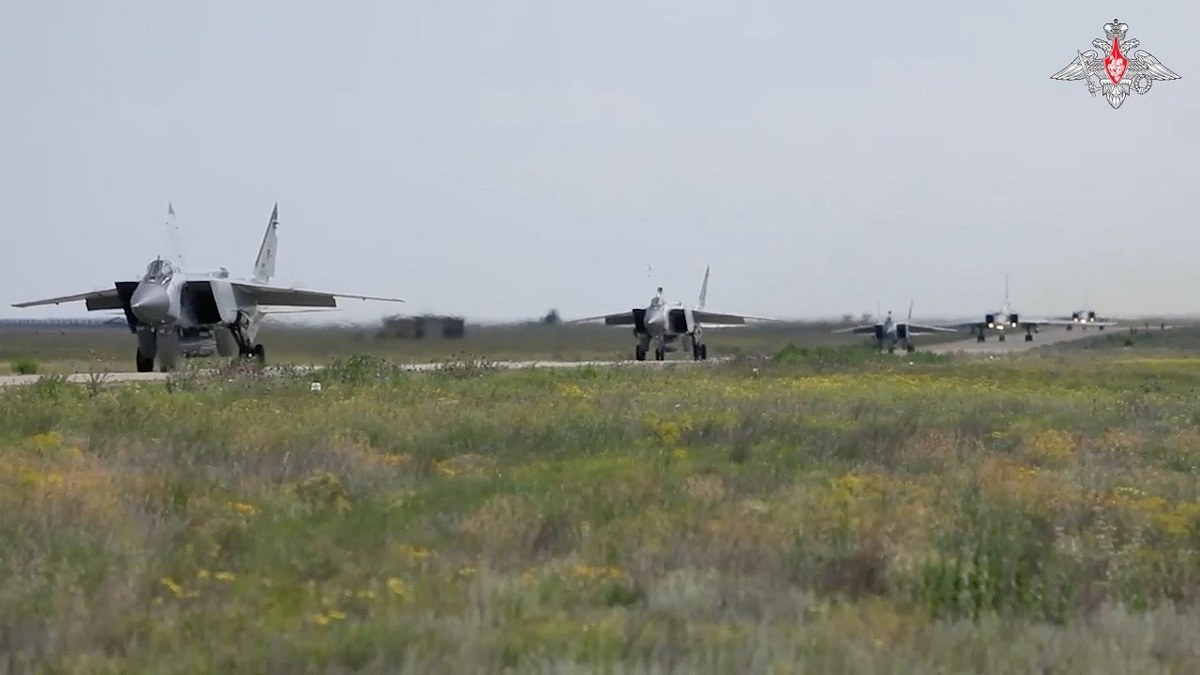
Military jets take off from the airfield during the second stage of tactical nuclear drills of the armed forces of Russia and Belarus at an undisclosed location, in this still image from video released June 11, 2024.
17:37 JST, June 12, 2024
MOSCOW, June 12 (Reuters) – Russia said on Wednesday that soldiers and sailors from its northern Leningrad military district bordering NATO members Norway, Finland, Poland, Estonia, Latvia and Lithuania took part in drills to deploy tactical nuclear weapons.
The move appears to broaden the disclosed geography of the nuclear drills to include soldiers from military districts which cover almost all of Russia’s European border, which stretches from the Arctic Ocean down to the Black Sea.
President Vladimir Putin ordered the drills, which were announced last month to take place in the Southern Military district bordering Ukraine, after what Russia said were signals from Western officials that they would allow Ukraine to strike deep into Russia with Western weapons.
“The personnel of the Leningrad Military District missile unit are practicing combat training tasks,” Russia’s defense ministry said in a statement about the drills.
These included obtaining special training ammunition for the Iskander-M operational-tactical missile system, equipping launch vehicles with them and covertly advancing to the designated position area for preparations for missile launches, it added.
“The crews of navy ships involved in the training will equip sea-based cruise missiles with special mock warheads and enter designated patrol areas,” the ministry said.
A video released by the Russian defense ministry showed a mobile missile system being escorted to a field as well as a rocket being loaded into a warship.
Russia said on Tuesday it started a second stage of drills to practice deployment of tactical nuclear weapons alongside Belarusian troops.
Putin said on Friday Russia had no need to use nuclear weapons to secure victory in Ukraine, the Kremlin’s strongest signal to date that Europe’s deadliest conflict since World War Two will not escalate into a nuclear war.
But he also said he did not rule out changes to Russia’s nuclear doctrine, which sets out the conditions under which such weapons could be used. He has previously said he saw no reason to change the doctrine.
The United States says it has seen no change to Russia’s strategic posture, though senior intelligence officials say they have to take Moscow’s remarks about nuclear weapons seriously.
Putin, Russia’s main decision-maker on deploying nuclear weapons, has faced calls from within the Russian elite to lower the threshold for using nuclear weapons.
Russia and the United States are by far the world’s biggest nuclear powers, holding about 88% of all nuclear weapons, according to the Federation of American Scientists.
When Russia announced the nuclear drills last month, it said missile forces in the Southern Military District would take part, together with aviation and the navy.
The Southern Military District, headquartered in Rostov-on-Don, lies alongside Ukraine and includes parts of Ukraine which Russia controls.
The Leningrad military district stretches from the border with Norway in the north down to Belarus, and includes the Northern Fleet and the exclave of Kaliningrad which sits on the Baltic Sea between Lithuania and Poland.
Russia has about 1,558 non-strategic nuclear warheads, though arms control experts say it is very difficult to say just how many there are due to secrecy.
Putin said last week that many of Russia’s tactical nuclear weapons were 70-75 kilotons of explosive power – around five times the size of the U.S. nuclear bomb dropped on Hiroshima in August 1945.






Most Read
Popular articles in the past 24 hours
-

University of Tsukuba Hospital to Introduce Working Dog Next Year...
-
Record 167 Elementary School Students Harmed Via Social Media in ...
-
Nidec Chairman Resigns Amid Accounting Scandal at Major Japanese ...
-

Japan’s Hikonyan Cat Mascot to Celebrate 20th Birthday with Party...
-

Humbert Humbert: Husband-Wife Vocal Duo Brings Cheerful Singing t...
-
Japan's Kairos Rocket Set to Launch on Sunday After Delays
-

Trump’s Address: Confront the Dead End that Authoritarianism Has ...
-

Mizuho to Cut Up to 5,000 Administrative Jobs with AI-Driven Oper...
Popular articles in the past week
-

Producer Behind Pop Group XG Arrested for Cocaine Possession
-

iPS Treatments Pass Key Milestone, but Broader Applications Far f...
-

Tokyo Skytree's Elevator Stops, Trapping 20 People; All Rescued (...
-

Nepal Bus Crash Kills 19 People, Injures 25 Including One Japanes...
-

Milano Cortina 2026: Japanese Gold Medalist Figure Skater Miura S...
-

Japan’s Major Real Estate Firms Expanding Overseas Businesses to ...
-

Milano Cortina 2026: Japanese Figure Skater Kaori Sakamoto’...
-

Reciprocal Tariffs Ruled Illegal: Judiciary Would Not Tolerate Pr...
Popular articles in the past month
-
Producer Behind Pop Group XG Arrested for Cocaine Possession
-

Japan PM Takaichi’s Cabinet Resigns en Masse
-

Japan Institute to Use Domestic Commercial Optical Lattice Clock ...
-

Man Infected with Measles Reportedly Dined at Restaurant in Tokyo...
-

Israeli Ambassador to Japan Speaks about Japan’s Role in the Reco...
-

Videos Plagiarized, Reposted with False Subtitles Claiming ‘Ryuky...
-

Man Infected with Measles May Have Come in Contact with Many Peop...
-

Prudential Life Insurance Plans to Fully Compensate for Damages C...
Top Articles in News Services
-
Survey Shows False Election Info Perceived as True
-

Hong Kong Ex-Publisher Jimmy Lai’s Sentence Raises International Outcry as China Defends It
-

Japan’s Nikkei Stock Average Touches 58,000 as Yen, Jgbs Rally on Election Fallout (UPDATE 1)
-
Japan’s Nikkei Stock Average Falls as US-Iran Tensions Unsettle Investors (UPDATE 1)
-
Japan’s Nikkei Stock Average Rises on Tech Rally and Takaichi’s Spending Hopes (UPDATE 1)
JN ACCESS RANKING
-
Producer Behind Pop Group XG Arrested for Cocaine Possession
-
Japan PM Takaichi’s Cabinet Resigns en Masse
-
Man Infected with Measles Reportedly Dined at Restaurant in Tokyo Station
-
Israeli Ambassador to Japan Speaks about Japan’s Role in the Reconstruction of Gaza
-
Videos Plagiarized, Reposted with False Subtitles Claiming ‘Ryukyu Belongs to China’; Anti-China False Information Also Posted in Japan