
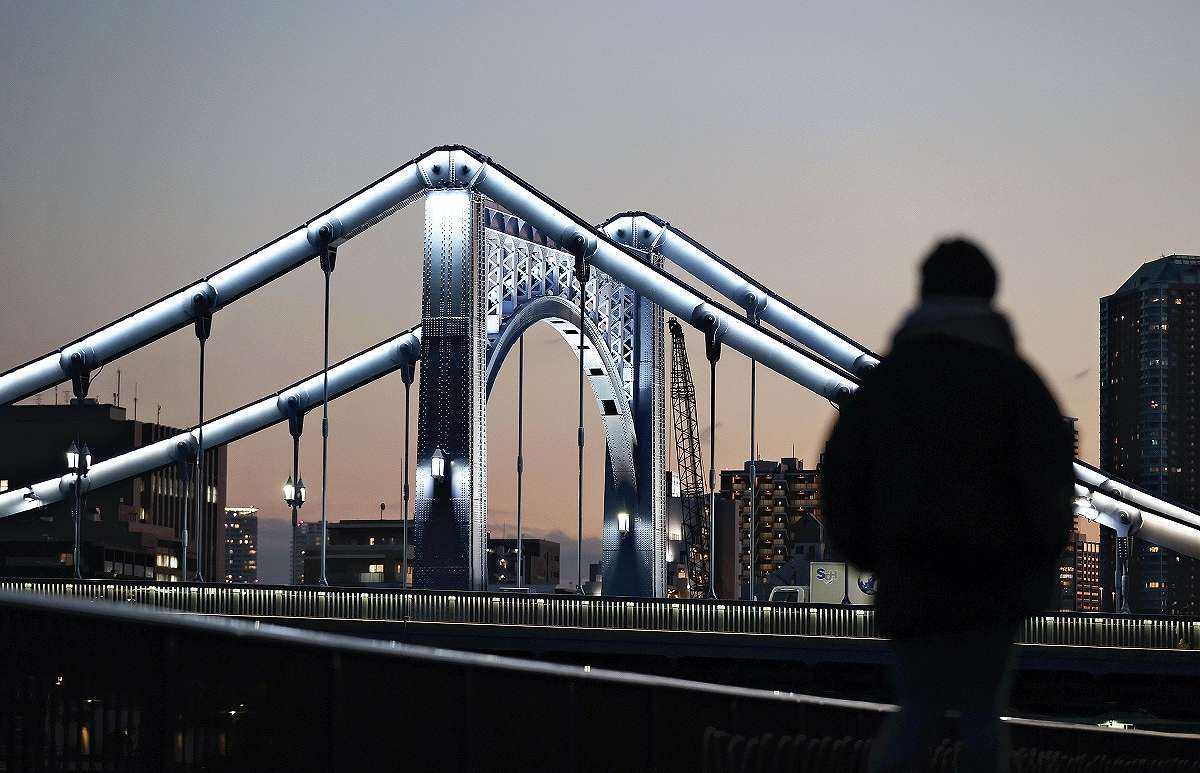
Kiyosu Bridge at dusk
15:00 JST, April 19, 2023
Kiyosu Bridge crossing the Sumida River in Tokyo’s Koto and Chuo wards is an impressive suspension bridge with graceful curves. The bright aqua-colored bridge looks brilliant against the blue sky and when illuminated at night, reminding us that Tokyo coexists with many rivers as a “city of water.”
The 186-meter-long bridge was completed in 1928 in accordance with the reconstruction plan after the Great Kanto Earthquake. The name of the bridge uses three kanji, two of them taken from Kiyosumi and Nakasu, towns on both banks of the river at the time. The third means a bridge.
It is no wonder that the bridge, characterized by street lamps with pointy tops, looks as though it is located in an old European town. It was modeled after a large suspension bridge over the Rhine in Germany, which was described as the most beautiful bridge in the world. Although the German bridge was destroyed during World War II, Kiyosu Bridge, which retains the appearance of the original, was designated as a national important cultural property in 2007.
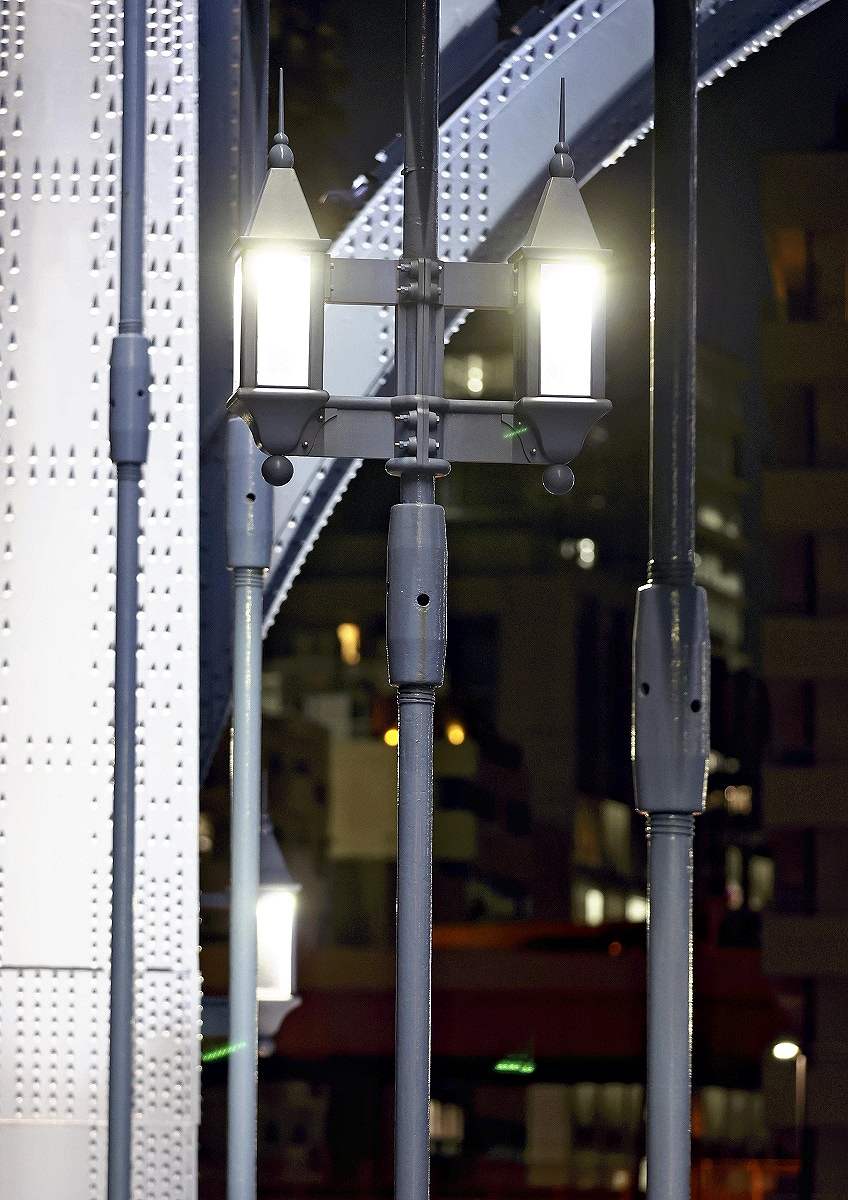
Streetlamps on the bridge
Kiyosu Bridge is often used as a location for shooting TV dramas, and became the setting for “Danjo Shichinin Natsu Monogatari” (Summer stories of seven men and women) in 1986, starring Sanma Akashiya and Shinobu Otake. Some people from the bubble economy generation may recall a scene on the bridge from the drama.
At the foot of the bridge on the Chuo Ward side is a plaque explaining the bridge. It is also embossed with the characters for “Kiyosu Bridge,” written by former Tokyo Gov. Shintaro Ishihara, who was also a writer. It shows his peculiar handwriting, which is said to have given his editors a hard time reading his work.
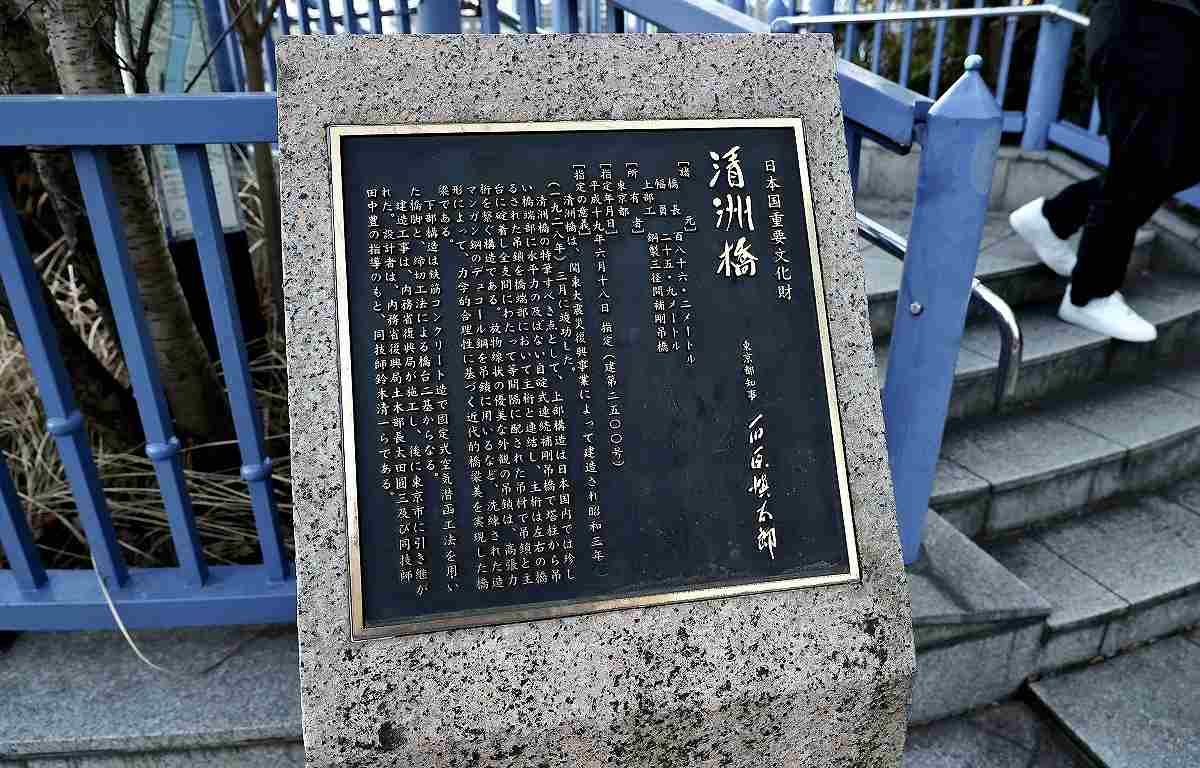
A plate embossed with the characters for “Kiyosu Bridge,” as written by former Tokyo Gov. Shintaro Ishihara
Reiganji temple, a short walk from the bridge on the Koto Ward side, is home to the graveyard of a lord of the Shirakawa domain, Matsudaira Sadanobu, known for his Kansei no kaikaku reform during the Edo period (1603-1867).
The names of a town in the area and the Kiyosumi-Shirakawa subway station are derived from the Shirakawa domain. Today, the Kiyosumi and Shirakawa areas are home to many unique stores, including an American-born coffee shop. The downtown area is changing into a stylish and popular town.
“When I was a child, I used to look up at the bridge and play in the river,” said Yoshiharu Suzuki, 62, the operator of local information website “Shitamachi Tanteidan.” Although those children are long gone, the 95-year-old Kiyosu Bridge still watches over the people of the town.
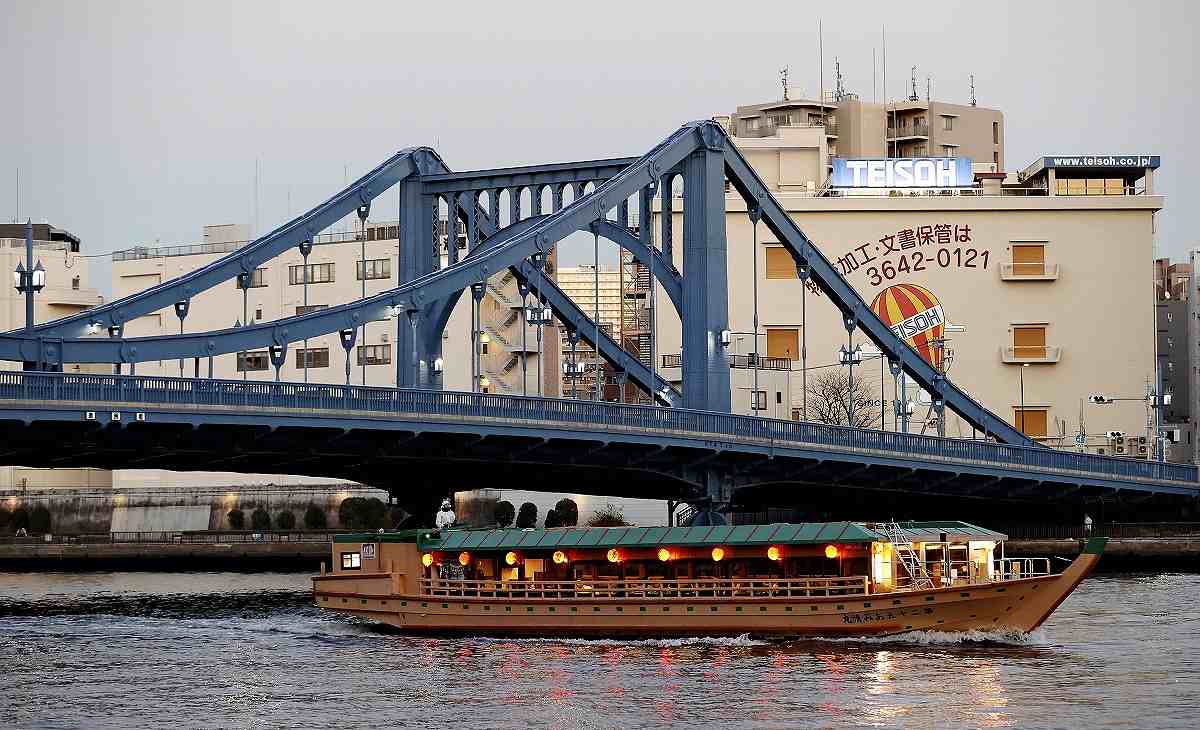
A yakatabune pleasure boat passes under the Kiyosu Bridge
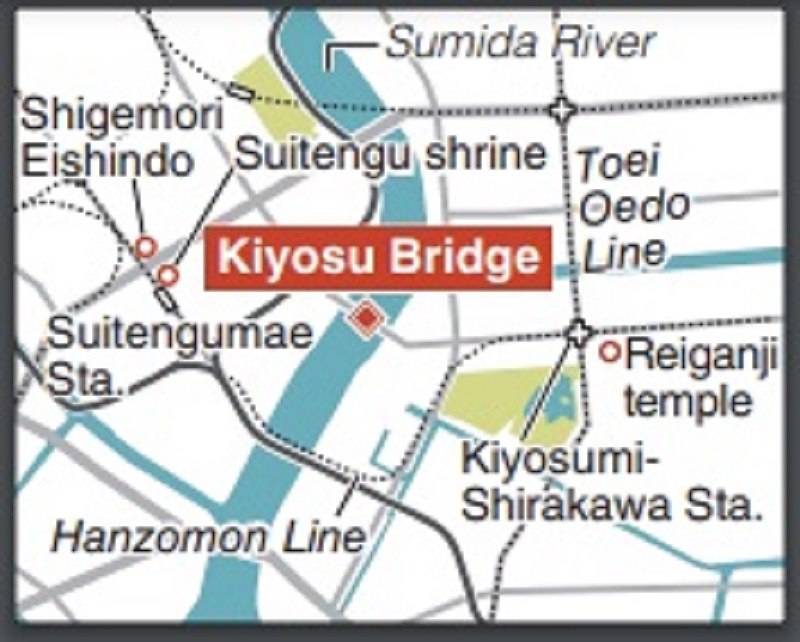
Kiyosu Bridge
Address: Kiyosumi, Koto Ward, and Nihombashi-Nakasu, Chuo Ward, Tokyo
Access: 8-minute walk from Kiyosumi-Shirakawa Station on the Hanzomon Line and the Toei Oedo Line as well as a 10-minute walk from Suitengumae Station on the Hanzomon Line
Memo: The bridge is illuminated 15 minutes after sunset until 11 p.m.


Related Tags



Most Read
Popular articles in the past 24 hours
-

Ransomware Attacks Hitting Japan's Small, Midsize Firms
-

German Journalist Traces Footsteps of Great-Grandfather Who Was P...
-

10 Foreign Tourists Sustain Injuries After Fire at Capsule Hotel ...
-

World Baseball Classic: Venezuela Beats Japan in Nail-biting Back...
-
Rapid Services Resume on JR Chuo Line; Suspension Caused by Accid...
-
Rapid Services on JR Chuo Line Suspended; Accident at Kokubunji S...
-

World Baseball Classic: Venezuela Beats Japan in Back-and-Forth Q...
-

World Baseball Classic: Red Sox’s Abreu Hits 3-run Homer, Giving ...
Popular articles in the past week
-

Japan Figure Skating Legend Yuzuru Hanyu Is Proud Disaster Surviv...
-
15 Measles Patients Confirmed in Tokyo in Past 6 Days; 1 May Have...
-
Massive Sewer Pipe Found Jutting Out of Highway in Osaka
-

Japan Govt to Tighten Requirements to Receive Permanent Residency...
-
Power Outage Forces About 980 Passengers in Yokohama to Walk to T...
-
JR Tokai Breaks Ground on Yamanashi Maglev Station; Will Be Part ...
-

Parents in Japan to Get Instagram Notifications When Teens Repeat...
-
'World's Oldest Bio-Business' Is Japan's Seed Koji Retailing, Mol...
Popular articles in the past month
-

Producer Behind Pop Group XG Arrested for Cocaine Possession
-

Japan PM Takaichi’s Cabinet Resigns en Masse
-

Man Infected with Measles Reportedly Dined at Restaurant in Tokyo...
-
Japan Figure Skating Legend Yuzuru Hanyu Is Proud Disaster Surviv...
-

iPS Treatments Pass Key Milestone, but Broader Applications Far f...
-

Sanae Takaichi Elected Prime Minister of Japan; Keeps All Cabinet...
-
South Korea Tightens Rules on Foreigners Buying Homes in Seoul Me...
-

Nepal Bus Crash Kills 19 People, Injures 25 Including One Japanes...
Top Articles in Features
-
Japanese Students Use Traditional Pickle to Create Novel Wagashi Confectionery
-

My Spendthrift Mother Constantly Asks Me for Money
-
Kawazu Cherry Blossoms in Full Bloom in Japan’s Shizuoka Pref.; Festival to Be Held through March 8
-
Tourists Ignore Safety Barriers Near Famous Zao ‘Snow Monsters’ in Japan
-
Tottori: 95-Year-Old Japanese Descendent from Philippines Visits Father’s Grave
JN ACCESS RANKING
-
Producer Behind Pop Group XG Arrested for Cocaine Possession
-
Japan PM Takaichi’s Cabinet Resigns en Masse
-
Man Infected with Measles Reportedly Dined at Restaurant in Tokyo Station
-
Japan Figure Skating Legend Yuzuru Hanyu Is Proud Disaster Survivor and Gold Medalist, Vows to Continue Support Efforts
-
iPS Treatments Pass Key Milestone, but Broader Applications Far from Guaranteed