
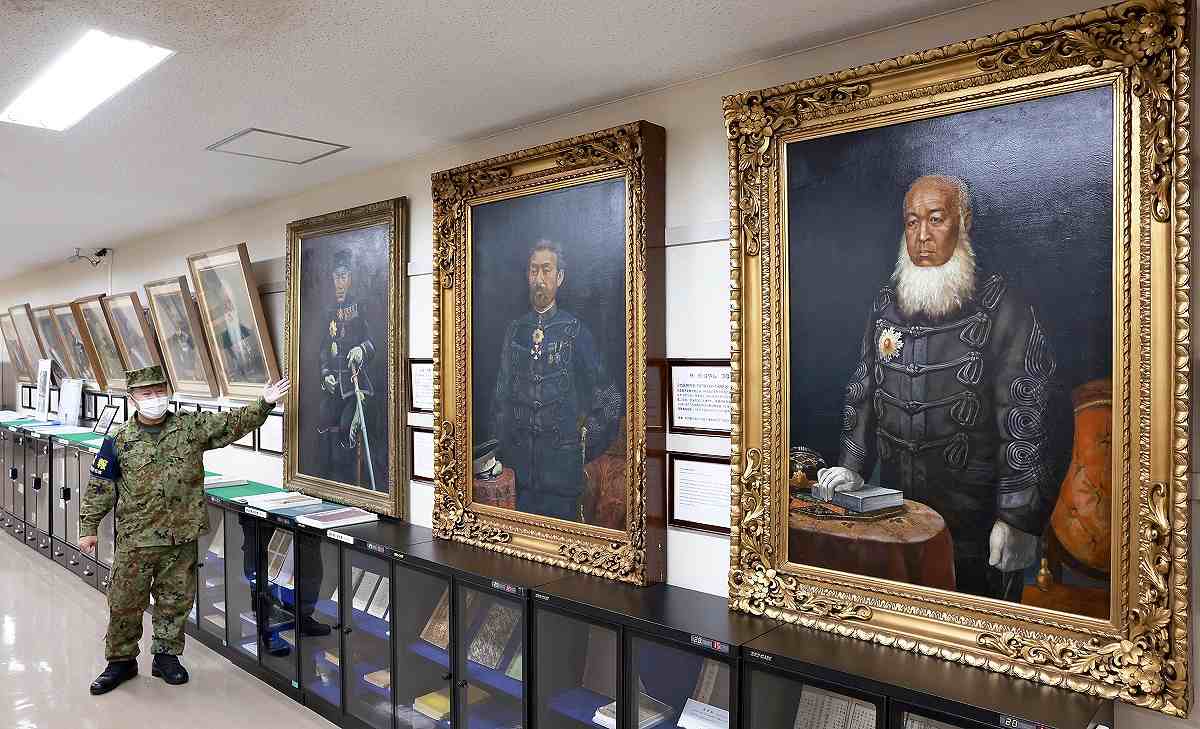
A museum gallery where portraits of directors of the Army Ministry’s medical bureau and others line the walls. The portrait third from the right is of Tadanori Ishiguro.
11:00 JST, April 5, 2023
Ironically, war and medical science have advanced in lockstep. The development of weapons has led to the diversification of war injuries, as well as advances in new treatment and medical equipment to cure them.
The Shoukokan Military Medicine Historical Museum allows visitors to learn about the history and advancement of medical science since the end of the Edo period.
Portraits of successive directors of the Army Ministry’s medical bureau line the walls of the exhibition hall. One of the portraits is of Tadanori Ishiguro, who laid the foundation of the military medical system in Japan.
Ishiguro predicted that the Shinpuren no Ran rebellion by samurai warriors in 1876 would be the last war in which people would get injured by swords. Therefore, he asked an artist to draw sword wounds to keep records of them. The original paintings, which are among the museum’s collection, vividly depict the characteristics of wounds suffered by samurai in battle.
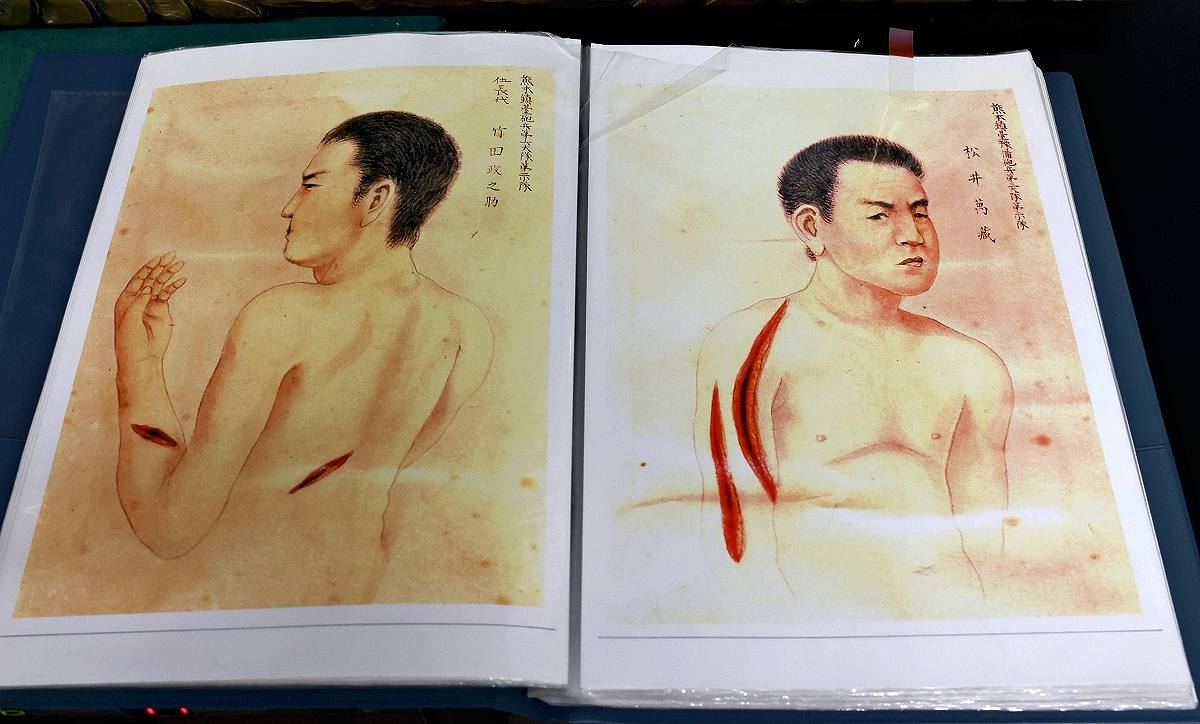
A copy of a drawing depicting sword wounds from the Shinpuren no Ran rebellion by samurai warriors in 1876.
Bullets removed from bodies are on display, as are anatomical models of faces that show how operations for facial injuries were conducted. The latter are so painful to see that one might be tempted to turn away. Such materials that have documented war wounds clearly convey to visitors the reality of war.
The museum also exhibits the oldest clinical X-ray machine in Japan and other valuable medical equipment.
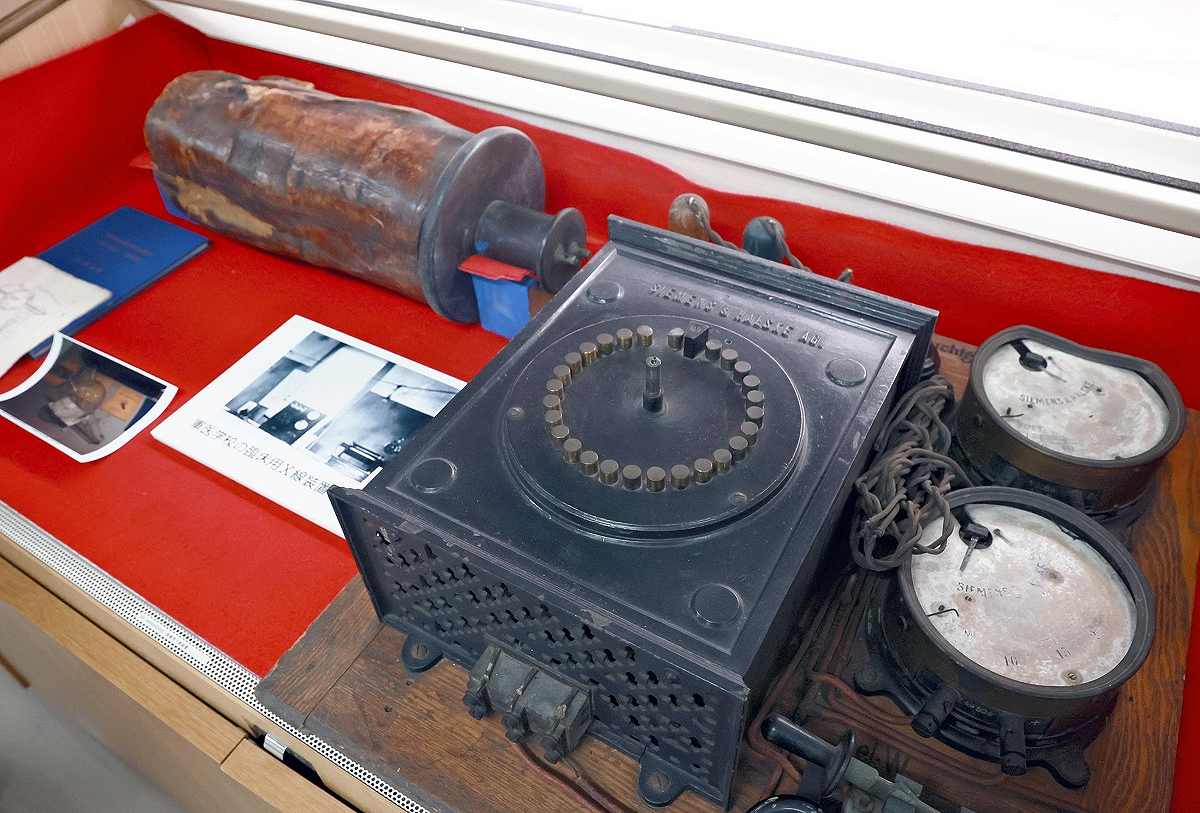
The oldest clinical X-ray machine in Japan cost about ¥1,000, when the monthly salary of the military doctor who purchased it was about ¥90.
One unexpected display is a prosthetic hand, which was proposed by Imperial Japanese Army Gen. Maresuke Nogi (1849-1912) so that soldiers who lost both hands could still smoke cigarettes. The prosthetic hands are said to have been produced at Nogi’s expense and distributed to wounded soldiers.
Among the museum’s photographic archives are photos showing Russian soldiers captured during the Russo-Japanese War who were sent to a prison camp in Narashino, Chiba Prefecture. These suggest the POWs lived relatively freely, gambling and relaxing on the lawn.
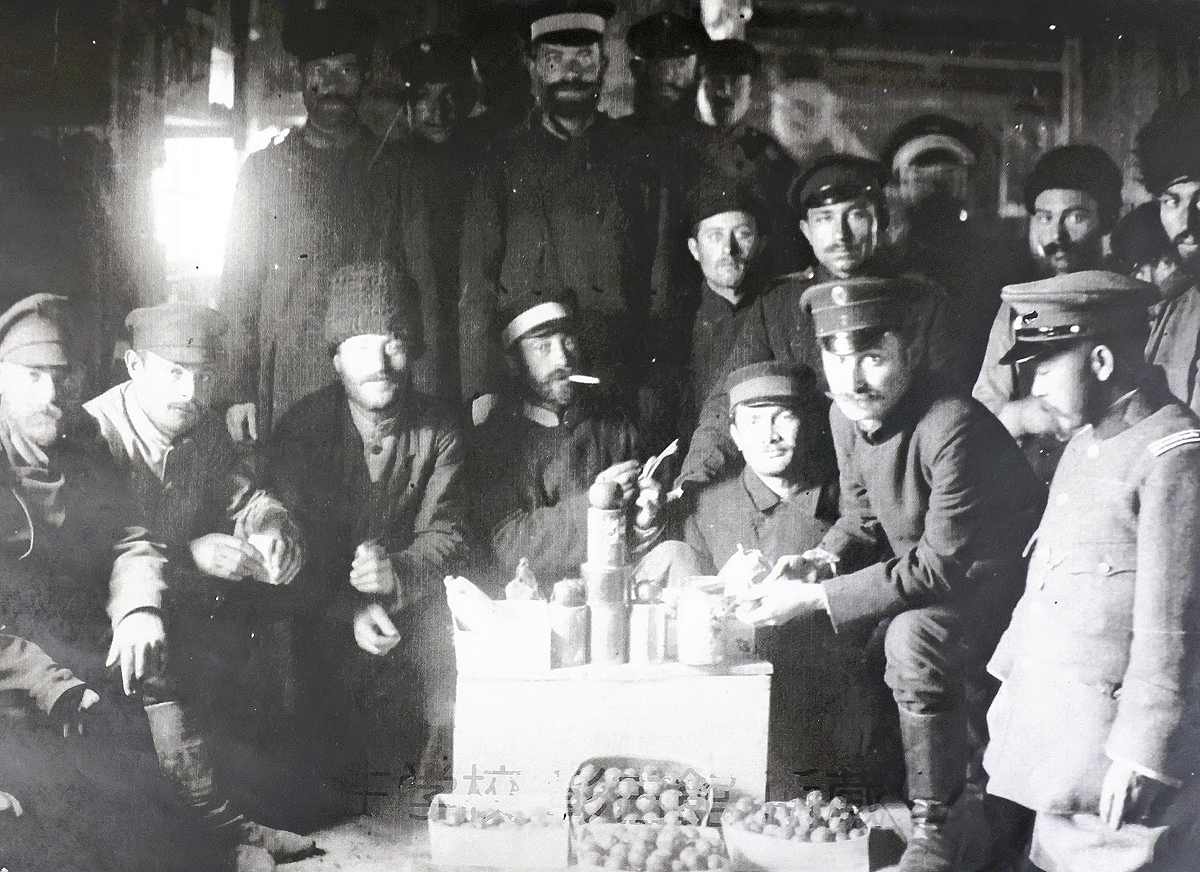
A photo shows Russian soldiers and others running a black market at a POW camp in Narashino, Chiba Prefecture.
“How optimistic they are despite being captured by an enemy country at a time when their home country is in danger of extinction?” a military doctor at that time wrote in a document.
“Many of the items in the collection are valuable pieces inherited from the old military medical school,” a public relations support officer at the JGSDF Medical Service School said. “Sources of these items are identified and therefore, the backgrounds [of these records] can be well understood.”
Recently, the museum received an inquiry from a person who was looking for a photo of their mother, and it was found after a search using the mother’s name and other personal details.
The museum shows that continuous advances in medical science are essential for those injured in war and reminds visitors that it is people themselves who are waging wars and saving the lives of those injured.
Shoukokan Military Medicine Historical Museum
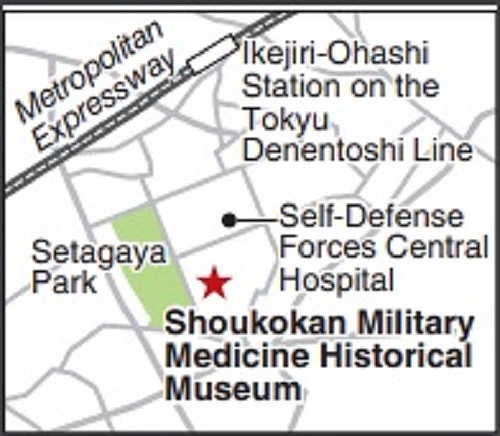
The museum opened as an educational facility in 1956 and is open to the public. A reservation is required at least two weeks before a planned visit, as the museum is located on the grounds of the Self-Defense Forces.
Address: 1-2-24 Ikejiri, Setagaya Ward, Tokyo
Open: 9:00 a.m. to noon, 1:00 p.m. to 4 p.m. on weekdays.
Admission: Free.


Related Tags



Most Read
Popular articles in the past 24 hours
-

Ransomware Attacks Hitting Japan's Small, Midsize Firms
-
German Journalist Traces Footsteps of Great-Grandfather Who Was P...
-

10 Foreign Tourists Sustain Injuries After Fire at Capsule Hotel ...
-

World Baseball Classic: Venezuela Beats Japan in Nail-biting Back...
-

Rapid Services Resume on JR Chuo Line; Suspension Caused by Accid...
-

Rapid Services on JR Chuo Line Suspended; Accident at Kokubunji S...
-

World Baseball Classic: Venezuela Beats Japan in Back-and-Forth Q...
-

World Baseball Classic: Red Sox’s Abreu Hits 3-run Homer, Giving ...
Popular articles in the past week
-

Japan Figure Skating Legend Yuzuru Hanyu Is Proud Disaster Surviv...
-
15 Measles Patients Confirmed in Tokyo in Past 6 Days; 1 May Have...
-
Massive Sewer Pipe Found Jutting Out of Highway in Osaka
-
Japan Govt to Tighten Requirements to Receive Permanent Residency...
-
Power Outage Forces About 980 Passengers in Yokohama to Walk to T...
-
JR Tokai Breaks Ground on Yamanashi Maglev Station; Will Be Part ...
-

Parents in Japan to Get Instagram Notifications When Teens Repeat...
-
'World's Oldest Bio-Business' Is Japan's Seed Koji Retailing, Mol...
Popular articles in the past month
-

Producer Behind Pop Group XG Arrested for Cocaine Possession
-

Japan PM Takaichi’s Cabinet Resigns en Masse
-

Man Infected with Measles Reportedly Dined at Restaurant in Tokyo...
-
Japan Figure Skating Legend Yuzuru Hanyu Is Proud Disaster Surviv...
-

iPS Treatments Pass Key Milestone, but Broader Applications Far f...
-

Sanae Takaichi Elected Prime Minister of Japan; Keeps All Cabinet...
-

South Korea Tightens Rules on Foreigners Buying Homes in Seoul Me...
-

Nepal Bus Crash Kills 19 People, Injures 25 Including One Japanes...
Top Articles in Features
-
Japanese Students Use Traditional Pickle to Create Novel Wagashi Confectionery
-

My Spendthrift Mother Constantly Asks Me for Money
-
Kawazu Cherry Blossoms in Full Bloom in Japan’s Shizuoka Pref.; Festival to Be Held through March 8
-
Tourists Ignore Safety Barriers Near Famous Zao ‘Snow Monsters’ in Japan
-
Tottori: 95-Year-Old Japanese Descendent from Philippines Visits Father’s Grave
JN ACCESS RANKING
-
Producer Behind Pop Group XG Arrested for Cocaine Possession
-
Japan PM Takaichi’s Cabinet Resigns en Masse
-
Man Infected with Measles Reportedly Dined at Restaurant in Tokyo Station
-
Japan Figure Skating Legend Yuzuru Hanyu Is Proud Disaster Survivor and Gold Medalist, Vows to Continue Support Efforts
-
iPS Treatments Pass Key Milestone, but Broader Applications Far from Guaranteed