
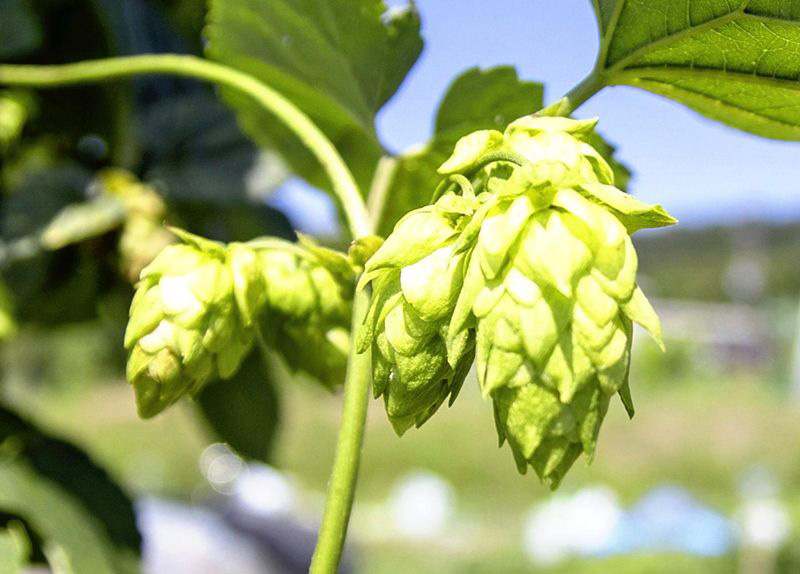
An up-close view of a hop plant
10:55 JST, January 11, 2022
Beer gets its distinctive flavor from hops, and communities around Japan are putting their own local flavor into beer through projects to grow hops at the grassroots level.
In some places, there are even hopes of promoting the plant as a new local specialty.
An event called Takanawa Hop Fest was held in November near Takanawa Gateway Station on the JR Yamanote Line in Minato Ward, Tokyo. Organized by East Japan Railway Co. and others, the event featured beer made from hops grown at nine locations by companies and individuals in the neighborhood of the station.
Hops are cone-shaped flowers. Inside the flowers are yellow grains called lupulin, which are removed and added to beer during the brewing process to add a bitter flavor and aroma to the beverage.
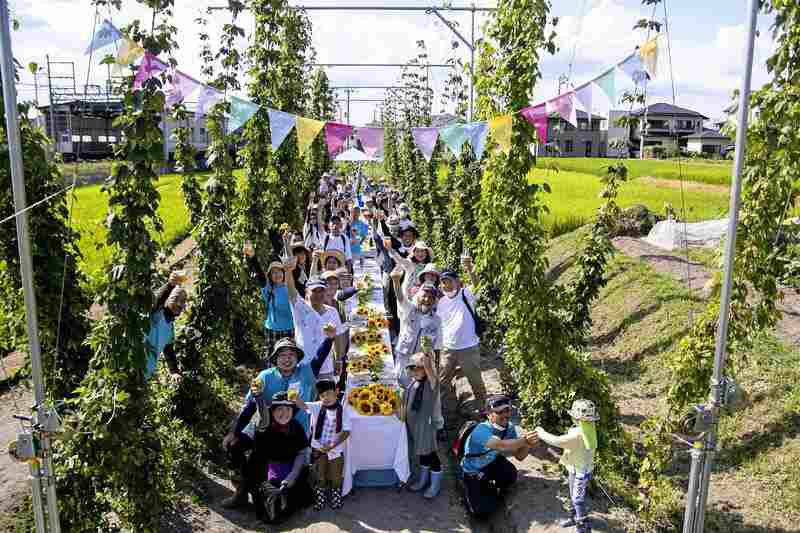
A Katano Orihime University event held in a hops field in Katano, Osaka Prefecture
Local residents cultivated hop seedlings in planters and harvested the flowers in August with the specific purpose of using them for the event.
Yuki Minami, who runs a nearby restaurant, is one of those local residents. He planted hop seedlings in April and harvested them in the summer.
“I watered them every day and took good care of them,” he said. “Drinking the beer gave me a real sense that I produced the hops,” he said with a smile.
The group harvested about 2.8 kilograms of hops last year, helping to produce 600 bottles, each containing 330 milliliters of beer featuring all “Takanawa hops.”

A glass of beer with added hops
A JR East official said, “We would like to cultivate a new community through hops-driven exchange.”
In recent years, craft beers with unique flavors have become popular, and hops, which add depth to the taste of beer, are attracting attention. People are also increasingly becoming interested in growing their own hops.
A field next to the terminal at Nanki-Shirahama Airport in Shirahama, Wakayama Prefecture, was used to plant hops. This year, together with local residents, Nanki-Shirahama Airport, Inc. — which operates the facility — plans to increase the cultivation of hops and use the plant to manufacture a homegrown brew at Nagisa Beer Co., a craft brewery in town.
“We hope that airport beer will become a specialty and boost the community,” said Shinichiro Okada, president of the airport company.
Related moves by local residents are also noticeable. In March last year, Katano Orihime University, a community college in Katano, Osaka Prefecture, began recruiting members for its “craft beer club” and rented fields totaling about 2,000 square meters in two locations for the cultivation of hops. About 60 participants planted seedlings in the fields and cleared weeds from the area, the college said.
Brewing of beer using hops harvested in the area took place in late November. The group, which also began growing barley, among other plants, plans to build a brewery.
Takeshi Kai, vice president of the college, deemed the event a success. “The club activity was well-received by the members, who said their participation in this [project] helped them make new friends. I hope the beer will become a local specialty,” Kai said.
Jun Kumahara of Osaka-based Toho Leo Co., which supports community building through the cultivation of hops, said growing the plant builds community spirit.
“Participation by a lot of people is necessary to cultivate hops for beer making. When people come together, various connections are formed,” Kumahara said. “With the activity spreading nationwide, the number of people interested in hops cultivation is likely to increase in the future.”
Cultivating hops at home
Growing hops can also be an at-home hobby. Yasuko Tanaka, a horticultural specialist, has been growing hops on her balcony for the past five years, forming a “green curtain” that acts as a protective shade.
She also experiments with the taste of hops by adding them to commercially available beer. Tanaka said the plant’s bitterness and aroma enhance the flavor.
“The addition makes me realize the flavor of beer does come from hops. And it is not difficult to grow hops,” Tanaka said.
The seedlings become available online or hit the shelves at hardware stores and other shops around March. A large planter is said to be best when cultivating hops, a perennial plant that can be grown over multiple years.









Most Read
Popular articles in the past 24 hours
-

Japan's Budget on Track for Quick Passage, but Ruling Parties to ...
-

Japan-Based USS Tripoli, Marine Unit to Be Sent to Middle East, U...
-

Ransomware Attacks Hitting Japan's Small, Midsize Firms
-

7 Men Arrested Over Robbery of ¥423 Mil. on Tokyo Street; Members...
-

National Intelligence Council: Proposed Body Must Be Utilized To ...
-

‘Kokuho’ Wins Record 10 Awards at Japan Academy Film Prize; Demon...
-

North Korea Fires about 10 Missiles toward Sea in Show of Force, ...
-

Milano Cortina 2026: Japan’s Daichi Oguri Wins Silver in Pa...
Popular articles in the past week
-

Japan Figure Skating Legend Yuzuru Hanyu Is Proud Disaster Surviv...
-

Govt to Utilize ODA for Ensuring Economic Security; Securing Ener...
-
15 Measles Patients Confirmed in Tokyo in Past 6 Days; 1 May Have...
-

Massive Sewer Pipe Found Jutting Out of Highway in Osaka
-

Japan Govt to Tighten Requirements to Receive Permanent Residency...
-

Power Outage Forces About 980 Passengers in Yokohama to Walk to T...
-

JR Tokai Breaks Ground on Yamanashi Maglev Station; Will Be Part ...
-

Beckoning Cats Get Makeover to Fit Modern Lifestyles with Sleek D...
Popular articles in the past month
-

Producer Behind Pop Group XG Arrested for Cocaine Possession
-

Japan PM Takaichi’s Cabinet Resigns en Masse
-

Man Infected with Measles Reportedly Dined at Restaurant in Tokyo...
-
Japan Figure Skating Legend Yuzuru Hanyu Is Proud Disaster Surviv...
-

iPS Treatments Pass Key Milestone, but Broader Applications Far f...
-

Sanae Takaichi Elected Prime Minister of Japan; Keeps All Cabinet...
-

South Korea Tightens Rules on Foreigners Buying Homes in Seoul Me...
-

Nepal Bus Crash Kills 19 People, Injures 25 Including One Japanes...
Top Articles in Features
-

High-Hydration Bread on the Rise, Seeing Increase in Specialty Shops, Recipe Searches
-
Japanese Students Use Traditional Pickle to Create Novel Wagashi Confectionery
-

My Spendthrift Mother Constantly Asks Me for Money
-

Tourists Ignore Safety Barriers Near Famous Zao ‘Snow Monsters’ in Japan
-

Kawazu Cherry Blossoms in Full Bloom in Japan’s Shizuoka Pref.; Festival to Be Held through March 8
JN ACCESS RANKING
-
Producer Behind Pop Group XG Arrested for Cocaine Possession
-
Japan PM Takaichi’s Cabinet Resigns en Masse
-
Man Infected with Measles Reportedly Dined at Restaurant in Tokyo Station
-
Japan Figure Skating Legend Yuzuru Hanyu Is Proud Disaster Survivor and Gold Medalist, Vows to Continue Support Efforts
-
iPS Treatments Pass Key Milestone, but Broader Applications Far from Guaranteed