
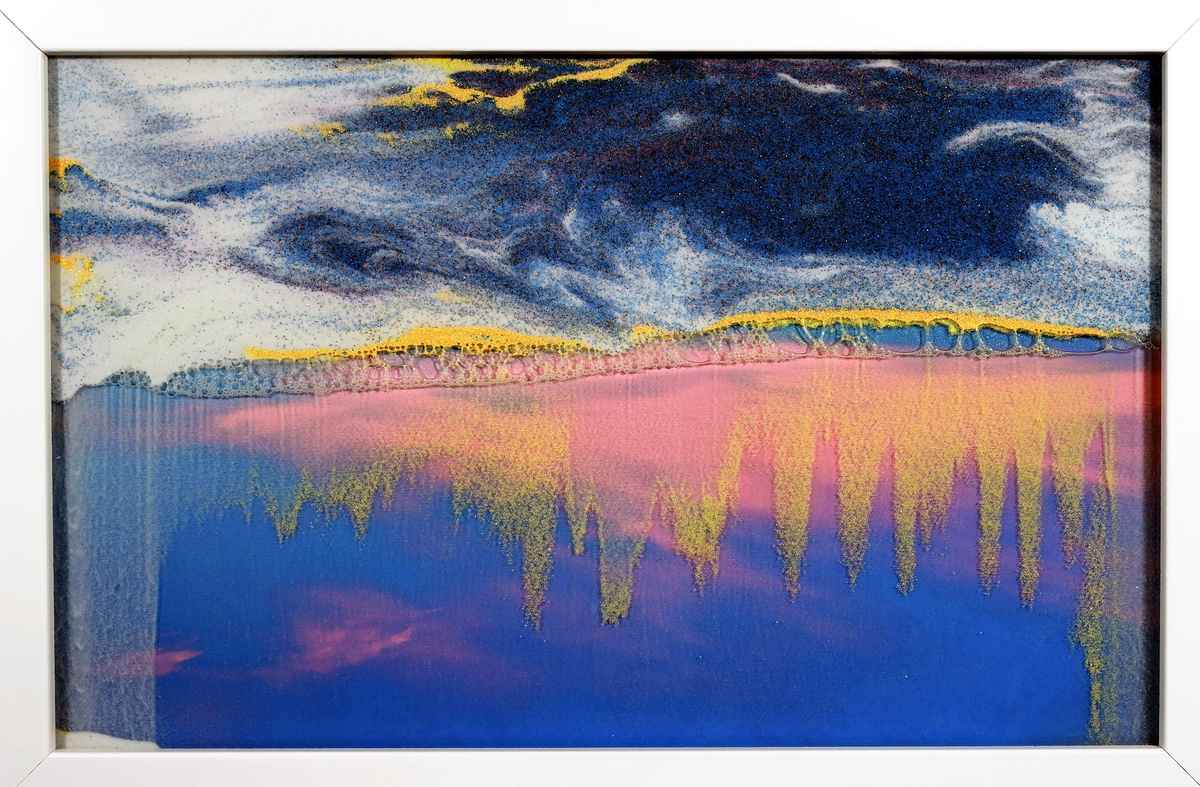
A sand picture is seen immediately after being turned. The sand begins to fall through the air layer.
14:30 JST, August 29, 2025
“Sand pictures” are pieces of art in which patterns gradually shift with the flow of sand. These captivating pieces surprise and soothe observers with their ever-changing landscapes.
In one piece, sand in colors like purple, dark blue and gold flows down as if in an hourglass inside a 22-centimeter-high by 33-centimeter-wide frame. In the background is a beautiful dawn sky. As the sand falls, it piles up like the gentle ridges of mountains, eventually forming a complete “landscape painting.”
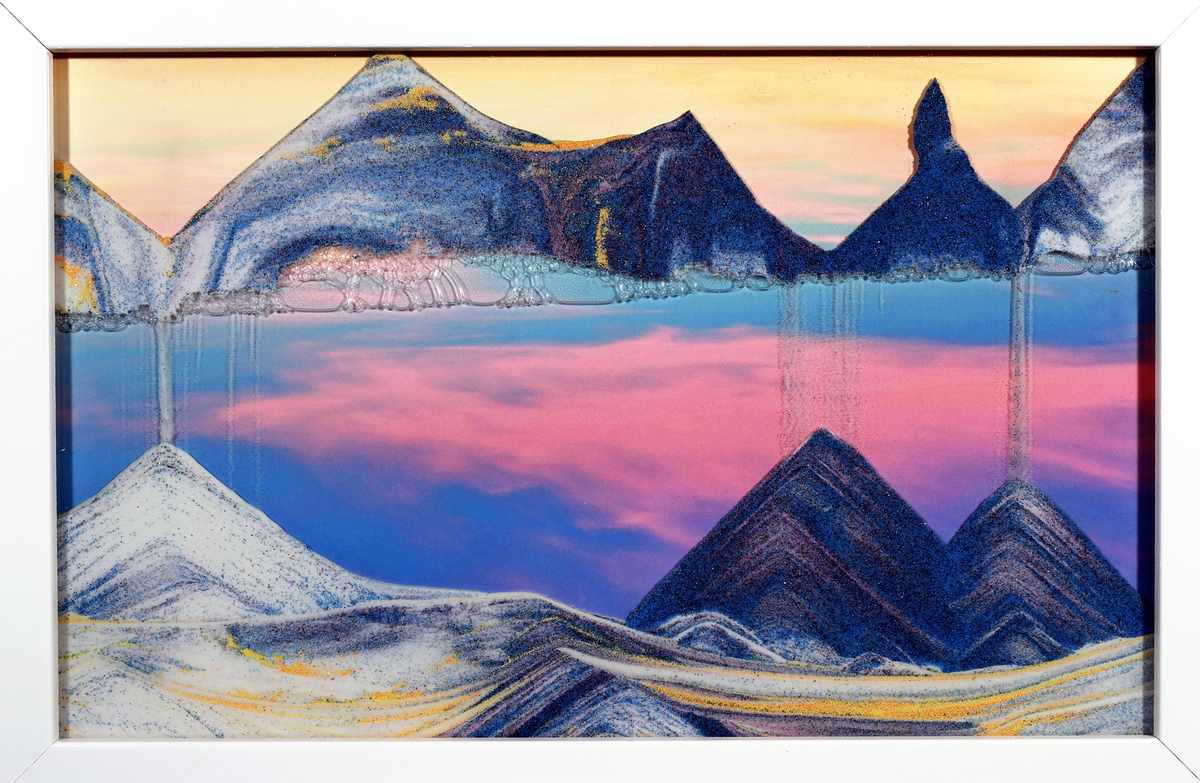
Once more than half of the sand has fallen, black mountain-like shapes form on the right.
The pieces were conceived and created by Austrian artist Klaus Bosch in 1988. Several types of sand with different levels of density, along with water and air, are placed between two thin glass plates, and the edges are sealed with special silicone. When the artwork is inverted, the sand moves through the gaps between the bubbles, creating various patterns.
The pieces were sold as pop-up items by Daimaru Matsuzakaya Department Stores Co. “I was attracted to their artistic quality, as well as how they allow people to enjoy the serendipity of the sand,” said Akio Hisada, 65, who oversaw product development at Daimaru at the time of his interview with The Yomiuri Shimbun. “They are popular among a range of generations, both for personal use and gifting.”
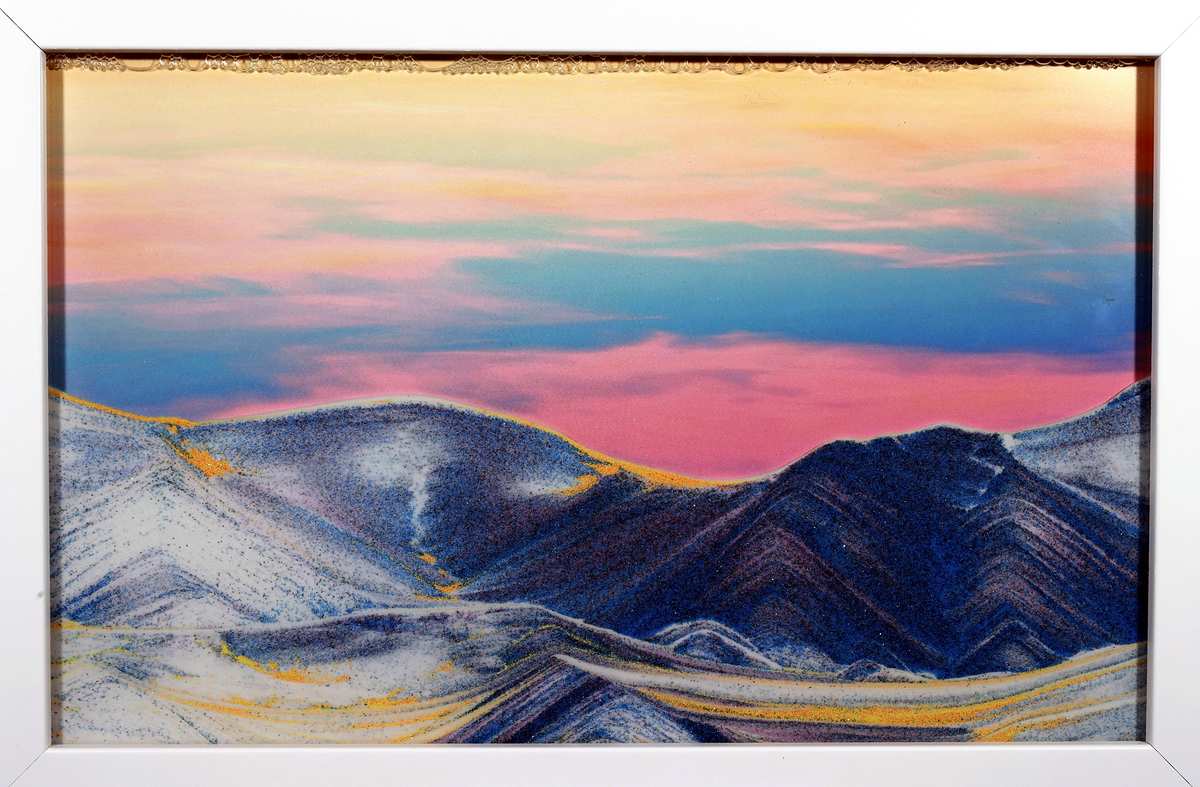
After all the sand has fallen, the work resembles a landscape painting of mountains illuminated by the morning sun.
The sizes vary from that of postcards to framed pieces measuring 50-centimeter-high by 70-centimeter-wide. In addition to wall-mounted pieces, there are also tabletop types with stands. Some pieces do not have backgrounds, but recently, those set against paintings or photographs have become popular.
For example, “Mangetsu” (Full moon) uses a photograph of a full moon taken by professional Japanese photographer Kagaya. Two types of blue sand represent the depth of the night sky, while white sand represents clouds, highlighting the light of the full moon. “It’s a wonderful piece that allows you to watch as the moon appears and disappears,” said Hisada.
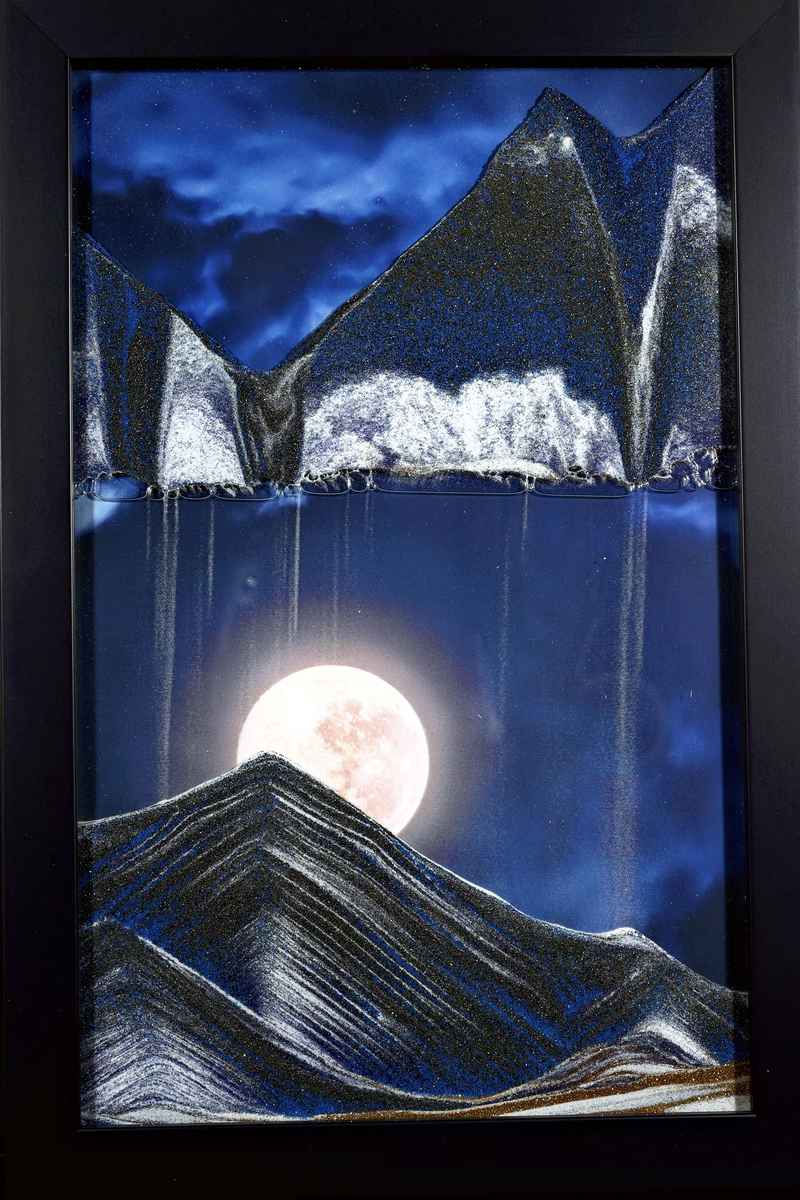
“Mangetsu”
The sand falls according to how vigorously the work is inverted and the amount of air used, so the same pattern never appears twice. Depending on size, it can take anywhere from a few minutes to five or six hours for patterns to shift after changing the orientation. In Europe, the sand pictures have been displayed in spaces where people gather, like offices and waiting rooms, to stir up lively conversations.
Adjustable air volume
The momentum of the sand falling is determined by the amount of air inside the glass plates. With a lot of air, the layer of bubbles becomes thicker, slowing down the movement of the sand. Conversely, with less air, the gaps between the bubbles widen with the weight of the sand, increasing the speed at which it falls. The amount of air can be adjusted using an attached tool called an injector.
“If you want to pile the sand like a steep mountain, use more air; if you want it flat, use less,” said Hisada. “By adjusting to your preferences, you open up even more ways to enjoy the art.”

An injector, which is used to adjust the speed at which sand flows down by increasing or decreasing the amount of air trapped between the glass plates



Most Read
Popular articles in the past 24 hours
-
Tokyo Spends Big on Children, Wins Over Parents
-

Japan’s Miura, Kihara Announce Withdrawal from Figure Skating Wor...
-

Nidec Chairman Resigns Amid Accounting Scandal at Major Japanese ...
-

Japan's Opposition Parties Largely Absent from Social Security-Re...
-
Hokkaido's Shiretoko Peninsula Offers Unique Drift Ice Walking To...
-

Trump’s Address: Confront the Dead End that Authoritarianism Has ...
-

6 of Japan's Remote Islands to Be Added to Govt List for Priority...
-

JR Kyushu Mulls Using Trains for Concertgoer Lodgings; Performanc...
Popular articles in the past week
-

Producer Behind Pop Group XG Arrested for Cocaine Possession
-

Nepal Bus Crash Kills 19 People, Injures 25 Including One Japanes...
-

Tokyo Skytree's Elevator Stops, Trapping 20 People; All Rescued (...
-

Milano Cortina 2026: Japanese Gold Medalist Figure Skater Miura S...
-

Japan’s Major Real Estate Firms Expanding Overseas Businesses to ...
-

Reciprocal Tariffs Ruled Illegal: Judiciary Would Not Tolerate Pr...
-
Japanese High School Student Aims to Share Kaiten History Through...
-

Milano Cortina 2026: Miura-Kihara Duo, Other Japanese Figure Skat...
Popular articles in the past month
-
Producer Behind Pop Group XG Arrested for Cocaine Possession
-

Japan PM Takaichi’s Cabinet Resigns en Masse
-

Man Infected with Measles Reportedly Dined at Restaurant in Tokyo...
-

Israeli Ambassador to Japan Speaks about Japan’s Role in the Reco...
-

Videos Plagiarized, Reposted with False Subtitles Claiming ‘Ryuky...
-

Man Infected with Measles May Have Come in Contact with Many Peop...
-

Prudential Life Insurance Plans to Fully Compensate for Damages C...
-
Woman with Measles Visited Hospital in Tokyo Multiple Times Befor...
Top Articles in Culture
-

BTS to Hold Comeback Concert in Seoul on March 21; Popular Boy Band Releases New Album to Signal Return
-

Director Naomi Kawase’s New Film Explores Heart Transplants in Japan, Production Involved Real Patients, Families
-

Tokyo Exhibition Offers Inside Look at Impressionism; 70 of 100 Works on ‘Interiors’ by Monet, Others on Loan from Paris
-
Traditional Japanese Silk Hakama Tradition Preserved by Sole Weaver in Sendai
-
Japanese Byobu Folding Screens Tailored to Meet Modern Lifestyles; Foreign Orders Also Piling up
JN ACCESS RANKING
-
Producer Behind Pop Group XG Arrested for Cocaine Possession
-
Japan PM Takaichi’s Cabinet Resigns en Masse
-
Man Infected with Measles Reportedly Dined at Restaurant in Tokyo Station
-
Israeli Ambassador to Japan Speaks about Japan’s Role in the Reconstruction of Gaza
-
Videos Plagiarized, Reposted with False Subtitles Claiming ‘Ryukyu Belongs to China’; Anti-China False Information Also Posted in Japan