
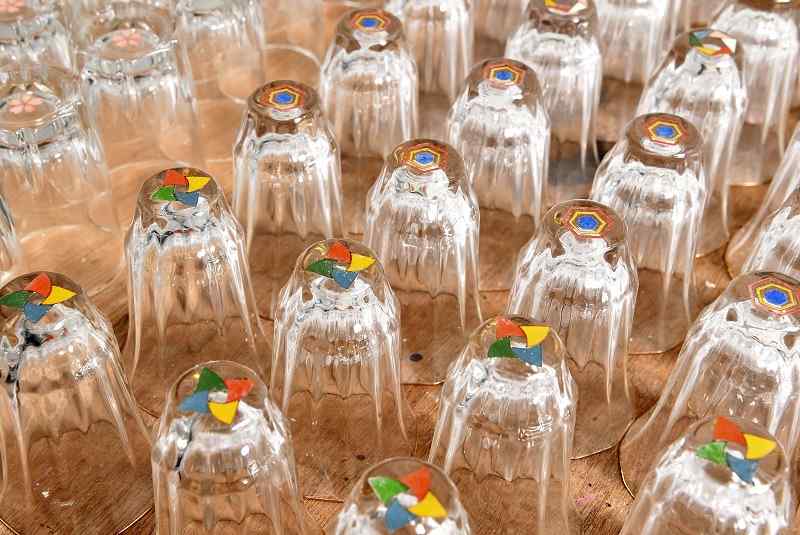
Raden work applied to glasses in Takaoka, Toyama Prefecture
16:51 JST, November 17, 2022
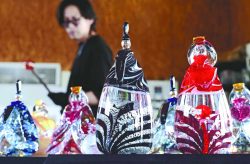
Small thin pieces of abalone shells were being carefully attached to the bottom of a dodecagonal glass with a pointed stick.
The work requires careful attention from Takeshi Musashigawa, 41, the fourth-generation owner of Musashigawa Kobo factory for raden shell-inlay work in Takaoka, Toyama Prefecture. When a glass finished with lacquer or other techniques is filled with sake or water, patterns like those of a kaleidoscope appear on the surface due to the reflection of the raden work.
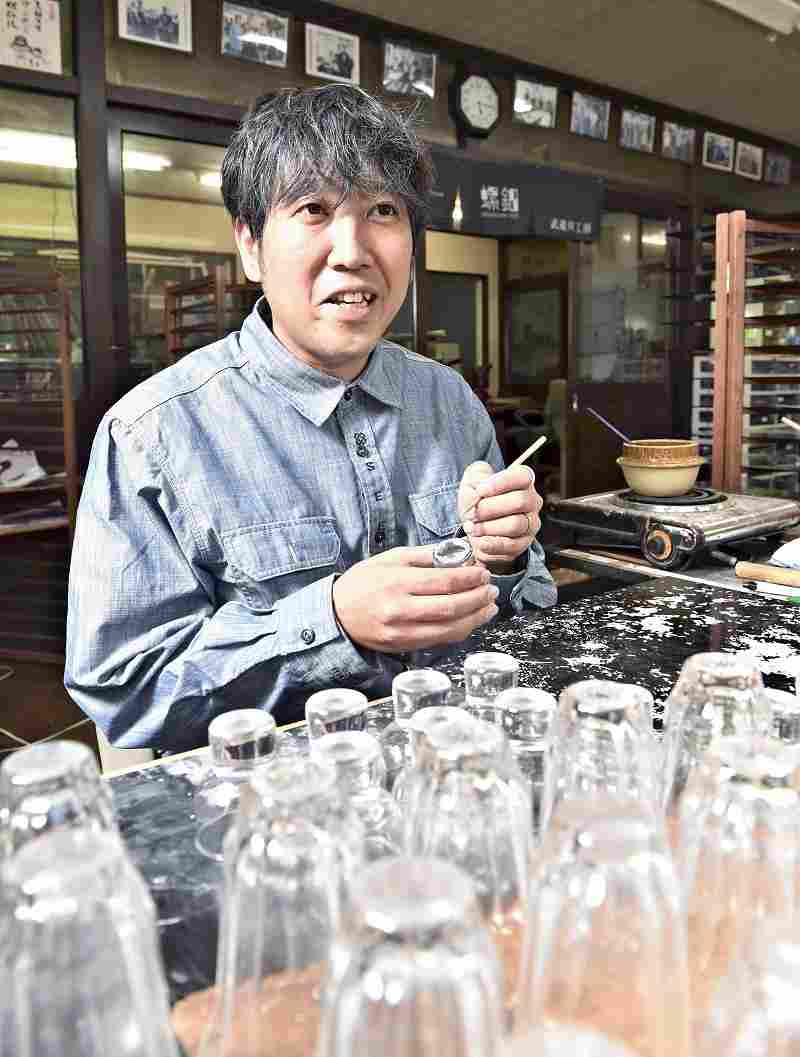
Takeshi Musashigawa performs raden work
Takaoka lacquerware dates back to the early Edo period (1603-1867) when it began as an industry promotion measure led by Maeda Toshinaga, the second-generation head of the Kaga Maeda family. The lacquerware production has a traditional division-of-labor structure that divides work into three stages of kiji (wood base), kashoku (decoration) and nuri lacquer application. In 1975, the lacquerware was designated by the government as a traditional craft product. Sales exceeded ¥2 billion in the 1980s and it is said that wholesalers lined up at lacquerware factories. However, sales slumped in the mid-1990s. According to the Takaoka municipal government, sales dropped to about ¥230 million in 2020. The number of craftsmen has declined, and the shortage of successors is now a serious issue.
Aogai-nuri is a raden technique for Takaoka lacquerware and was used to decorate wooden vessels and furniture. However, a newly developed coating material has made it possible to use the technique for glass and other materials.
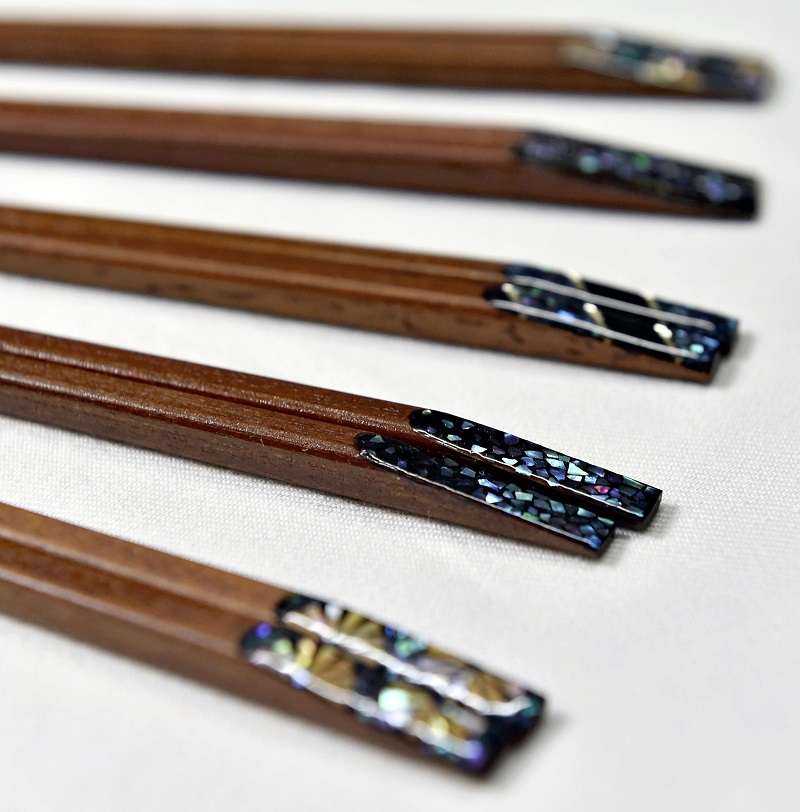
Raden work on chopsticks
“We are trying to apply the raden work to resin, metal and other materials so that we will be able to survive if kiji-ya [wood crafters] cease to exist,” Takeshi said. He said he has been working with a sense of urgency since he joined the factory in 2004. Takeshi and his wife Hiromi, 42, who is also a raden craftsperson, have produced products for modern lifestyles such as smartphone cases and chopsticks that can be washed in dishwashers, so that young people will use them.
Recently, they have been using social media to promote their products, resulting in more orders from customers in distant places. The couple made a skateboard decorated with skull and flame patterns using the raden technique with an eye to showcase their work overseas, and it received the Japan Urushi Association chairperson award at this year’s national lacquerware exhibition.
Their next goal is to apply raden to jewelry for daily use. They are trying to flexibly incorporate the traditional technique into modern lifestyles.




Most Read
Popular articles in the past 24 hours
-

University of Tsukuba Hospital to Introduce Working Dog Next Year...
-
Record 167 Elementary School Students Harmed Via Social Media in ...
-

Nidec Chairman Resigns Amid Accounting Scandal at Major Japanese ...
-

Japan’s Hikonyan Cat Mascot to Celebrate 20th Birthday with Party...
-
Humbert Humbert: Husband-Wife Vocal Duo Brings Cheerful Singing t...
-

Japan's Kairos Rocket Set to Launch on Sunday After Delays
-

Trump’s Address: Confront the Dead End that Authoritarianism Has ...
-

Mizuho to Cut Up to 5,000 Administrative Jobs with AI-Driven Oper...
Popular articles in the past week
-

Producer Behind Pop Group XG Arrested for Cocaine Possession
-

iPS Treatments Pass Key Milestone, but Broader Applications Far f...
-

Tokyo Skytree's Elevator Stops, Trapping 20 People; All Rescued (...
-

Nepal Bus Crash Kills 19 People, Injures 25 Including One Japanes...
-
Milano Cortina 2026: Japanese Gold Medalist Figure Skater Miura S...
-

Japan’s Major Real Estate Firms Expanding Overseas Businesses to ...
-

Milano Cortina 2026: Japanese Figure Skater Kaori Sakamoto’...
-

Reciprocal Tariffs Ruled Illegal: Judiciary Would Not Tolerate Pr...
Popular articles in the past month
-
Producer Behind Pop Group XG Arrested for Cocaine Possession
-

Japan PM Takaichi’s Cabinet Resigns en Masse
-

Japan Institute to Use Domestic Commercial Optical Lattice Clock ...
-

Man Infected with Measles Reportedly Dined at Restaurant in Tokyo...
-

Israeli Ambassador to Japan Speaks about Japan’s Role in the Reco...
-

Videos Plagiarized, Reposted with False Subtitles Claiming ‘Ryuky...
-

Man Infected with Measles May Have Come in Contact with Many Peop...
-

Prudential Life Insurance Plans to Fully Compensate for Damages C...
Top Articles in Culture
-

BTS to Hold Comeback Concert in Seoul on March 21; Popular Boy Band Releases New Album to Signal Return
-

Director Naomi Kawase’s New Film Explores Heart Transplants in Japan, Production Involved Real Patients, Families
-

Tokyo Exhibition Offers Inside Look at Impressionism; 70 of 100 Works on ‘Interiors’ by Monet, Others on Loan from Paris
-
Traditional Japanese Silk Hakama Tradition Preserved by Sole Weaver in Sendai
-
Japanese Byobu Folding Screens Tailored to Meet Modern Lifestyles; Foreign Orders Also Piling up
JN ACCESS RANKING
-
Producer Behind Pop Group XG Arrested for Cocaine Possession
-
Japan PM Takaichi’s Cabinet Resigns en Masse
-
Man Infected with Measles Reportedly Dined at Restaurant in Tokyo Station
-
Israeli Ambassador to Japan Speaks about Japan’s Role in the Reconstruction of Gaza
-
Videos Plagiarized, Reposted with False Subtitles Claiming ‘Ryukyu Belongs to China’; Anti-China False Information Also Posted in Japan