
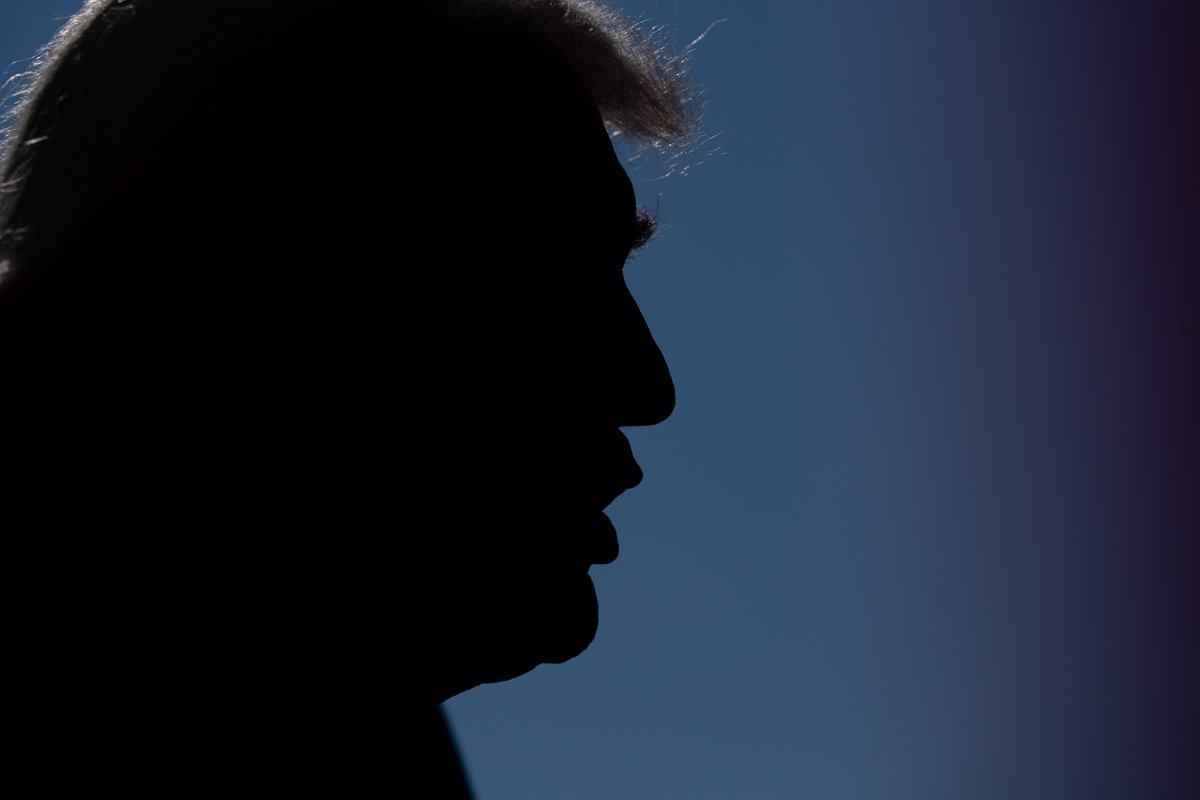
President Donald Trump on Feb. 13 at the White House.
12:25 JST, March 4, 2026
President Donald Trump for the first time acknowledged a personal dimension to his decision to attack Iran, citing the country’s efforts to assassinate him in 2024 as a factor in ordering the joint U.S.-Israeli operation that killed Ayatollah Ali Khamenei.
“I got him before he got me,” Trump said in an interview on Sunday night with ABC News. “I got him first.”
Trump had not previously addressed how the Iranian threats to his life colored his thinking on taking the United States to war in the Middle East. Those threats, on top of the assassination attempts in July and September 2024, dominated his and his advisers’ experience of the fall 2024 campaign, with repeated security scares and emergency measures such as changing planes and motorcade routes.
The Iranian desire to kill Trump dates back to the U.S. airstrike that killed Gen. Qasem Soleimani in January 2020. Federal prosecutors have charged two cases of alleged Iranian murder-for-hire schemes. No evidence has connected Iran with the two assassination attempts against Trump in 2024.
Trump suggested he sees a connection, telling ABC, “They tried twice.”
The White House did not provide evidence to support a connection.
“There are a million reasons to eliminate terrorists like Ayatollah Khamenei,” a senior administration official said, speaking on the condition of anonymity. “His plots to assassinate President Trump are just one reason.”
Trump’s ambassador to the United Nations, Mike Waltz, portrayed Iran’s interest in killing Trump as part of a pattern of behavior that justified the U.S. attack.
“It is responsible for a series of unprovoked armed attacks against the United States and Israel, violations of the U.N. charter, and threats to international peace and security across the Middle East,” Waltz said Saturday at an emergency meeting of the U.N. Security Council. “It has even attempted to assassinate the U.S. president, President Trump.”
National security officials warned Trump’s campaign that Iran wanted to kill him – before he was injured at a July 13, 2024, rally in Butler, Pennsylvania. The shooter, 20-year-old Thomas Matthew Crooks, was killed at the scene, and investigators have not established a clear motive.
At a briefing on the threats in September 2024, U.S. officials told the Trump campaign that Iran had multiple kill teams inside the country. Trump repeatedly asked whether Iran was behind the Butler shooting, and investigators said they could not rule it out, according to people familiar with the briefing.
The would-be assassin at Trump’s golf course in West Palm Beach, Florida, 59-year-old Ryan Wesley Routh, represented himself at trial and was sentenced last month to life in prison.
A trial began last week for a Pakistani man, Asif Merchant, arrested in July 2024 and accused of trying to hire hit men to kill a political figure. Last month, a Brooklyn man was sentenced to 15 years in prison for planning to murder an Iranian dissident, working for an Iranian who prosecutors said was plotting to assassinate Trump.
Iranian officials publicly vowed revenge against American leaders, including Trump and former advisers Mike Pompeo and John Bolton. The government continued providing security details for Pompeo and Bolton throughout the Biden administration, until Trump withdrew them.
Trump and his administration have not extensively presented a public case for the attack on Iran. The subject occupied three of 108 minutes of his State of the Union address last week, and he released two videos over the weekend and spoke on the subject for about six minutes on Monday, without taking questions.
On Monday, Trump listed four objectives: destroying Iran’s missile capabilities, navy, nuclear ambitions and ability to sponsor terrorism. In earlier remarks, he spoke more broadly of overthrowing the regime and freeing the Iranian people.






Most Read
Popular articles in the past 24 hours
-

Iran Situation: Japan Must Exert Diplomatic Efforts without Merel...
-
Measles Patient Visited Hospital in Bunkyo Ward, Tokyo, Metropoli...
-
2 Unpublished Early Novellas by Japan's Kenzaburo Oe Discovered, ...
-
Prime Minister Sanae Takaichi to Visit Fukushima Pref. on 15th An...
-

Milano Cortina 2026: Japanese Figure Skater Miura Returns to Home...
-

Takayama Among World's Top 10 Most Welcoming Cities for 2026; 2nd...
-
Pass Rate for Overseas Driver's License Conversion Test in Japan ...
-
Former Nomura Securities Employee Given 18-year Prison Sentence f...
Popular articles in the past week
-
Milano Cortina 2026: Japanese Gold Medalist Figure Skater Miura S...
-
Tokyo Spends Big on Children, Wins Over Parents
-
Japan’s Miura, Kihara Announce Withdrawal from Figure Skating Wor...
-

Yokohama to Test Out Renewable-Powered Offshore Floating Data Cen...
-
BOJ Keeping Eye on Economy and Takaichi's ‘Proactive Fiscal Polic...
-
Tokyo Measles Patient Traveled to Fukuoka Aboard JAL Planes; Susp...
-
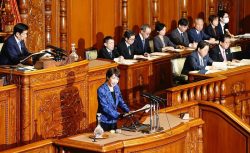
Japan’s Takaichi Speaks on New U.S. Tariff in Upper House, Says P...
-

South Korea Tightens Rules on Foreigners Buying Homes in Seoul Me...
Popular articles in the past month
-

Producer Behind Pop Group XG Arrested for Cocaine Possession
-

Japan PM Takaichi’s Cabinet Resigns en Masse
-

Man Infected with Measles Reportedly Dined at Restaurant in Tokyo...
-

Israeli Ambassador to Japan Speaks about Japan’s Role in the Reco...
-

Videos Plagiarized, Reposted with False Subtitles Claiming ‘Ryuky...
-

Prudential Life Insurance Plans to Fully Compensate for Damages C...
-
Woman with Measles Visited Hospital in Tokyo Multiple Times Befor...
-

iPS Treatments Pass Key Milestone, but Broader Applications Far f...
Top Articles in News Services
-
Survey Shows False Election Info Perceived as True
-
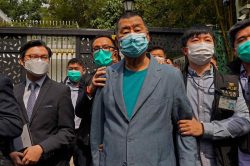
Hong Kong Ex-Publisher Jimmy Lai’s Sentence Raises International Outcry as China Defends It
-

Japan’s Nikkei Stock Average Falls as US-Iran Tensions Unsettle Investors (UPDATE 1)
-
Japan’s Nikkei Stock Average Touches 58,000 as Yen, Jgbs Rally on Election Fallout (UPDATE 1)
-
Japan’s Nikkei Stock Average Rises on Tech Rally and Takaichi’s Spending Hopes (UPDATE 1)
JN ACCESS RANKING
-
Producer Behind Pop Group XG Arrested for Cocaine Possession
-
Japan PM Takaichi’s Cabinet Resigns en Masse
-
Man Infected with Measles Reportedly Dined at Restaurant in Tokyo Station
-
Israeli Ambassador to Japan Speaks about Japan’s Role in the Reconstruction of Gaza
-
Videos Plagiarized, Reposted with False Subtitles Claiming ‘Ryukyu Belongs to China’; Anti-China False Information Also Posted in Japan