
Japan Moves to Strengthen Europe Ties at Munich Security Conference as China Exploits U.S.-Europe Divide
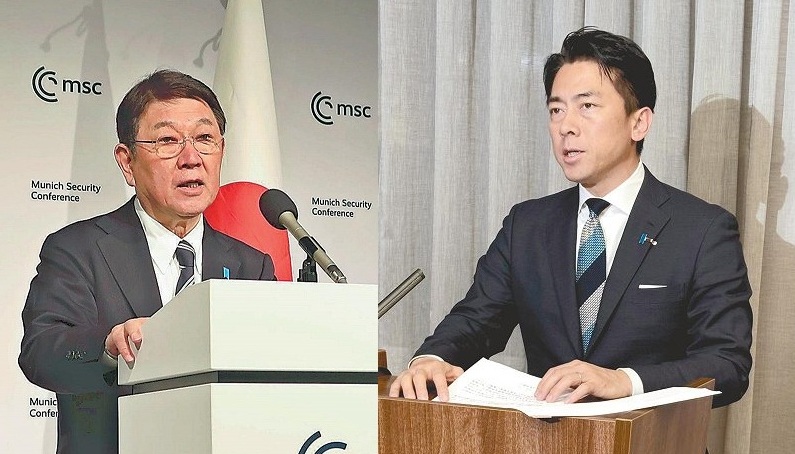
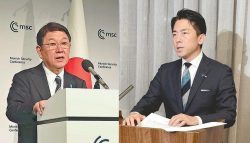
Foreign Minister Toshimitsu Motegi, left, and Defense Minister Shinjiro Koizumi speak to the press in Munich on Saturday.
14:27 JST, February 16, 2026
MUNICH — In an unusual move, Japan dispatched both Foreign Minister Toshimitsu Motegi and Defense Minister Shinjiro Koizumi to the Munich Security Conference held in Munich from Friday through Sunday. As China intensifies efforts to draw closer to Europe amid growing distrust of the Donald Trump administration in the United States, the Japanese government aims to reinforce its ties with European partners.
Emphasizing significance
“By having both the foreign and defense ministers attend, we were able to communicate our efforts to maintain and strengthen a free and open international order based on the rule of law,” Motegi told reporters on Saturday, underscoring the importance of their joint participation. It marked the first time since 2020 that both ministers attended the Munich Security Conference together.
During his stay, Motegi took part in the Group of 7 foreign ministers’ meeting and joined a public panel discussion at the conference. Koizumi, for his part, met with defense ministers from Germany and other countries, as well as the secretary general of the North Atlantic Treaty Organization, and delivered a speech at the conference on short notice.
Both ministers repeatedly stressed that security in the Euro-Atlantic and the Indo-Pacific regions are inseparable. Europe faces Russia’s invasion of Ukraine, while Japan confronts China’s growing military pressure in the Indo-Pacific. By highlighting these shared challenges, Tokyo hopes to deepen security cooperation with Europe.
Speaking at a public session on Saturday, Motegi said, “Given the current international situation, Japan places importance not only on the Japan-U.S. alliance but also on multilayered cooperation with like-minded countries, including those in Europe.”
Urgent task
Another pressing priority is coordinating responses with European partners regarding China, with which relations have deteriorated rapidly following Prime Minister Sanae Takaichi’s remarks concerning a potential Taiwan contingency.
As rifts emerge between the United States and Europe over issues such as the status of Greenland, an autonomous territory of Denmark, Chinese Foreign Minister Wang Yi used the occasion of the Munich conference to hold successive meetings with European counterparts, signaling Beijing’s intent to exploit transatlantic divisions.
The Japanese government hopes to strengthen its collective response by working in unity with Europe and the United States, which share common values. At Saturday’s G7 foreign ministers’ meeting, Motegi outlined Japan’s “Free and Open Indo-Pacific” initiative and called for closer coordination among like-minded nations.





Most Read
Popular articles in the past 24 hours
-
Warning Issued After Fake Social Media Account Impersonating Nobe...
-
G7 Foreign Ministers Meet for Talks in Munich, Discussing Situati...
-

Milano Cortina 2026: Miho Takagi Won Bronze in Women’s 500-...
-

Sony's Entertainment Focus Becomes Even Clearer; Shift Away from ...
-

Milano Cortina 2026: Japan’s Ikuma Horishima Wins Silver in...
-

Milano Cortina 2026: Ren Nikaido Takes ‘Disappointing’ Silver in ...
-

Japan's Toshikazu Yamanishi Sets Half Marathon Race Walk World Re...
-

1st Overseas Suke-San Udon to Open in Taiwan; Company Aims for Mo...
Popular articles in the past week
-

Prudential Life Insurance Plans to Fully Compensate for Damages C...
-

Woman with No Overseas Travel History Infected with Measles in Na...
-

Measles Patient Flew Between Tokyo, Hokkaido in Late January; Lik...
-

Videos Plagiarized, Reposted with False Subtitles Claiming ‘Ryuky...
-

Milano Cortina 2026: Kokomo Murase Comes Out on Top After Overcom...
-
CRA Leadership Election Will Center on Party Rebuilding; Lower Ho...
-
Crime in Japan Ticks Up for 4th Straight Year
-

Japan’s Sumitomo Life Employees Mishandled Nearly 800 Documents a...
Popular articles in the past month
-

Japan Institute to Use Domestic Commercial Optical Lattice Clock ...
-

Israeli Ambassador to Japan Speaks about Japan’s Role in the Reco...
-

Man Infected with Measles May Have Come in Contact with Many Peop...
-

China Eyes Rare Earth Foothold in Malaysia to Maintain Dominance,...
-
Prudential Life Insurance Plans to Fully Compensate for Damages C...
-

Woman with Measles Visited Hospital in Tokyo Multiple Times Befor...
-
Australian Woman Dies After Mishap on Ski Lift in Nagano Prefectu...
-
Foreign Snowboarder in Serious Condition After Hanging in Midair ...
Top Articles in Politics
-

LDP Wins Historic Landslide Victory
-

LDP Wins Landslide Victory, Secures Single-party Majority; Ruling Coalition with JIP Poised to Secure Over 300 seats (UPDATE 1)
-
Japan Tourism Agency Calls for Strengthening Measures Against Overtourism
-
CRA Leadership Election Will Center on Party Rebuilding; Lower House Defeat Leaves Divisions among Former CDPJ, Komeito Members
-

Voters Using AI to Choose Candidates in Japan’s Upcoming General Election; ChatGPT, Other AI Services Found Providing Incorrect Information
JN ACCESS RANKING
-
Japan Institute to Use Domestic Commercial Optical Lattice Clock to Set Japan Standard Time
-
Israeli Ambassador to Japan Speaks about Japan’s Role in the Reconstruction of Gaza
-
Man Infected with Measles May Have Come in Contact with Many People in Tokyo, Went to Store, Restaurant Around When Symptoms Emerged
-
Prudential Life Insurance Plans to Fully Compensate for Damages Caused by Fraudulent Actions Without Waiting for Third-Party Committee Review
-
Woman with Measles Visited Hospital in Tokyo Multiple Times Before Being Diagnosed with Disease