
Piece by Germany’s ‘Last’ Romantic Composer Debuts in Japan With Performance by Yomiuri Orchestra
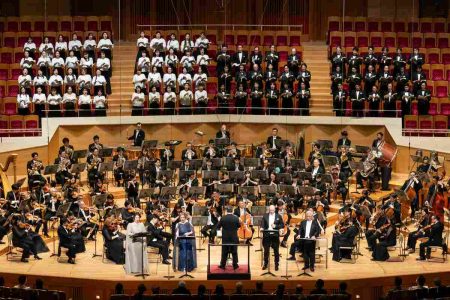
Sebastian Weigle conducts “Von Deutscher Seele” with the Yomiuri Nippon Symphony Orchestra at Suntory Hall in Tokyo on Jan. 20.
12:03 JST, February 13, 2026
Sebastian Weigle masterfully conducted the Yomiuri Nippon Symphony Orchestra (YNSO) in the Japanese premiere of Hans Pfitzner’s “Von Deutscher Seele” (Of the German soul) at Suntory Hall in Akasaka, Tokyo, on Jan. 20.
This magnificent cantata, requiring an orchestra, four solo singers and a chorus, took about 100 minutes and was performed without intermission.
Pfitzner, whose life straddled the 19th and 20th centuries, is a complex figure in the history of German music for his somewhat nationalistic views, which were not dimmed when the Nazis seized power. He is often referred to as arguably the last composer of German romanticism. He rejected atonality and other modern composition techniques and stayed faithful to romantic and conservative music styles, including in “Von Deutscher Seele.” To this work, he appended the subtitle “Romantic Cantata.”
Pfitzner composed the cantata from 1920 to 1921. After World War I, he had to leave Strasbourg, where he held a secure job as a music teacher and opera director, because the border city had been retaken by France. Dejected, he turned to “Wanderspruche,” a set of poems by Joseph von Eichendorff (1788-1857), whose poesy he had always loved, and composed the cantata.
Despite the piece’s imposing title, which may seem jingoistic in light of the composer’s nationalistic inclinations, the music is rich in romanticism and lyricism, and the Eichendorff poems evoke nostalgia, yearning and sympathy.
Weigle, the YNSO’s principal conductor, led the orchestra in the Japanese premiere of a Pfitzner cello concerto in 2019. The conductor then grew interested in the composer’s lieder, or German art songs for solo voice and piano. A plan arose for him to conduct the Japanese premiere of “Von Deutscher Seele,” which he believes adheres to the style of a lied, according to his interview with The Yomiuri Shimbun in 2024.
In the cantata, orchestral interludes and songs, by soloists and the chorus, alternate across two parts. Part one is titled “Mensch und Natur” (Human and nature), and part two “Leben und Singen” (Living and singing).
The piece, which starts tenderly in D minor, develops via various metamorphoses throughout. The organ sounds lingering between some of the songs gave the music a Teutonic color. Parts for solo instruments interspersed throughout the interludes were exquisitely played by YNSO members. These included a beautiful duet between a harp and a horn in the sixth piece, “Abend” (Evening), and a flute solo in the 16th piece, “Ergebung” (Deference).
The instruments playing the lower register, such as the contrabasses and tubas, added excitement to the performance, which was also blessed with excellent singers. Soprano Magdalena Hinterdobler’s impassioned singing was indelible, and mezzo-soprano Claudia Mahnke’s rich voice was easy on the ears.
Just before the performance, an announcement was made that tenor Stephan Rugamer was not feeling well but would still sing. Though he might not have been at his best, he did not disappoint. South Korean bass Kwangchul Youn, who replaced the indisposed Falk Struckmann on short notice, impressed the audience with his beautifully resonant voice. Solid singing by the New National Theatre Chorus was also a big asset for the performance.
Adjusting to changes
On Feb. 4, the YNSO performed at the same venue a program of two contrasting pieces — Violin Concerto “Genesis” by Toshio Hosokawa and Bruckner’s Symphony No. 7.
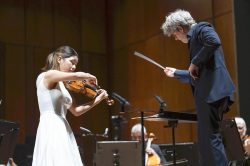
This time, young American James Feddeck assumed the role of conductor, replacing Mario Venzago at very short notice and making his debut with the orchestra. With his careful and steady handling of the program, Feddeck was impressive.
Akiko Suwanai rendered a sensitive and nuanced violin solo for the single-movement concerto.
Hosokawa composed this mysterious and alluring piece in 2020 and dedicated it to violinist Veronica Eberle and her newborn son. Feddeck carefully conducted a small force of 40 plus members of the YNSO.
In fact, the YNSO and Suwanai were originally scheduled to play the world premiere of a new work by Misato Mochizuki, which was pulled by the composer and replaced by the Hosokawa piece in mid-January. They coped well with the program change and the last-minute switch of conductor.
The Bruckner symphony followed after an intermission. This is probably Bruckner’s most melodious symphony. Feddeck, who is reputed for his interpretation of Bruckner works, was steady and precise throughout, and the audience erupted seconds after he brought down his baton.




Most Read
Popular articles in the past 24 hours
-
CRA Leadership Election Will Center on Party Rebuilding; Lower Ho...
-
Crime in Japan Ticks Up for 4th Straight Year
-

Milano Cortina 2026: From Despair to Pure Joy: Takanashi’s 4-Year...
-

Milano Cortina 2026: Mitsuki Ono Wins Bronze in Women’s Snowboard...
-

Flu Cases Surging Again: Infection Can Also Be Prevented by Humid...
-
High School Baseball Players Referred to Prosecutors for Sharing ...
-

Chiba City Man in His 20s Tests Positive for Measles; Used Chiba ...
-
Man Arrested for Shining Laser Beam at Driver’s Compartment of Mo...
Popular articles in the past week
-

Woman with Measles Visited Hospital in Tokyo Multiple Times Befor...
-

Prudential Life Insurance Plans to Fully Compensate for Damages C...
-

LDP Wins Historic Landslide Victory
-

Woman with No Overseas Travel History Infected with Measles in Na...
-

LDP Wins Landslide Victory, Secures Single-party Majority; Ruling...
-

Measles Patient Flew Between Tokyo, Hokkaido in Late January; Lik...
-
Symptomatic Measles Victim Visited Defense Ministry in Tokyo; May...
-

Tokyo, Many Regions across Japan Hit with Heavy Snow
Popular articles in the past month
-

Japan Institute to Use Domestic Commercial Optical Lattice Clock ...
-

Israeli Ambassador to Japan Speaks about Japan’s Role in the Reco...
-

Man Infected with Measles May Have Come in Contact with Many Peop...
-

China Eyes Rare Earth Foothold in Malaysia to Maintain Dominance,...
-
Australian Woman Dies After Mishap on Ski Lift in Nagano Prefectu...
-

Japan, Qatar Ministers Agree on Need for Stable Energy Supplies; ...
-
Woman with Measles Visited Hospital in Tokyo Multiple Times Befor...
-
Foreign Snowboarder in Serious Condition After Hanging in Midair ...
Top Articles in Culture
-

BTS to Hold Comeback Concert in Seoul on March 21; Popular Boy Band Releases New Album to Signal Return
-
Lifestyle at Kyoto Traditional Machiya Townhouse to Be Showcased in Documentary
-

‘Jujutsu Kaisen’ Voice Actor Junya Enoki Discusses Rapid Action Scenes in Season 3, Airing Now
-

Maison&Objet Kicks off Near Paris with Japanese Lighting Designers’ Installations on Display, Creating Rich Environment
-

Tokyo Exhibition Offers Inside Look at Impressionism; 70 of 100 Works on ‘Interiors’ by Monet, Others on Loan from Paris
JN ACCESS RANKING
-
Japan Institute to Use Domestic Commercial Optical Lattice Clock to Set Japan Standard Time
-
Israeli Ambassador to Japan Speaks about Japan’s Role in the Reconstruction of Gaza
-
Man Infected with Measles May Have Come in Contact with Many People in Tokyo, Went to Store, Restaurant Around When Symptoms Emerged
-
China Eyes Rare Earth Foothold in Malaysia to Maintain Dominance, Counter Japan, U.S.
-
Australian Woman Dies After Mishap on Ski Lift in Nagano Prefecture