
Ukrainian Energy Workers Carry Out Repairs Despite Russia’s Pounding of the Country’s Power Grid
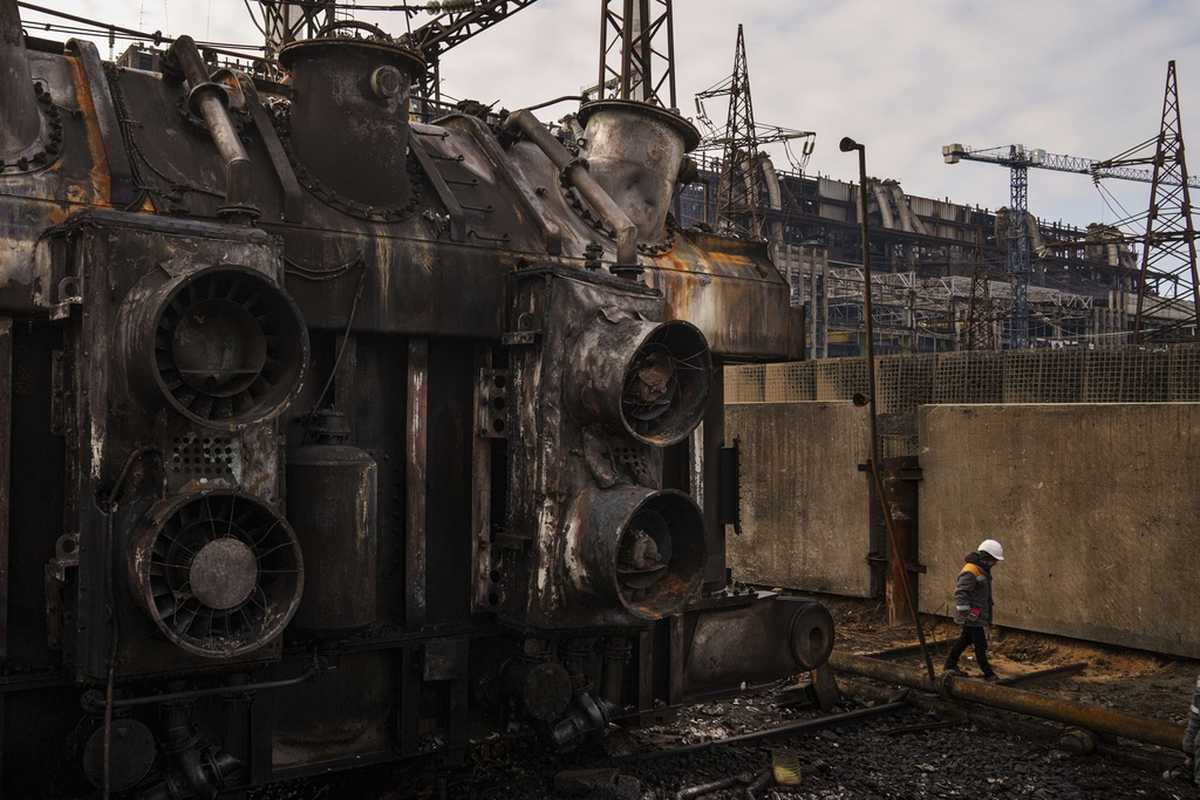
A worker walks in front of a transformer which was destroyed after a recent Russian missile attack at DTEK’s power plant in Ukraine, Nov. 28, 2024.
13:19 JST, November 30, 2024
On a bright winter day, workers at a Ukrainian thermal power plant repair its heavily damaged equipment as drops of water from melted snow leak through gaping holes in its battered roof.
Several weeks earlier, the facility was targeted by a Russian air attack that left scorch marks, shrapnel scars on the walls, and missile fragments scattered across the production floor.
This is our life now. Workers at a thermal power plant that’s supposed to produce electricity are walking on frozen floors and using firewood to keep warm, Oleksandr, 52, head of the Production Management Department, told The Associated Press. He spoke on condition that only his first name be used citing security concerns.
Repeated Russian strikes on infrastructure have seriously impacted Ukraine’s energy sector often resulting in rolling blackouts across the country. On Thursday, Moscow launched another large-scale air attack. Ukrainian authorities said nearly 200 drones and missiles targeted infrastructure, d isrupting power supply to more than a million people.
The scale of the ongoing work to fix the sector is huge. Since the start of Russia’s full-scale invasion in 2022, th e G7 and other allied countries have allocated more than $4 billion in energy assistance to Ukraine, U.S. Secretary of State Antony Blinken said in September.
Oleksandr, who works at the power plant operated by Ukraine’s largest private energy company, DTEK, says since the station was first attacked in November 2022, it has been unable to return to full capacity due to continuous strikes that have left critical equipment in ruins. The exact location of the plant visited by the AP, details on the damage and even workers’ last names cannot be disclosed for fear this information could help Russia coordinate future attacks.
DTEK operated around 20% of Ukraine’s electricity production before the full-scale invasion, but this figure dropped to 12% since the war broke out. The company says its facilities have been attacked by Russia almost 200 times since 2022. They also say nearly 90% of the company’s infrastructure was destroyed or suffered damage and that was before Russia launched its large-scale attack on Nov 17.
Oleksandr says he expects repairs at the station to continue through the winter into next year, and potentially far beyond. Repair efforts at the plant are further complicated by the fact that some critical equipment was manufactured in the Soviet Union and finding parts is now difficult. To mitigate this, some former Soviet countries who are now Ukraine’s allies have helped supply equipment.
Potentially, Western countries could also help us with equipment, but their power grids have different characteristics, Oleksandr said.
Only half of DTEK’s generating capacities have been restored since the first attacks on its plants in November 2022 until the latest large-scale strike. Earlier this week, the European Commission and the U.S. government a nnounced a donation of $112 million in equipment and construction materials to help DTEK prepare for the winter.
With the war in its third year, staff at DTEK’s plant have adapted to the grim reality of their day-to-day existence. They know the protocols by heart. Not everyone can take shelter during an air alert. A minimal crew must remain in the control room to oversee operations, putting themselves at risk of a direct strike.
You have to sit and wait while monitoring the trajectories of whatever was fired, but the power units keep working so we cannot just leave, we stay in the control room, said Dmytro, 41, a power unit operator at the plant.
Despite the challenges, Dmytro and his colleagues press on, driven by a mission to keep the lights on in their town and region over the winter months.
Who’ll do it, if not us? I also have family waiting for me at home, but if we all leave and the equipment breaks down, the responsibility will be on our shoulders, the entire city will lose electricity and heating, he said.
Some are risking (their lives) at the frontline, while we here have our own energy front.










Most Read
Popular articles in the past 24 hours
-
Record 167 Elementary School Students Harmed Via Social Media in ...
-

Nidec Chairman Resigns Amid Accounting Scandal at Major Japanese ...
-

Humbert Humbert: Husband-Wife Vocal Duo Brings Cheerful Singing t...
-

Trump’s Address: Confront the Dead End that Authoritarianism Has ...
-

Japan’s Hikonyan Cat Mascot to Celebrate 20th Birthday with Party...
-

Japan's Kairos Rocket Set to Launch on Sunday After Delays
-

Pakistan, Afghan Forces Clash after Days of Hostilities
-

Mizuho to Cut Up to 5,000 Administrative Jobs with AI-Driven Oper...
Popular articles in the past week
-

Producer Behind Pop Group XG Arrested for Cocaine Possession
-

iPS Treatments Pass Key Milestone, but Broader Applications Far f...
-

Tokyo Skytree's Elevator Stops, Trapping 20 People; All Rescued (...
-

Nepal Bus Crash Kills 19 People, Injures 25 Including One Japanes...
-

Milano Cortina 2026: Japanese Gold Medalist Figure Skater Miura S...
-

Japan’s Major Real Estate Firms Expanding Overseas Businesses to ...
-

Reciprocal Tariffs Ruled Illegal: Judiciary Would Not Tolerate Pr...
-

Japanese High School Student Aims to Share Kaiten History Through...
Popular articles in the past month
-
Producer Behind Pop Group XG Arrested for Cocaine Possession
-

Japan PM Takaichi’s Cabinet Resigns en Masse
-

Japan Institute to Use Domestic Commercial Optical Lattice Clock ...
-

Man Infected with Measles Reportedly Dined at Restaurant in Tokyo...
-

Israeli Ambassador to Japan Speaks about Japan’s Role in the Reco...
-

Videos Plagiarized, Reposted with False Subtitles Claiming ‘Ryuky...
-

Man Infected with Measles May Have Come in Contact with Many Peop...
-

Prudential Life Insurance Plans to Fully Compensate for Damages C...
Top Articles in News Services
-
Survey Shows False Election Info Perceived as True
-
Hong Kong Ex-Publisher Jimmy Lai’s Sentence Raises International Outcry as China Defends It
-

Japan’s Nikkei Stock Average Touches 58,000 as Yen, Jgbs Rally on Election Fallout (UPDATE 1)
-
Japan’s Nikkei Stock Average Falls as US-Iran Tensions Unsettle Investors (UPDATE 1)
-
Japan’s Nikkei Stock Average Rises on Tech Rally and Takaichi’s Spending Hopes (UPDATE 1)
JN ACCESS RANKING
-
Producer Behind Pop Group XG Arrested for Cocaine Possession
-
Japan PM Takaichi’s Cabinet Resigns en Masse
-
Man Infected with Measles Reportedly Dined at Restaurant in Tokyo Station
-
Israeli Ambassador to Japan Speaks about Japan’s Role in the Reconstruction of Gaza
-
Videos Plagiarized, Reposted with False Subtitles Claiming ‘Ryukyu Belongs to China’; Anti-China False Information Also Posted in Japan