
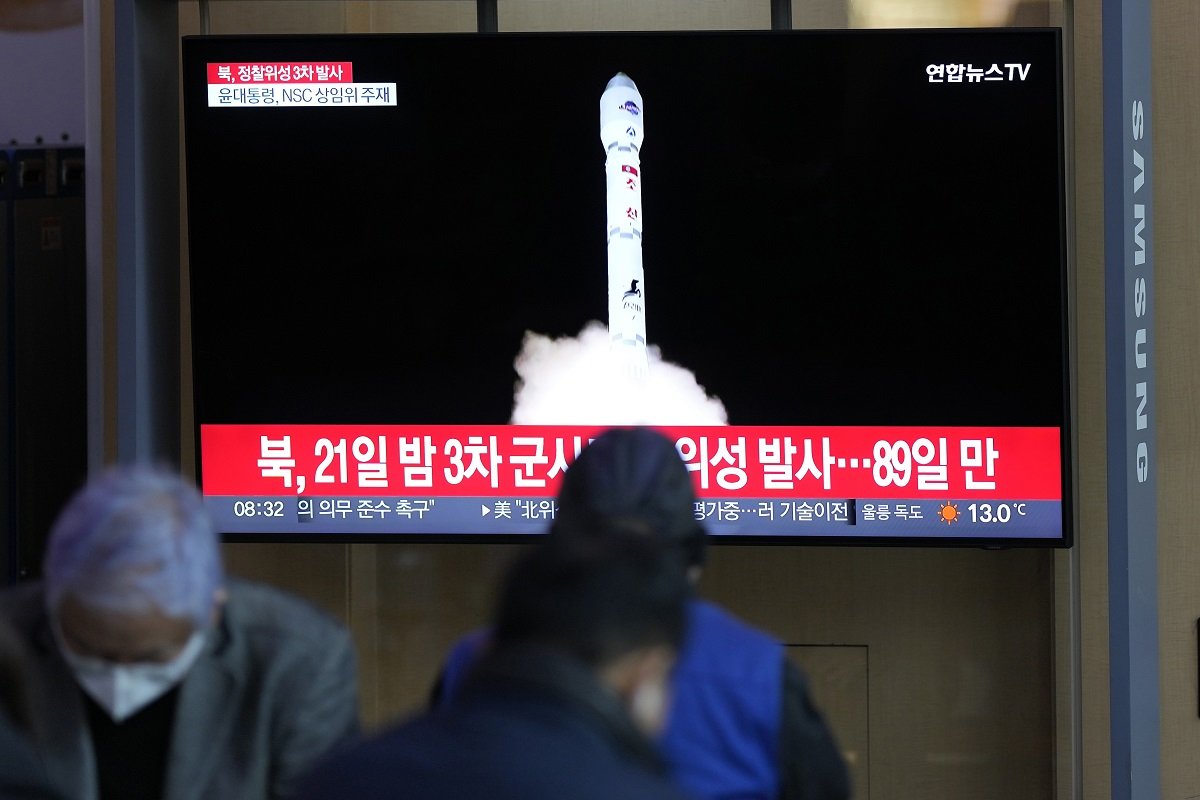
A TV screen shows a report of North Korea’s spy satellite going into orbit with its third launch attempt this year, during a news program at the Seoul Railway Station in Seoul on Wednesday.
17:32 JST, November 22, 2023
North Korea launched a projectile using ballistic missile technology at around 10:43 p.m. on Tuesday, traveling from the northwestern part of the country in a southerly direction, according to the Japanese government.
The rocket was loaded with what Pyongyang has described as a “satellite.” The rocket separated, and part of it passed over the area between Okinawa Island and Miyako Island before coming down in the Pacific Ocean.
The government used the J-Alert system to issue an emergency warning to Okinawa Prefecture at around 10:46 p.m. on the day. The warning called on people to evacuate to buildings and underground areas. The Self-Defense Forces did not take any countermeasures and no damage has been confirmed to Japan vessels, according to the Japan Coast Guard.
Japan, the United States and South Korea strongly condemned the launch during a director-level telephone conference on Wednesday morning.
Japan said there had been no confirmation of a satellite having entered Earth’s orbit as of Wednesday morning. Meanwhile, North Korea’s Korean Central News Agency reported Wednesday that the country had successfully launched a rocket carrying a reconnaissance satellite.
The directors confirmed that such launches violate a U.N. Security Council resolution prohibiting Pyongyang from launching rockets using ballistic missile technology.
Tokyo, Washington and Seoul also shared the recognition that “North Korea has been carrying out such activities as launching ballistic missiles with unprecedented frequency and in new ways, posing a serious and imminent threat to regional security and a clear and grave challenge to the international community,” according to the Japanese Foreign Ministry.
Speaking at a press conference on Wednesday morning, Chief Cabinet Secretary Hirokazu Matsuno said, “At this point, there is no confirmation that a satellite has been inserted into Earth’s orbit.”
A senior official of the Defense Ministry said Wednesday morning that “the launch may have failed.”
The projectile was launched from the Sohae Satellite Launching Station in Tongchang-ri, northwestern North Korea, and separated into several sections. The first came down about 350 kilometers west of the Korean Peninsula in the East China Sea — outside the pre-notified falling area — at around 10:50 p.m. on Tuesday. The second traveled over waters between Okinawa Island and Miyako Island before landing in the Pacific Ocean about 1,200 kilometers southwest of Okinotorishima Island — within the pre-notified area — at around 10:57 p.m. on Tuesday. Both spots are outside Japan’s EEZ.
North Korea had notified Japan that it would launch a satellite some time between Wednesday and Dec. 1, designating three locations — including in the Yellow Sea, west of the Korean Peninsula — as areas where sections of the rocket could potentially come down.








Most Read
Popular articles in the past 24 hours
-

Tokyo Skytree's Elevator Stops, Trapping 20 People; All Rescued (...
-

China, India Tapping into Promising African Market; Beijing Annou...
-

Milano Cortina 2026: Miura-Kihara Duo, Other Japanese Figure Skat...
-

Japan’s Major Real Estate Firms Expanding Overseas Businesses to ...
-

Reciprocal Tariffs Ruled Illegal: Judiciary Would Not Tolerate Pr...
-
‘Storytellers’ Being Dispatched Overseas to Promote Japan; Events...
-

Japan, Pacific Island Nations to Work on Deepening Cooperation
-

Fiji Defense Minister Hopes Japan Will Support Stabilization of P...
Popular articles in the past week
-

Japan PM Takaichi’s Cabinet Resigns en Masse
-

Man Infected with Measles Reportedly Dined at Restaurant in Tokyo...
-

Sanae Takaichi Elected Prime Minister of Japan; Keeps All Cabinet...
-

Japan's Govt to Submit Road Map for Growth Strategy in March, PM ...
-

Bus Carrying 40 Passengers Catches Fire on Chuo Expressway; All E...
-

Milano Cortina 2026: Figure Skaters Riku Miura, Ryuichi Kihara Pa...
-

Japan, U.S. Name 3 Inaugural Investment Projects; Reached Agreeme...
-
U.S. Firm to Build Training Hub in Fukushima N-plant for Debris R...
Popular articles in the past month
-
Japan PM Takaichi’s Cabinet Resigns en Masse
-

Japan Institute to Use Domestic Commercial Optical Lattice Clock ...
-

Israeli Ambassador to Japan Speaks about Japan’s Role in the Reco...
-
Man Infected with Measles Reportedly Dined at Restaurant in Tokyo...
-

Videos Plagiarized, Reposted with False Subtitles Claiming ‘Ryuky...
-

Man Infected with Measles May Have Come in Contact with Many Peop...
-

Prudential Life Insurance Plans to Fully Compensate for Damages C...
-

Woman with Measles Visited Hospital in Tokyo Multiple Times Befor...
Top Articles in Politics
-
Japan PM Takaichi’s Cabinet Resigns en Masse
-
Sanae Takaichi Elected Prime Minister of Japan; Keeps All Cabinet Appointees from Previous Term
-
Japan’s Govt to Submit Road Map for Growth Strategy in March, PM Takaichi to Announce in Upcoming Policy Speech
-

LDP Wins Historic Landslide Victory
-

LDP Wins Landslide Victory, Secures Single-party Majority; Ruling Coalition with JIP Poised to Secure Over 300 seats (UPDATE 1)
JN ACCESS RANKING
-
Japan PM Takaichi’s Cabinet Resigns en Masse
-
Japan Institute to Use Domestic Commercial Optical Lattice Clock to Set Japan Standard Time
-
Israeli Ambassador to Japan Speaks about Japan’s Role in the Reconstruction of Gaza
-
Man Infected with Measles Reportedly Dined at Restaurant in Tokyo Station
-
Videos Plagiarized, Reposted with False Subtitles Claiming ‘Ryukyu Belongs to China’; Anti-China False Information Also Posted in Japan