
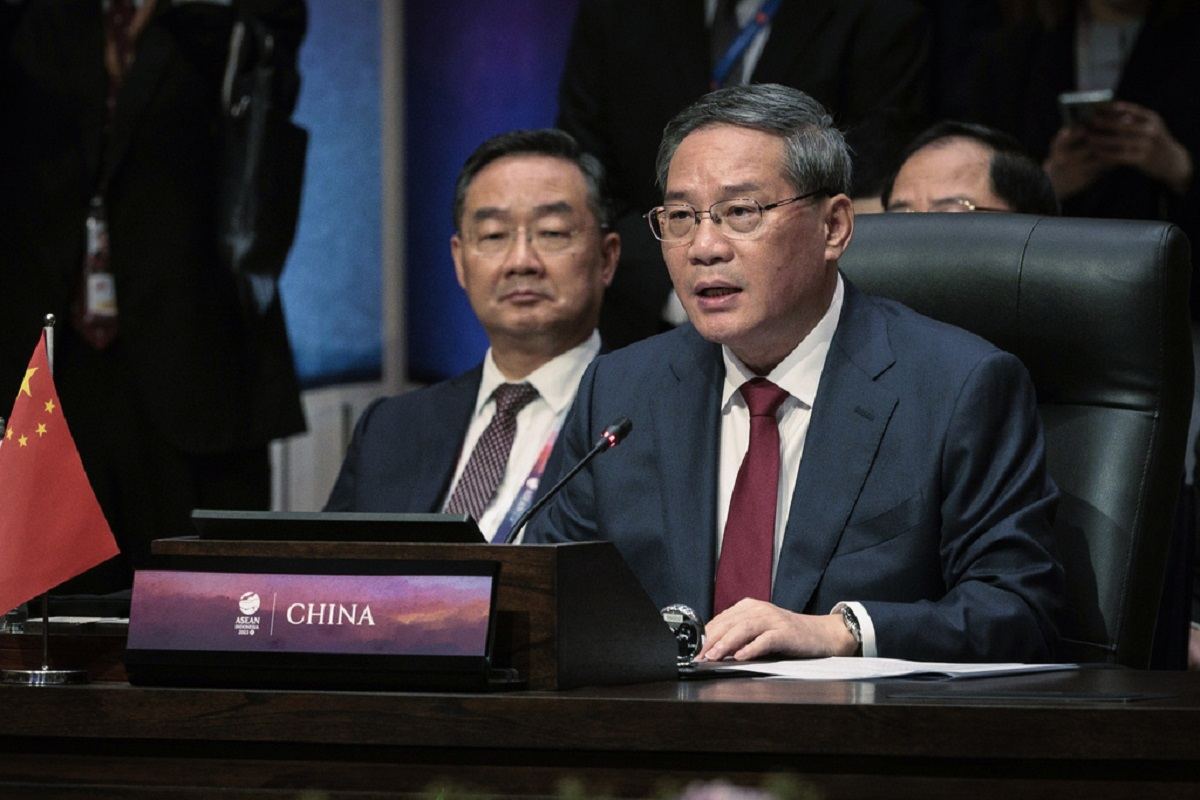
Chinese Premier Li Qiang speaks at the 26th ASEAN-China Summit during the 43rd ASEAN Summit in Jakarta on Wednesday.
17:16 JST, September 7, 2023
JAKARTA — Members of the Association of Southeast Asian Nations (ASEAN) convened Wednesday at the ASEAN-China summit meeting in Jakarta, against a background in which China continues to expand its influence in the South China Sea.
For its part, China is worried that some ASEAN countries are leaning toward military alliances with the United States. “China and ASEAN are good neighbors that can’t be separated,” Chinese Premier Li Qiang said during the meeting. Li also called on ASEAN nations to build a peaceful and prosperous region together.
Wednesday’s meeting was the first time for Li to attend a multilateral summit since assuming the premiership in March.
According to China’s state-run Xinhua news agency, Li also urged ASEAN to “work together to build an economic growth center … and deepen cooperation in industrial and supply chains,” while calling on participating countries to cooperate over agriculture and trade and make use of the Belt and Road Initiative framework that aims to create a massive economic zone.
Despite China’s reconciliatory overtures, however, progress stalled over the formulation of the Code of Conduct, which China has been promoting with ASEAN since 2013 with the aim of avoiding possible conflicts in the South China Sea. This is likely due to a backlash against Beijing’s attempts to push forward with a Code of Conduct that would be more aligned to its own purposes.
Although guidelines for accelerating the formulation of the code were adopted at an ASEAN-related foreign ministers’ meeting in July, the initiative’s title now seems to have the ring of an empty slogan.
A chairman’s statement released by ASEAN on Tuesday noted that some member states had expressed concerns over land reclamation and dangerous oceanic activities in the South China Sea, likely with China in mind.
Speaking during Tuesday’s meeting, Philippine President Ferdinand Marcos Jr. said, “We do not seek conflict, but it is our duty as citizens and as leaders to always rise to meet any challenge to our sovereignty… and maritime jurisdictions in the South China Sea.”
In a map released in late August, Beijing marked almost all the disputed territories in the South China Sea as China’s “territorial waters.” The map drew fire from a number of countries, including the Philippines and Indonesia, both of which China has been trying to woo through economic cooperation.
Some such nations may already have begun to distance themselves from Beijing over its hard-line claims regarding territories and sovereignty.





Most Read
Popular articles in the past 24 hours
-

Artisans from Disaster-Hit Areas Work Together to Keep Memories o...
-

Japan Tourist Spot's Capsule Toys Made from Recycled Materials Pr...
-

Japan’s Space One Kairos 3rd Flight Rocket Launched, but Mission ...
-

Person Apparently Caught in Avalanche on Mt. Kamifurano in Hokkai...
-

NTT Docomo to Discontinue 3G Service in March
-

Space One's No. 3 Kairos Rocket Terminates Mid-Flight
-

Former Unification Church: Proceed Steadily with Liquidation to P...
-
LCC Greater Bay Airlines to Launch Regular Service on Fukuoka-Hon...
Popular articles in the past week
-

Tokyo Spends Big on Children, Wins Over Parents
-

South Korea Tightens Rules on Foreigners Buying Homes in Seoul Me...
-

Japan’s Miura, Kihara Announce Withdrawal from Figure Skating Wor...
-
2 Unpublished Early Novellas by Japan's Kenzaburo Oe Discovered, ...
-

Strait of Hormuz Closure Shakes Markets; Prolonged Closure Could ...
-

Nidec Chairman Resigns Amid Accounting Scandal at Major Japanese ...
-

Tourists Ignore Safety Barriers Near Famous Zao ‘Snow Monsters’ i...
-

Iran Situation: Japan Must Exert Diplomatic Efforts without Merel...
Popular articles in the past month
-

Producer Behind Pop Group XG Arrested for Cocaine Possession
-

Japan PM Takaichi’s Cabinet Resigns en Masse
-

Man Infected with Measles Reportedly Dined at Restaurant in Tokyo...
-

Israeli Ambassador to Japan Speaks about Japan’s Role in the Reco...
-

Videos Plagiarized, Reposted with False Subtitles Claiming ‘Ryuky...
-

Prudential Life Insurance Plans to Fully Compensate for Damages C...
-

Woman with Measles Visited Hospital in Tokyo Multiple Times Befor...
-

iPS Treatments Pass Key Milestone, but Broader Applications Far f...
Top Articles in World
-
Israeli Ambassador to Japan Speaks about Japan’s Role in the Reconstruction of Gaza
-
Videos Plagiarized, Reposted with False Subtitles Claiming ‘Ryukyu Belongs to China’; Anti-China False Information Also Posted in Japan
-

Nepal Bus Crash Kills 19 People, Injures 25 Including One Japanese National
-
South Korea Tightens Rules on Foreigners Buying Homes in Seoul Metro Area
-

Ukrainian Ambassador Closely Watching Japan’s Revision of Defense Export Rules, Hopes for Future Arms Support
JN ACCESS RANKING
-
Producer Behind Pop Group XG Arrested for Cocaine Possession
-
Japan PM Takaichi’s Cabinet Resigns en Masse
-
Man Infected with Measles Reportedly Dined at Restaurant in Tokyo Station
-
Israeli Ambassador to Japan Speaks about Japan’s Role in the Reconstruction of Gaza
-
Videos Plagiarized, Reposted with False Subtitles Claiming ‘Ryukyu Belongs to China’; Anti-China False Information Also Posted in Japan