
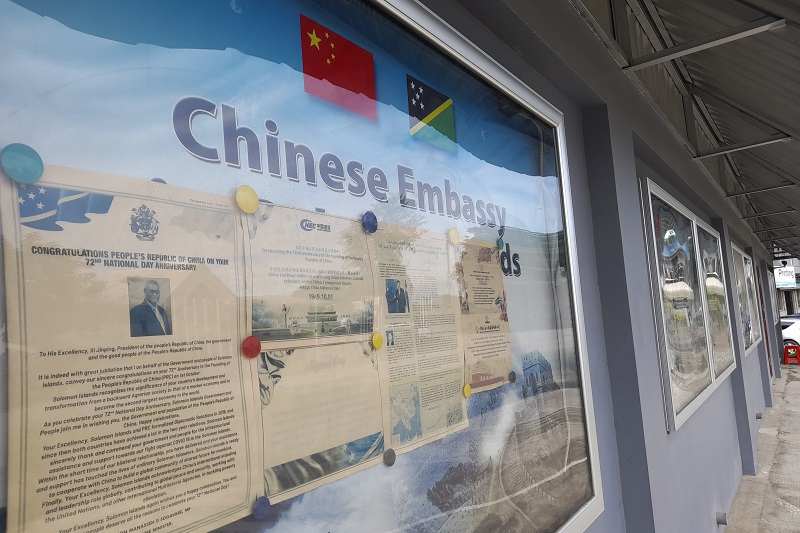
A display case of photos is seen outside the Chinese Embassy in Honiara, Solomon Islands, April 2, 2022.
21:09 JST, April 21, 2022
WASHINGTON/JAKARTA — With Beijing attempting to increase its influence in the South Pacific region, the administration of U.S. President Joe Biden wants to boost its commitments in the South Pacific Ocean, including the Solomon Islands, in cooperation with Japan and Australia, among other countries.
The White House said Monday that National Security Council Indo-Pacific Coordinator Kurt Campbell and Assistant Secretary of State for East Asian and Pacific Affairs Daniel Kritenbrink would visit Fiji, Papua New Guinea and the Solomon Islands this week.
The pair will lead a delegation of U.S. government officials including members of the Department of Defense and the Agency for International Development, with issues including security and economic assistance on the agenda.
The White House said the meetings in the three countries are “to ensure our partnerships deliver prosperity, security and peace across the Pacific Islands and the Indo-Pacific.”
In February, just before U.S. Secretary of State Antony Blinken’s visit to Fiji, the Biden administration released its “Indo-Pacific Strategy,” underlining the importance it attaches to the South Pacific region. It also announced plans for Washington to establish an embassy in the Solomon Islands.
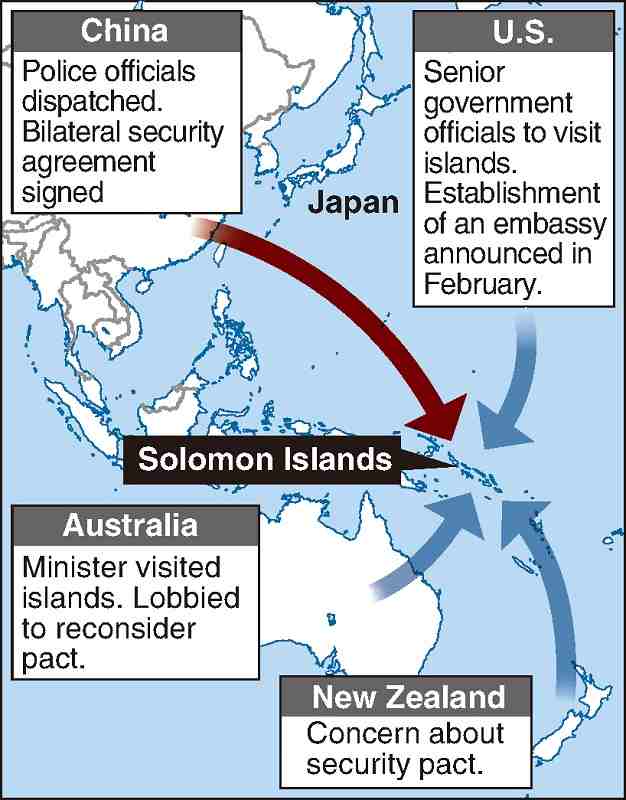
However, chatter surfaced in March indicating the Solomon Islands and China were poised to sign a bilateral security pact. On Tuesday, Beijing announced that an agreement had been signed.
Although China has stressed the accord is not targeting other countries, Tuesday’s announcement is thought to be aimed at keeping the United States and other countries in check following Washington’s decision to dispatch senior officials to the region.
“Despite the Solomon Islands government’s comments, the broad nature of the security agreement leaves open the door for the deployment of PRC [People’s Republic of China] military forces to the Solomon Islands,” U.S. State Department spokesman Ned Price said at a press conference on Monday. “We believe that signing such an agreement could increase destabilization within the Solomon Islands and will set a concerning precedent for the wider Pacific Island region.”
The United States is expected to express its concerns over China’s growing influence in the region directly during its upcoming visits.
Regional power Australia, which has opposed the security cooperation agreement, sent Zed Seselja, minister for international development and the Pacific, to the Solomon Islands from April 12-13.
Reportedly, Seselja held talks with Prime Minister Manasseh Sogavare and other ministers, urging them against signing the accord.
“Australia is deeply disappointed by the signing of a security cooperation agreement,” Seselja and other officials said in a statement released Tuesday. “We are concerned about the lack of transparency with which this agreement has been developed, noting its potential to undermine stability in our region. We continue to seek further clarity on the terms of the agreement.”
Regarding its position on the Solomon Islands, the United States intends to coordinate efforts with Japan — which has some influence through its Grant Aid program — in conjunction with New Zealand and Australia, which both have strong relationships with the Pacific island nation.




Most Read
Popular articles in the past 24 hours
-
Artisans from Disaster-Hit Areas Work Together to Keep Memories o...
-

Japan Tourist Spot's Capsule Toys Made from Recycled Materials Pr...
-
Japan’s Space One Kairos 3rd Flight Rocket Launched, but Mission ...
-

Person Apparently Caught in Avalanche on Mt. Kamifurano in Hokkai...
-
NTT Docomo to Discontinue 3G Service in March
-
Space One's No. 3 Kairos Rocket Terminates Mid-Flight
-

Former Unification Church: Proceed Steadily with Liquidation to P...
-
LCC Greater Bay Airlines to Launch Regular Service on Fukuoka-Hon...
Popular articles in the past week
-
Tokyo Spends Big on Children, Wins Over Parents
-

South Korea Tightens Rules on Foreigners Buying Homes in Seoul Me...
-

Japan’s Miura, Kihara Announce Withdrawal from Figure Skating Wor...
-
2 Unpublished Early Novellas by Japan's Kenzaburo Oe Discovered, ...
-
Strait of Hormuz Closure Shakes Markets; Prolonged Closure Could ...
-
Nidec Chairman Resigns Amid Accounting Scandal at Major Japanese ...
-
Tourists Ignore Safety Barriers Near Famous Zao ‘Snow Monsters’ i...
-

Iran Situation: Japan Must Exert Diplomatic Efforts without Merel...
Popular articles in the past month
-

Producer Behind Pop Group XG Arrested for Cocaine Possession
-

Japan PM Takaichi’s Cabinet Resigns en Masse
-

Man Infected with Measles Reportedly Dined at Restaurant in Tokyo...
-

Israeli Ambassador to Japan Speaks about Japan’s Role in the Reco...
-

Videos Plagiarized, Reposted with False Subtitles Claiming ‘Ryuky...
-

Prudential Life Insurance Plans to Fully Compensate for Damages C...
-

Woman with Measles Visited Hospital in Tokyo Multiple Times Befor...
-

iPS Treatments Pass Key Milestone, but Broader Applications Far f...
Top Articles in World
-
Israeli Ambassador to Japan Speaks about Japan’s Role in the Reconstruction of Gaza
-
Videos Plagiarized, Reposted with False Subtitles Claiming ‘Ryukyu Belongs to China’; Anti-China False Information Also Posted in Japan
-

Nepal Bus Crash Kills 19 People, Injures 25 Including One Japanese National
-
South Korea Tightens Rules on Foreigners Buying Homes in Seoul Metro Area
-

Ukrainian Ambassador Closely Watching Japan’s Revision of Defense Export Rules, Hopes for Future Arms Support
JN ACCESS RANKING
-
Producer Behind Pop Group XG Arrested for Cocaine Possession
-
Japan PM Takaichi’s Cabinet Resigns en Masse
-
Man Infected with Measles Reportedly Dined at Restaurant in Tokyo Station
-
Israeli Ambassador to Japan Speaks about Japan’s Role in the Reconstruction of Gaza
-
Videos Plagiarized, Reposted with False Subtitles Claiming ‘Ryukyu Belongs to China’; Anti-China False Information Also Posted in Japan