

Workers install AI security cameras in Mito in December.
2:00 JST, January 12, 2026
MITO — In an effort to prevent forcefully luring customers to an establishment, known as kyaku-hiki, in entertainment districts, the Mito city government has introduced a system that uses artificial intelligence to detect such acts by analyzing human movement.
The city installed AI security cameras to capture the typical movements of people who engage in such practices, such as approaching passersby and walking alongside them.
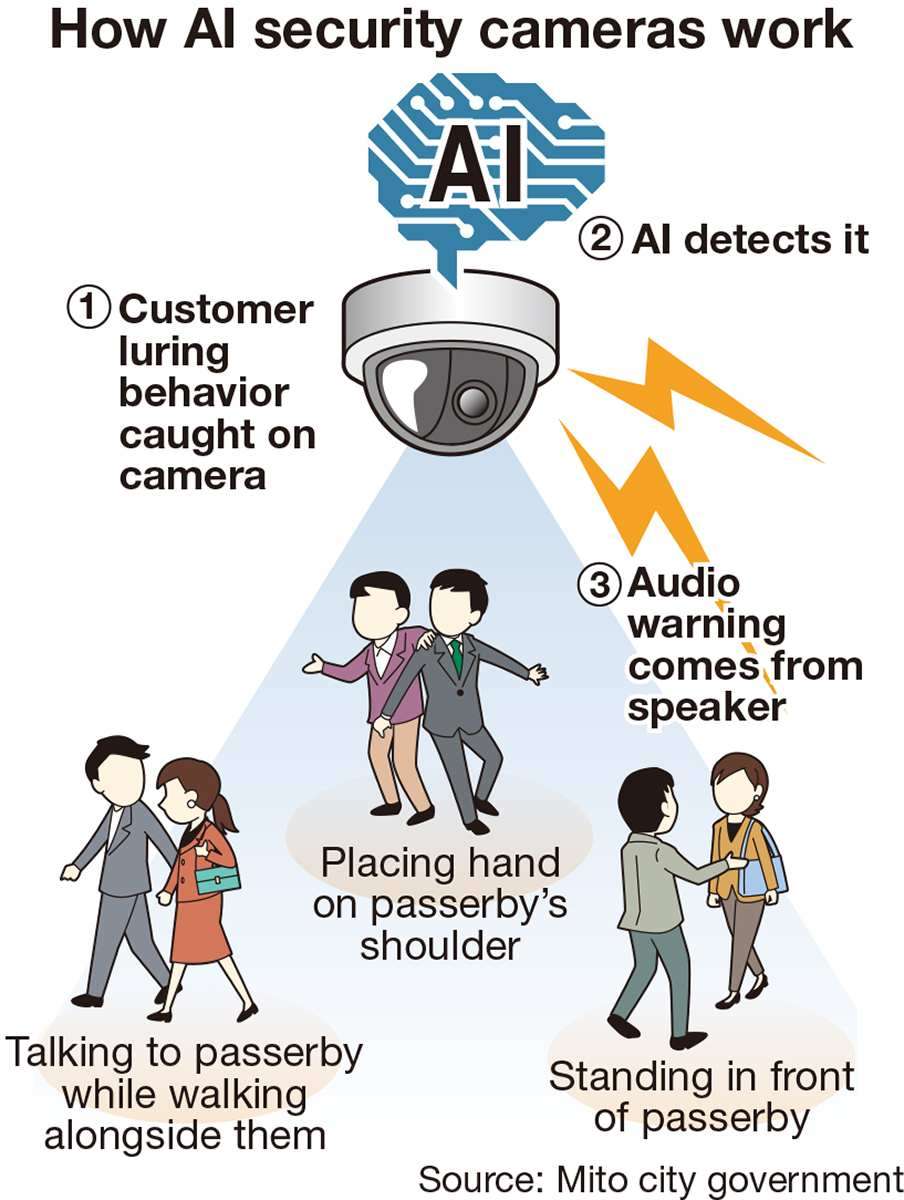
This attempt to stop the practice through AI is rare in Japan. The system will be fully operational from spring after a three-month period during which the AI system will learn the typical behaviors of those who try to lure customers.
On Dec. 16, cameras and speakers equipped with AI devices were installed in three locations in the Daikumachi district, the largest entertainment district in Mito. The devices can analyze images to determine if passersby are being lured, such as when a person related to an establishment follows a passerby, stands in front of them or places their hand on the passerby.
The speakers will issue audio warnings if it determines a passerby is being lured. The city is considering the warning messages such as, “Kyaku-hiki is a violation of the city’s ordinance” and “Don’t be lured.”
In malicious cases, such as when people ignore warnings and continue such problematic behaviors, the city will share information with the police about the individuals identified using facial recognition technology.
In just the central part of the Daikumachi district, there are more than 100 establishments, including hostess bars and izakaya bars. Ibaraki Prefecture’s ordinance prohibits targeting passersby to come into establishments, but the behavior is rampant in this area.
Residents have complained to the city government that the practice is deteriorating public safety. The city has installed 10 security cameras in the area to monitor for malicious behavior and has patrolled with police and others at the end of the year when opportunities to drink alcohol increase.
The new cameras will be installed in collaboration with a Tokyo-based company using central government subsidies.
For about three months, the cameras will be used as ordinary security cameras, as it takes time for the AI to learn what kind of behavior constitutes forcefully luring customers. In consideration of privacy, the footage will be deleted after 30 days and will not be used for anything other than detecting that type of misconduct.
“[The cameras] will monitor the area 24 hours a day,” said a man in his 80s who often passes by the area. “Just knowing that there are cameras will serve as a warning to people to be careful.”
On the other hand, Iwao Otsuka, 52, the head of the resident association of the area, believes that the matter should not be left solely to AI.
“Bad actors will likely take refuge in the backstreets that are outside of the camera’s view,” he said. “We need to take measures that combine this technology with the observation of people, such as increasing the number of police officers on patrol.”
Accuracy
The Hyogo prefectural government conducted experiments using AI security cameras in Kobe and Nishinomiya in 2024 to stop the targeting of passersby. When the cameras detected a certain number of people had stopped walking, it issued a warning, assuming that staff were loitering in the same area and targeting passersby. The system was effective to a certain extent, but also had some false detections.
The AI security cameras in Mito do not work in the same way and instead work off the typical movements of staff targeting passersby.
“If detection accuracy improves, there will be no difference from having a human constantly watching,” said Haruhiko Tazawa, head of the public safety division of the city government. “We want to ensure that Mito residents and tourists can visit Daikumachi with peace of mind.”
The city government is considering installing more AI security cameras while verifying their effectiveness in preventing passersby from being lured, as well as adding a function that will send notifications to monitors installed in relevant city departments.
“Using AI to combat this practice is rare and very advanced. I hope it will spread to other local governments,” said an official at Cabinet Office’s Headquarters for the Strategy for the Future of Regions, which supports local government initiatives using digital technology.





Most Read
Popular articles in the past 24 hours
-

Strait of Hormuz Closure Shakes Markets; Prolonged Closure Could ...
-
Measles Patient Visited Hospital in Bunkyo Ward, Tokyo, Metropoli...
-

Iran Situation: Japan Must Exert Diplomatic Efforts without Merel...
-

Milano Cortina 2026: Japanese Figure Skater Miura Returns to Home...
-

2 of Japan's Opposition Parties Submit Bill to Revise Political F...
-

Takayama Among World's Top 10 Most Welcoming Cities for 2026; 2nd...
-
Chiba Police to Arrest Japanese National in Midair; Man Accused o...
-
Former Nomura Securities Employee Given 18-year Prison Sentence f...
Popular articles in the past week
-

Milano Cortina 2026: Japanese Gold Medalist Figure Skater Miura S...
-
Tokyo Spends Big on Children, Wins Over Parents
-

Japan’s Miura, Kihara Announce Withdrawal from Figure Skating Wor...
-

Yokohama to Test Out Renewable-Powered Offshore Floating Data Cen...
-

BOJ Keeping Eye on Economy and Takaichi's ‘Proactive Fiscal Polic...
-
Tokyo Measles Patient Traveled to Fukuoka Aboard JAL Planes; Susp...
-

Japan’s Takaichi Speaks on New U.S. Tariff in Upper House, Says P...
-

Nidec Chairman Resigns Amid Accounting Scandal at Major Japanese ...
Popular articles in the past month
-

Producer Behind Pop Group XG Arrested for Cocaine Possession
-

Japan PM Takaichi’s Cabinet Resigns en Masse
-

Man Infected with Measles Reportedly Dined at Restaurant in Tokyo...
-

Israeli Ambassador to Japan Speaks about Japan’s Role in the Reco...
-

Videos Plagiarized, Reposted with False Subtitles Claiming ‘Ryuky...
-

Prudential Life Insurance Plans to Fully Compensate for Damages C...
-

Woman with Measles Visited Hospital in Tokyo Multiple Times Befor...
-

iPS Treatments Pass Key Milestone, but Broader Applications Far f...
Top Articles in Society
-
Producer Behind Pop Group XG Arrested for Cocaine Possession
-
Man Infected with Measles Reportedly Dined at Restaurant in Tokyo Station
-
Woman with Measles Visited Hospital in Tokyo Multiple Times Before Being Diagnosed with Disease
-

Bus Carrying 40 Passengers Catches Fire on Chuo Expressway; All Evacuate Safely
-

Tokyo Skytree’s Elevator Stops, Trapping 20 People; All Rescued (Update 1)
JN ACCESS RANKING
-
Producer Behind Pop Group XG Arrested for Cocaine Possession
-
Japan PM Takaichi’s Cabinet Resigns en Masse
-
Man Infected with Measles Reportedly Dined at Restaurant in Tokyo Station
-
Israeli Ambassador to Japan Speaks about Japan’s Role in the Reconstruction of Gaza
-
Videos Plagiarized, Reposted with False Subtitles Claiming ‘Ryukyu Belongs to China’; Anti-China False Information Also Posted in Japan